 I’m not very good at writing description and have a tendency to avoid it. This is reflected in critiques that I receive on my work. “You need to help me picture the setting in my mind. Where is your main character? It’s like looking at a blank canvas. There’s nothing there.”
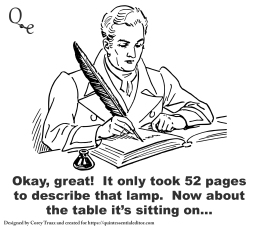
You may be like me or you may be on the opposite side of the spectrum. I have critiqued some beautifully ridiculous description. I’m sure many of you know what I’m talking about. Imagine your reader picking up a book at the bookstore and reading page after page of description on the gowns at a regency ball or the inner hull of a slave ship. They, like me, would probably put it down immediately.
Think of bad description as that one teacher you had in high school who went on and on putting the class to sleep. Good description is more like the teacher that got everybody involved in the action. She provided the information we needed but didn’t bog us down with a lot of fluff.
Avoid Huge Lumps of Description
Description that comes out of nowhere and does nothing but describe, is known as a ‘narrative lump’. It can bring your story to a stand still and pull your reader out of the action. Instead of progressing through your storyline, they find themselves on the outside looking in.
In the past Authors could get away with this, but in today’s society, unless a reader was actively seeking out writers known for lyrical descriptive passages, they wouldn’t put up with it. That doesn’t mean there aren’t a few who get away with it, but it’s only because they are really good, and in all reality, many of their fans are skimming those passages.
Make Description an Active Part of Your Story
Find a way to use description in combination with action, whenever possible. A great example I read during this research is as follows:
Zara grabbed her mug and gulped it down, shivering when a few drops of the ale trickled under her leather top. I didn’t have to say….The ale was cold or She wore a leather top. That information was provided in the action sequence.
Describe what your Characters Would Notice
Remember you are seeing the world through the eyes of your main character. If that character works and goes to the same office everyday, they aren’t going to stare at the craftsmanship and detail of the bookshelf housing a wall of books in the office library. They see it everyday, but they are going to notice if a substantial number of volumes were removed. They aren’t going to look around their office and go on and on about the lavishly decorated room-unless they just had it up fitted. They will notice a vase of red roses sitting on their desk.
Words, Words, Words
Use Strong, active, concrete words. The stronger the writing the better the description. Remember, nouns and verbs are your friends. Adjectives and adverbs can be your friends, depending on how you use them.
Avoid adjectivitis. I wish I could claim this word, but again I read it during my research. Adjectivitis is when you use to many adjectives to describe something. The rule of thumb is no more than two.
And you also want to limit your trips to the thesaurus. I know what it’s like trying to come up with different words to avoid overuse. But when I have to stop reading a prose to look up the word the author has written, or I stumble over a rarely used word, chances are, that author took one to many trips to the thesaurus.
Use all the senses
Most writers concentrate on sight and sound but you can really bring a scene to life by incorporating the other senses. Don’t forget about touch, smell and taste.
Fit the Description to the Type of Story
Fast paced action novels will have less description, as you are trying to get your main character from point A to point B in a hurry. Slower paced novels may take the opportunity to smell the roses, but be mindful of how long they are smelling them.
Avoid Excessive Name-dropping
It’s all right to use brand names in your story. But there are a few basic rules: Get the name right and do not portray the product in a disparaging light. Do not say your main character got food poisoning from the Golden Corral. (Go to the Publishing Law Center website for more information)
You don’t want to go overboard with brand names, but it is a way to provide your reader with a good concrete description. When you say Chevy Silverado-people know instantly and can picture it in their minds.
Don’t Let Description Hang You Up During a First Draft
Remember you can always go back and add it later. When I started writing my novel, I had a great plot idea and my characters sketched out in my head. I put pencil to paper and wrote until completion.
As a matter of fact, that is were I am, and why I am writing this article. I have completed my first draft, and I’m in the process of icing my cake.
I hope this review on description helps you as much as it helped me.
-Jan R
 What is on-the-nose writing? It’s prose that mirrors real life without advancing your story. No one chooses to write this way. It has nothing to do with your ability to put together a sentence, paragraph, or scene. Even pros have a hard time with it.
 When I first decided to write my novel, I was so excited. My thought was how hard can it be? I had a great idea, all I had to do was get it down on paper. I’ve read a lot of books and my story was every bit as good or better than some of them.
 So why do you blog? You have to have a reason. Not many people take the time to type meaningful information or interesting banter without a reason. It’s too much work.
 I contemplated what to write about today. If you’re a blogger you know the routine. You want to share something meaningful that will be helpful and not sound stupid. You also want to be yourself and not sound like a reference book.
 I know I’m suppose to write in the active voice, but why? What is the difference between active voice and passive voice and why does it matter?
 So I’ve been married to my novel for five years. I’ve made some changes along the way, but one thing that has been a constant, is my main character going to Fallujah Iraq.
 People who love to read but have never written books are cognizant of the pacing. Pacing sets the tempo of your story. Is it a fast read or did it seem to drag on for days? Hopefully you’ve found a balance between the two and they perform like a fine tuned orchestra.
 Heroes and heroines, or your lead character, doesn’t have to leap tall buildings in a single bound, and he doesn’t have to stop speeding bullets with his bare hands, but he darn well better know the difference between right and wrong, and he better be kind to animals, and it sure wouldn’t hurt any if he brushed his teeth regularly… Dean Koontz
 I do a lot of critiques for different writers during the week. Some of the writers are very polished; others, not so much.
