



Hope this helps those of you who are considering self-publishing.
-Jan R
Hope this helps those of you who are considering self-publishing.
-Jan R
 It’s the beginning and more specifically the first sentence, then paragraph, then page, then chapter. You have to grab your reader the minute they pick up your novel.
When you are ready to submit your work to an agent, one thing you will notice is they don’t want your complete work. They only want the first few pages, or some may ask for a couple of chapters. Don’t be bold and overconfident sending them the entire thing.
They probably will toss it to the side for your failure to follow instructions. If they do read, they won’t get very far if the first few pages aren’t compelling enough to draw them in (which was the part they wanted to see in the first place).
Agents as a rule, don’t want to see the entire manuscript until they know you can write a compelling story. You have to make them want to see more. Leave them hanging on the edge of their seat. They will ask for the rest of your manuscript just to find out what happens next.
That’s the same thing that will happen for your readers. You want to do an e-book and bypass the literary agent, that’s fine too, but your readers will do the same thing the agent does. They will read a sample prior to buying the book. It had better be compelling from the beginning or you lost a sale. Remember you’re asking people to invest time and money when they purchase your work. Make it worthy of their interest.
Look at your first chapter as a promise to your readers. Remember your first pages set the tone and ground rules for how you will tell your story. No matter how polished your manuscript is, how compelling your characters are, how tightly you’ve plotted the story, that first chapter has to draw the reader in or they will never know.
-Jan R
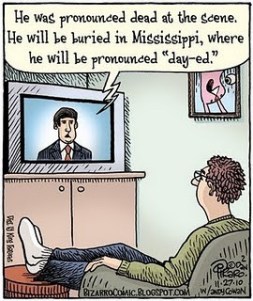 Do your characters have their own voice or do they sound the same? I had a critique partner tell me that she couldn’t distinguish characters in my manuscript based on dialogue. They all sounded the same. If I hadn’t provided a dialogue tag, she would have had no idea which character was speaking. She was right.
This was something I definitely had to correct. So I did some research, watched a webinar, and took a class on dialogue. Distinguishing between characters is a lot easier than you would think.
One way to differentiate characters and determine who they are is through dialect. We can learn a lot about a person based on their accent, grammar, and choice of words.
You don’t have to ask a person if they are from the North or South-just listen to how they speak and note their word choices. While this is one of the most obvious examples for me, you can also distinguish education level, social status, race, and ethnicity from the way a person speaks.
One thing you want to avoid is coming across offensive or stereotypical(racist). Look at your word choice or variation of syntax as tools to differentiate your characters and suggest their ethnicity.
Use slang, nonstandard syntax, or grammar to suggest race, social class, education i.e. gonna vs. going to, kinda vs kind of, holler vs hollow, don’t matta vs It doesn’t matter. If you have a character from abroad throw in some regional slang ( Scottish say-aye for yes and bairns for children).
The next time you read a book take a close look at your characters and their dialect. You will learn a lot, and the fact that you didn’t even think about it while reading the novel is a plus for the author. It was woven seamlessly into the story.
Creating a characters speech pattern is less about reproducing dialect and more about knowing your character. If your character is……
If you’re writing science fiction you can develop you own language and your own rules. There is no limits. Just be consistent.
Hope this gives you something to think about when writing dialogue. Remember to differentiate using dialect, and the dialect should match your characters position in society. Also remember to be consistent with speech patterns, unless an evolution in speech pattern is an integral part of the story (Flowers for Algernon, My fair lady).
-Jan R
 What is on-the-nose writing? It’s prose that mirrors real life without advancing your story. No one chooses to write this way. It has nothing to do with your ability to put together a sentence, paragraph, or scene. Even pros have a hard time with it.
I’m a big fan or Jerry Jenkins and recommend his blog to anyone reading my posts. I have gained so much useful information from him and he writes in a way that anybody can understand. He’s a great teacher. With this being said, I’m using an example that he gave to help you understand on-the-nose writing.
Paige’s phone chirped, telling her she had a call. She slid her bag off her shoulder, opened it, pulled out her cell, hit the Accept Call button and put it to her ear.
“This is Paige,” she said.
“Hey, Paige.”
She recognized her fiancé’s voice. “Jim, darling! Hello!”
“Where are you, Babe?”
“Just got to the parking garage.”
“No more problems with the car then?”
“Oh, the guy at the gas station said he thinks it needs a wheel alignment.”
“Good. We still on for tonight?”
“Looking forward to it, Sweetie.”
“Did you hear about Alyson?”
“No, what about her?”
“Cancer.”
“What?”
Here’s a good example of how that scene should be rendered:
Paige’s phone chirped. It was her fiancé, Jim, and he told her something about one of their best friends that made her forget where she was.
“Cancer?” she whispered, barely able to speak. “I didn’t even know Alyson was sick. Did you?”
We don’t need to be told that the chirp told her she had a call, that her phone is in her purse, that her purse is over her shoulder, that she has to open it to get her phone, push a button to take the call, identify herself to the caller, be informed who it is. I think you’re getting the point.
This is a good example of dragging dialogue as well. It’s not necessary and adds fluff without any real purpose. Don’t distract with minutia. Give the reader the adventure they signed up for when they chose to purchase your book. Take the reader with Paige when she says:
“I need to call her, Jim. I’ve got to cancel my meeting. And I don’t know about tonight…”
-Jan R
 When I first decided to write my novel, I was so excited. My thought was how hard can it be? I had a great idea, all I had to do was get it down on paper. I’ve read a lot of books and my story was every bit as good or better than some of them.
So I wrote my first novel. It was over 90,000 words. I thought I did a great job conveying the gist of the story. I had family members read it, and they thought it was great. So I sent it out to agents.
Only one of the agents I submitted to responded with why my book wasn’t publishable. My dialogue dragged, I had on-the-nose-writing, and I was head hopping. Well what the heck was all of that suppose to mean. I didn’t realize there were rules other than grammar.
Well there are rules, and if you expect an agent or a publisher to take you seriously, you’d better learn them. If you haven’t heard the terms mentioned, I would suggest googling them. I have blogs that cover the highlights. Visit me as well, and I will give you the Cliff-notes version.
My initial thought after receiving the rejections, was to throw in the towel. I must admit, I was pretty bummed. I had worked on that manuscript for over a year, faced criticism from family and friends, and developed some unrealistic expectations along the way. But I am a wannabe, and I have no intentions of becoming a wannabe that won’t.
What are the main characteristics of Wannabes that Won’t?
They take their own counsel-That’s a nice way of saying they thought they knew it all. They convinced themselves that they were experts in publishing which led to numerous mistakes. One of my favorite sayings, is you don’t know what you don’t know 🙂
They go rogue-Instead of doing their homework and getting counsel from editors and others in the business, they plunge ahead, falling all over themselves. I’m guilty of this one. I took my own counsel. So I guess I’m guilty of the first characteristic too 🙂
They follow a trend-It takes more than a year to get a book to the market(traditional publishing) and that’s after you find an agent who sells it to a publisher. By the time the book is released the trend could be over.
They believe in overnight success-Overnight success happens about 1 in 1,000,000 times. When the wannabes synopsis or proposal isn’t received with enthusiasm, they quit.
They start their career by writing a book-This may be surprising, but it is highly recommended that you begin with short stories and articles. You have skills to hone and polish, and a quarter million clichés to get out of your system. Another thought is to start a blog 🙂
They are imitative-One of the most common traits of destined quitters is their attempts to imitate famous writers. They quickly grow discouraged and quit when they realize they can’t keep up.
Writing a novel that is publishable is hard work. It’s the hardest thing I’ve ever done. There are no shortcuts. If you won’t to be successful, you have to learn your craft and not give up.
-Jan R
 So why do you blog? You have to have a reason. Not many people take the time to type meaningful information or interesting banter without a reason. It’s too much work.
I’m in the middle of a move and was going through old blogs to see what I could recycle, when I took notice of my first blog. It was all about building your platform, which was the motivator for my starting this blog.
Did you know great manuscripts of first time authors get pushed to the side everyday, because the aspiring author doesn’t have a solid platform.
And I’m not saying my first manuscript was great, as a matter of fact, it was full of mistakes. Something a kind literary agent pointed out on three separate occasions. I suppose she saw potential in my work, because she sort of took me under her wing.
I spent a few years editing and rewriting major portions of my manuscript to address issues that she had mentioned-there were many. I was confident with my work and sent it to her for what I thought was a final review. I looked forward to a request for the complete story. Well, what I got wasn’t a request but a rejection.
The reason had nothing to do with my novel. I had focused so much on preparing it for publication, that I failed to do one of the most important things, build an audience of potential customers. Is it necessary? Unfortunately yes, especially for first time authors.
The agent who rejected me actually apologized for not giving me better news, but said it was really hard to place new authors, especially those who did not have a solid platform. While she recommended that I send it to other agents, she also emphasized the importance of building a platform.
The good news is with technology, it’s a lot easier than you would think. Google ‘Building a platform’, and you’ll find all kinds of information. I would personally recommend looking into Michael Hyatt. He is an author, blogger, speaker, and a former chairman and CEO of Thomas Nelson Publishers, so he knows a little bit about what we are trying to accomplish here. I would also recommend his book, ‘PLATFORM GET NOTICED IN A NOISY WORLD’. He provides all the information you need to get started, including websites that assist with the creation of your online presence.
I hope this helps someone out there on their quest to being published. I chose to discuss platforms in my first entry, because of the frustration I felt after receiving the news from the literary agent. I just didn’t know. This is something I could have been doing while preparing my novel for publishing.
When you start out there are so many things you don’t know. I’ve been working on my novel for over five years now. I actually completed the manuscript in the first year, but then discovered that I had no idea what I was doing. I spent the last five learning how to write a novel and applying that knowledge to my work.
This blog gives me great joy in knowing that I have provided useful information to others on their journey. And it is my hope that I not only build my platform, but help others avoid some of the mistakes that I have made.
-Jan Rouse
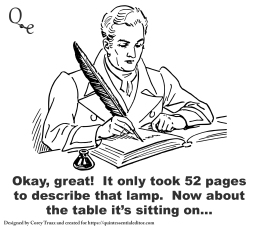 I’m not very good at writing description and have a tendency to avoid it. This is reflected in critiques that I receive on my work. “You need to help me picture the setting in my mind. Where is your main character? It’s like looking at a blank canvas. There’s nothing there.”
You may be like me or you may be on the opposite side of the spectrum. I have critiqued some beautifully ridiculous description. I’m sure many of you know what I’m talking about. Imagine your reader picking up a book at the bookstore and reading page after page of description on the gowns at a regency ball or the inner hull of a slave ship. They, like me, would probably put it down immediately.
Think of bad description as that one teacher you had in high school who went on and on putting the class to sleep. Good description is more like the teacher that got everybody involved in the action. She provided the information we needed but didn’t bog us down with a lot of fluff.
Avoid Huge Lumps of Description
Description that comes out of nowhere and does nothing but describe, is known as a ‘narrative lump’. It can bring your story to a stand still and pull your reader out of the action. Instead of progressing through your storyline, they find themselves on the outside looking in.
In the past Authors could get away with this, but in today’s society, unless a reader was actively seeking out writers known for lyrical descriptive passages, they wouldn’t put up with it. That doesn’t mean there aren’t a few who get away with it, but it’s only because they are really good, and in all reality, many of their fans are skimming those passages.
Make Description an Active Part of Your Story
Find a way to use description in combination with action, whenever possible. A great example I read during this research is as follows:
Zara grabbed her mug and gulped it down, shivering when a few drops of the ale trickled under her leather top. I didn’t have to say….The ale was cold or She wore a leather top. That information was provided in the action sequence.
Describe what your Characters Would Notice
Remember you are seeing the world through the eyes of your main character. If that character works and goes to the same office everyday, they aren’t going to stare at the craftsmanship and detail of the bookshelf housing a wall of books in the office library. They see it everyday, but they are going to notice if a substantial number of volumes were removed. They aren’t going to look around their office and go on and on about the lavishly decorated room-unless they just had it up fitted. They will notice a vase of red roses sitting on their desk.
Words, Words, Words
Use Strong, active, concrete words. The stronger the writing the better the description. Remember, nouns and verbs are your friends. Adjectives and adverbs can be your friends, depending on how you use them.
Avoid adjectivitis. I wish I could claim this word, but again I read it during my research. Adjectivitis is when you use to many adjectives to describe something. The rule of thumb is no more than two.
And you also want to limit your trips to the thesaurus. I know what it’s like trying to come up with different words to avoid overuse. But when I have to stop reading a prose to look up the word the author has written, or I stumble over a rarely used word, chances are, that author took one to many trips to the thesaurus.
Use all the senses
Most writers concentrate on sight and sound but you can really bring a scene to life by incorporating the other senses. Don’t forget about touch, smell and taste.
Fit the Description to the Type of Story
Fast paced action novels will have less description, as you are trying to get your main character from point A to point B in a hurry. Slower paced novels may take the opportunity to smell the roses, but be mindful of how long they are smelling them.
Avoid Excessive Name-dropping
It’s all right to use brand names in your story. But there are a few basic rules: Get the name right and do not portray the product in a disparaging light. Do not say your main character got food poisoning from the Golden Corral. (Go to the Publishing Law Center website for more information)
You don’t want to go overboard with brand names, but it is a way to provide your reader with a good concrete description. When you say Chevy Silverado-people know instantly and can picture it in their minds.
Don’t Let Description Hang You Up During a First Draft
Remember you can always go back and add it later. When I started writing my novel, I had a great plot idea and my characters sketched out in my head. I put pencil to paper and wrote until completion.
As a matter of fact, that is were I am, and why I am writing this article. I have completed my first draft, and I’m in the process of icing my cake.
I hope this review on description helps you as much as it helped me.
-Jan R
 I contemplated what to write about today. If you’re a blogger you know the routine. You want to share something meaningful that will be helpful and not sound stupid. You also want to be yourself and not sound like a reference book.
I was sitting on my couch reworking a scene in the novel I’m writing and stopped right in the middle of it. What am I doing? I asked myself. The purpose of the rewrite was to make some changes based on a critique I received from a critique partner.
The person that critiqued my book is very good at the craft, and I respect her opinion. There were others who critiqued the piece and loved it, offering a few comments here and there to correct grammar or replace a word. So who was right? The three people who loved it, or the one who thought I needed to go back and make some significant changes.
The more I looked at the changes this person suggested, there were quite a few throughout the time period I’ve posted my work, the more I realized she had her own idea of the way the story needed to go, and I had mine.
With this being said, she’s made some great suggestions. Because of her my story is more believable, my dialogue more natural, and my POV more consistent. Her critiques have been invaluable.
However, I had to remind myself that this is my story. Nobody has a better understanding of the dynamics than I do. Nobody knows it from beginning to end but me. Nobody can tell it better than me.
Weigh comments and suggestions you receive from others and ask this question. Is it making my story better or changing it into something it is not?
Remember: It’s your story.
-Jan R
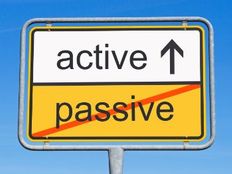 I know I’m suppose to write in the active voice, but why? What is the difference between active voice and passive voice and why does it matter?
In a sentence written in the active voice, the subject of the sentence performs the action. In a sentence written in the passive voice the subject receives the action.
Jan loves Danny. Jan is the subject and she is performing the action of loving Danny.
Jan is loved by Danny. Jan is the subject, but she’s doing nothing. She is the recipient of Danny’s love.
Sentences in active voice are more concise than those in passive voice, because fewer words are required to express action in active voice than in passive voice, making the sentence stronger.
Many a Tame sentence of description or exposition can be made lively and emphatic by substituting a transitive in the active voice for some such perfunctory expression as there is or could be heard.
There was a great number of dead leaves lying on the ground. Vs Dead leaves covered the ground.
At dawn, the crowing of a rooster could be heard. Vs The cock’s crow came with dawn.
After reading the previous sentences, what do you think? Active or Passive? I would definitely go with active 🙂
This is yet another area I am working on. And while the rule is to go with the active voice, it doesn’t mean you should entirely discard the passive voice. Sometimes it is necessary.
-Jan R
 So I’ve been married to my novel for five years. I’ve made some changes along the way, but one thing that has been a constant, is my main character going to Fallujah Iraq.
Anybody that’s been around for a while, knows that Fallujah played a big role in the Iraq War. Camp Baharia was set up just outside the city. It was one of the nicer camps, and the playground of Saddam Hussein’s sons, prior to their demise.
When I wrote the framework of my novel five years ago, it was set at the end of the war . Fallujah had been won by the allies, and our marines were still there to maintain order and ensure no further uprisings. This was why my main character had been sent there.
Since that time, Fallujah has been taken over by Isis, and there is major fighting going on, as the Iraqi forces, along with the US and other allies, attempt to take it back.
With that being said, my husband encouraged me a year ago, to rethink Fallujah. He thought the current conflicts and notoriety of the region would cause serious doubts and credibility issues with my story. Well I didn’t want to listen to him, Fallujah was in my story and had been there all along. I didn’t want to change it.
But then I received a critique from a very skilled writer. Her main problem with the story, as you probably guessed already, was Fallujah, Iraq. My husband loved that, and gave me the told you so look. I wish I could say he rose above it and didn’t say anything, but he quickly reminded me that he wasn’t a dummy. He knew what he was talking about:-)
One of the things I’ve heard time and time again from experienced writer, is sometimes you have to throw the baby out. That’s part of writing, but it doesn’t make it any easier.
So I’m throwing the baby out and looking for another Camp, maybe in Afghanistan.
If you’re on the fence, just do it. The sooner you let go and move on, the sooner you’ll get that novel completed. You might miss your baby for a while, but I’m thinking you’ll get over it, especially when your story comes together the way it was supposed to.
-Jan R
 Writing your first novel-Things you should know