
Writers Live The Life-Right?

read on beachMany people think writers live the life. Writers lay around in pajamas writing stories and making millions of dollars. They control their schedule, and of course, travel to exotic places all over the world.

I can picture it now. I’m sitting on a lounge chair, drinking a cold glass of lemonade, and looking out as the waves roll in, before I turn my attention back to my computer and start typing my flawless manuscript again. I can’t believe I got it perfect the first time 🙂

Only a handful of writers live out even part of that scenario, and that’s because they have become so successful they can afford to visit, or live at those exotic places, and of course, sip their drink of choice while laying on the beach typing their next best seller.

For the rest of us reality is very different.  If you want to become a writer, it’s a tough road.  I wanted to take a few minutes to give you a reality check, and I have listed a few things a writer has to do other than writing.

  • Writers are continuously reading books in their genre and how to books/tips on writing. We analyze what works and what doesn’t work. How can we use this information to improve our own writing.
  • Writers have to plan. What other books are we going to write? What’s next? We develop a strategy and create outlines for our books.
  • Writers have to do research, especially if the story line takes place in a different time period or location that we are unfamiliar with.
  • Writers have to network. Someone’s eyes, other than our own, must read our work. This is accomplished through participation in critique groups and attending conferences.
  • Writers edit, analyze, eliminate redundancies, and then edit some more, before they even send work out to critique groups.
  • Writers have to market and promote their work. Another reason to attend conference. You will also find writers on Facebook, Twitter, and keeping up with an active Website.
  • Writers have to learn to accept rejection. Unfortunately, it’s a major part of the business. Writers receive many more rejections than acceptances.
  • Also just like everybody else, Writers live. They have families and full time jobs.

So if you’re thinking writers live the life, think again. Writing has to be your passion. It’s the motivator that will get you through and ensure your success.

-Jan R



Writers Live The Life-Right?

Are Your Characters Behaving?

456ffd61f6611997a74945a5622289fbMake sure your characters behave the way they are supposed to, and don’t force them to do something that doesn’t fit with the persona you built.

You know what I’m talking about. Think about the people closest to you. You know them well, and you also know there are certain things they just wouldn’t do. Your characters should be the same. You introduced them one way-don’t send them in the opposite direction, unless you built a bridge explaining their actions or hinted that they aren’t who they pretend to be. Make sure they behave the way they are expected. That doesn’t mean they can’t surprise you occasionally, but remember they should always do what’s true to themselves.

Your character should also grow and change as they mature and face different circumstances in their lives. Felicity may start out being selfish and spoiled, but when she is forced to work at a homeless shelter, her perspective changes. She changes. She learns to empathize and relate.

Your character must act and not merely be acted upon. Nobody wants to read a book from front to back about a victim. The character may start out in peril and face numerous conflicts for which they have no control, but at some point, they had better step up and take control. Even the most passive protagonist must in the end choose to do something.

-Jan R


Are Your Characters Behaving?

Narrative Summary-Use With Caution

caution-tapeNarrative summary is a great weapon in the writers arsenal. It can be used to speed through scenes that aren’t important, slow things down after an intense scene to allow the reader to catch their breath,  compress time, and to provide exposition(background information).

So what’s the problem?

Narrative summary can sound like lecturing. It’s like somebody broke into the middle of the scene, shared some information, and then stepped back out. Your reader does a double take and then attempts to reenter the story, picking up where she left off before you blind sided her. Resist the urge to explain.

Narrative summary makes the reader unclear whose POV the scene is written in.  Set the scene first so we know whose POV we are in, and then add the narrative summary. Another suggestion is to tie the narrative to the POV character’s thoughts. Narrative summary should always be from the POV’s perspective.

Narrative summary runs the risk of robbing scenes of their power. You can’t summarize everything just to get through the scene. If something important is about to happen- Joanie breaks up with the man of her dreams- you need to take the time to provide details and work the scene. If  Joanie is flying to Rome to meet the man of her dreams, you should probably skip details about the uneventful, boring plane ride, a sentence or two of narrative will do, but be ready for the climatic meeting at the airport. Important scenes can’t be summarized in narrative. Your reader wants to be there when John greets her at the gate, and then gets down on one knee and proposes amidst the hustle and bustle of the airport.

-Jan R


Narrative Summary-Use With Caution

Set Your Scene!

Peche-Sitzgarnitur_E-1-800x499I had the opportunity to listen to a publisher discuss problems he sees in manuscripts the other day. While he focused on several major components of the novel during his session, I want to talk a little about scenes.
Most of you should have a pretty good understanding about what a scene is and how it fits into the novel. Your story is actually a series of scenes that continue until they reach the climax and finish.

Now there are many ways to mess up a scene, but he called attention to some things I had never really thought about, so I wanted to share them with my readers.

The most obvious mistake is jumping from one scene to the next with nothing in between.  John is in the car driving home from work, and then he miraculously appears in the kitchen having an argument with his wife. What just happened? The writer failed to provide a transition.

While some people add a transition at the end of the previous scene, most transitions are provided at the beginning of the new scene. Within the first few lines actually. I never knew how important those lines were, until I saw the podcast.

So what is the purpose of the first few lines of your scene?

  • They establish the point of view. With in the first few lines, I should know who’s head I’m in.
  • The first few lines should establish the place where the scene occurs. When you open a scene with two people talking, your reader won’t be able to visualize where they are and what’s going on. They could be sitting in John’s living room, or walking the streets of New York City. By forcing your reader to try to figure this out, you are pulling them out of the story.
  • Those first few lines should establish a sense of time. Is it day or night? Maybe he’s nervous because he’s suppose to meet someone in 15 minutes and he is 25 minutes away.

Enough about scenes for today. If you need more information, I have a blog post on the anatomy of a scene, and I would highly recommend a visit to  Randy Ingermanson’s (the snowflake guy) blog.

-Jan R


Set Your Scene!

Dialogue: It Matters!!!

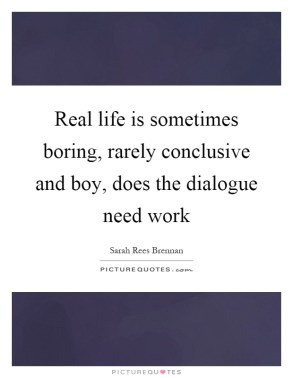
real-life-is-sometimes-boring-rarely-conclusive-and-boy-does-the-dialogue-need-work-quote-1I am doing yet another blog on dialogue. It’s one of the most important parts of your novel and will lead to your downfall if not done correctly.

A few important things to keep in mind when writing dialogue:

  • Dialogue is not real speech. It is the illusion of real speech.  Your dialogue should not be wordy or too formal-unless you’re talking to your boss or doing a presentation. Think about how you talk to friends and family. You don’t always use complete sentences. You trip over each other. Sometimes you don’t even get your complete thoughts out because of the constant interruptions.
  • With dialogue, you can choose your words more carefully. When we speak to people, we may  think, I wish I had said this or that, or I wish I had said that differently. Well in Dialogue you can.  Edit your words to say just what you want, but make them sound natural.
  • Fictional dialogue always has a point. You can’t waste words talking about the weather. Your dialogue has to move the story forward.
  • Your characters are not the same and should speak differently. Some people are quiet, others are domineering. Some people only want to talk about themselves, are manipulative and downright unbearable to be around 🙂 Are they educated or uneducated? Are they from Alabama or New York? I think you are getting the picture.
  • A character will even change the way they speak based on who they are having a conversation with. I speak differently to my husband than I do to my son. I speak differently to my boss than I do my friend.
  • Dialogue used for exposition can be tricky.  It is almost always better to try to find another route, unless you have mastered the skill.  In most cases, a narrative summary is a much better choice. Who wants to read three pages of two characters bouncing back and forth explaining what they already know?
  • Try to avoid synonyms for ‘he said, she said’. You know what I’m talking about. She whined, he exploded, she shrieked. All you are doing is driving your reader crazy and calling attention to an action you should be showing. You should even avoid ‘he said, she said’ as much as possible.
  • What’s not said is just as important as what is said.

I can honestly say I have been guilty of breaking all of the rules in writing dialogue, and not in a good way.

I hope this helps some of you newbies out there to avoid some of my more memorable mistakes. Dragging dialogue 🙂 Really!

-Jan R

Dialogue: It Matters!!!

Are You Too Close?

make-text-largerI think I’m ready to present my book to literary agents again. I’ve made numerous revisions and had it reviewed one last time by a beta reader- to make sure it flows and there are no plot holes. I have to admit I’m a little anxious, but this time around I know I am presenting a well written, publishable piece of work.
After my first round of rejections, I had my  manuscript critiqued by other aspiring authors on Scribophile. I know I’ve already promoted the site, but let me say it one more time. If you have started a novel, or want to start a novel, sign up. It’s free. They do offer extras for a $65 dollar a year fee, but you don’t need to bother with that. You can post work and do critiques without the membership. Your cost is time. You critique other people’s work and they critique yours.

At any rate, I developed a relationship with one of the members who far surpassed my writing skills, I might add, and we critiqued each others work.  I messaged her when I posted a new segment and  apologized in advance.

I was always amazed at the number of errors I missed. I would wonder if I was getting any better. Truthfully yes, but my work still looked like a Christmas tree when she finished marking it up. The bad part is, the mistakes were so obvious when she pointed them out.  I’m a pretty smart lady. Why couldn’t I see them? The only thing I could come up with, is I was too close to the story.

Are you too close to your story? I can’t emphasize enough the importance of having others review your work. I’m not talking about family and friends, I’m talking about people who will be honest and know what they are looking for.

I push scribophile because I’ve used the site and know it works. There are other groups out there that provide the same service. Just sign up with one, or join a group in your community. Get another set of eyes on your work.

-Jan R

Are You Too Close?

Do You Talk The Talk?

huhI’ve been reading literary agent biographies and blogs over the last few days in an attempt to narrow my search and find a few I think would be a good fit for my novel.

While researching, I found myself going on-line and doing searches for words and abbreviations that were totally foreign to me: MG, Dystopian, MS, Upmarket and so on- I guess I still have a lot to learn.

At any rate, I thought I could save you some time by sharing a list of not so common words and abbreviations that I found during my research.

  • MS:  Abbreviation for manuscript (the plural being MSS).
  • MG:  Middle grade-ages 8-12.
  • YA:  Young adult-ages 12-18.
  • NA:  New adult: features a protagonist 18-25 and focuses on first struggles of adulthood.
  • Speculative Fiction:  Fiction that encompasses supernatural, fantastical, or futuristic elements.
  • Upmarket:  Fiction with commercial appeal (book clubs) particularly women’s fiction.
  • Dystopian:  A futuristic, imagined universe, in which oppressive societal control and the illusion of a perfect society are maintained through corporate, bureaucratic, technical, moral, or totalitarian control.
  • Literary Fiction: Serious fiction, the style and technique are often as important as the subject matter.
  • Commercial Fiction:  Written with the purpose of attracting as wide an audience as possible. It includes westerns, romance, mysteries and horror genres.

I’m sure I missed a few, but these are the ones I saw during my research. Who knew there were so many different categories.

I guess I’m old school. In my day it was westerns, romance, mysteries, comedies, and horror. Oh yeah, you can throw children books and youth in there as well.

-Jan R

Do You Talk The Talk?

Critiques: Should I Be Completely Honest? (Repost)

imagesI’m a member of Scribophile. If you don’t know what that is, and you are really interested in writing and getting feedback, Scribophile is the place to be. It’s like Facebook for writers. You do critiques and in turn others critique your work. I wish I had found it years ago. You get some so so critiques, but you also get a lot of good ones from people who know what they are doing. At any rate this blog wasn’t suppose to be an infomercial for Scribophile.

I did a critique yesterday, and I felt awful when I was done.  The young lady who wrote it obviously had writing skills. Her descriptions, imagery, and grammar were better than mine. She could string a perfect sentence together, but that seemed to be were it ended. I read her premise which was a good one, but way overused.

The entire segment of 2600 words, which followed another segment of the same length, covered her main character’s flight on a plane to Italy. Now if the story was taking place in that plane, or for some reason all of the characters in that plane and what they did was important, I wouldn’t be writing this particular blog. But they are not, the plane is just getting her to Italy so she can find the love of her life. Again, it was very well written, and I could picture myself and all of those different people on the plane.

I am what I call a skipper, I have no problem skipping over complete paragraphs of exposition to get to the good stuff. I would have skipped most of what she had written, even though it was written beautifully. I didn’t for the sake of the critique.

While I tried to be nice in my summary and point out all of the things great about her work, and there were many, I felt as if I wouldn’t be doing her justice by letting it end at that. So I told her what I would want someone to tell me.

Your writing is great but the pace is nonexistent. I feel like I’m stuck on that plane and want to get off. You’re providing too much detail and putting a lot of time and energy into characters that we will never see again. You are giving great back story, but it’s too much at once. And finally, you do not need to give us a step by step account of everything that happens from the minute she gets on the plane until the minute she gets off.

I will continue to be honest with writers about their work in what I hope is a constructive manner. I don’t want to discourage anybody, but I want ignore major flaws to avoid hurt feelings either.

What do you think?  Would you want someone to tell you everything is great in your novel when it’s not, or would you want the truth, even if it hurt?
-Jan R

Critiques: Should I Be Completely Honest? (Repost)

Who Watches Paint Dry?

untitledI started out with a 90,000+ word manuscript and cut  it down to a little over 80,000 words. While this is still an acceptable size for a novel, it’s short in length. My initial thought was, I need to go back and add some of the stuff I cut, but then I remembered, there is a reason that I cut that stuff.
If I want to add more words, the best thing for me to do is throw in a little more conflict for my character to have to resolve. Adding fluff will only slow the story down and put my reader to sleep. If he manages to hold on that long.

I read a few articles yesterday and couldn’t help but laugh. They were so me. I hope I’ve completed that phase of the learning process, but the on-the-nose-writing can sneak up on you.

The blogger I was reading, called it ‘Tea, Vicar?” and provided an amusing example:

    “More tea, Vicar?” Angela asked, taking his cup and placing it on the tray beside her.
“Don’t mind if I do,” said the Rev. Phelps.
“That was two sugars, wasn’t it?” she asked, pouring the fragrant liquid from the heirloom pot into his cup and stirring in the milk. When he nodded, she dropped in two sugar lumps, stirred again, and handed him back the cup.
“Thank you, my dear,” he said, accepting it with a smile.

I agree with the blogger, this is about as exciting as watching paint dry.  Ask yourself, is this moving my story forward or increasing my word count? If it has nothing to do with the plot-get rid of it. Unless the fact that the Vicar always takes two sugar lumps or she uses an heirloom pot is significant to the story, it shouldn’t be there.  Who has time for the mundane?

Remember every scene, every sentence, every word, has a purpose, and that’s to propel the plot forward. Throw your MC right into the middle of the conflict and then resolve the issue.

I don’t want a tour of the countryside, or a long rambling chat. Don’t give me lifeless prose that adds fluff and not content. I don’t care how pretty it is, and the publisher want either. I want unrelenting movement towards the crisis. I want action. I want to be gripped. I think you get the picture 🙂

If you want your manuscript published, you’re going to have to roll up your sleeves and get to work. Cut that fluff. A publisher want do it for you. He/She will just send it back, or worse, toss it into the rejection pile.

-Jan R


Who Watches Paint Dry?

Dialogue Vs. Conversation: They’re Not The Same!

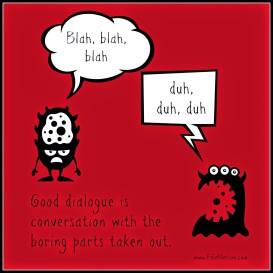
good_dialogueWriting dialogue isn’t as straight forward as it would seem. It was one of the areas I was dinged on when I first submitted my manuscript. According to a literary agent, my dialogue dragged. Basically I wrote out conversations just like real people talk. After taking a few classes and looking at published authors’ work, I did get a grasp of what the literary agent was saying.  My dialogue was weighing the story down and offering unnecessary detail. It caused everything to come to a stop.

Fictional speech is more focused and coherent than real speech. It has a purpose. You can’t just rant and rave about the newest fashion with your friends, unless it’s an integral part of the story that provides information you are going to need later.

It should flow. If you can feel yourself reading, then stopping for a brief conversation, and then reading again, something isn’t quite right.

Conversation works best when combined with thoughts, actions and settings.  Don’t separate them, but interweave them. People don’t stop to talk. They keep doing what they are doing, unless it’s something really important that demands their full attention.

Example:

The day had been crazy, but it wasn’t over yet. Walking into the conference room, Mark  found Ellen sitting at the head of the table preparing packets for their upcoming meeting.

“Sorry I’m late,” he said, walking over to offer assistance.

Handing him a few, she looked him in the eye, anger and disappointment written all over her face. “Isn’t that your norm?”

Mark grasped for something to say that would ease the tension between them and get him through this day. Staring at the packets he was at a loss. What she said was true, and he couldn’t explain why. At least not now.

Easing herself up, she walked by him without saying another word.

“Well that didn’t go well at all,” he said quietly to himself, as he continued to prepare for the meeting. He would attempt to smooth things over with his secretary later, but for now he had a business to save.

By interweaving thought, action, setting, and dialogue, the scene moved forward seamlessly, pulling your reader into the story 🙂

-Jan R


Dialogue Vs. Conversation: They’re Not The Same!