 If you are to have any chance as a writer, you must embrace the plot. Consider your plot as the skeleton of the novel. It’s the bare bones that keep everything from collapsing.
You must maintain control. Don’t give your plot over to a character who would gladly pick it up and carry it into directions you never intended to go.
Fictional characters can become so vivid, so alive, that you find yourself altering the plot to accommodate their growth and the direction they want to go.
I got caught up in the excitement of following one of my characters through a storyline that I didn’t write. It was as if the novel was writing itself. The problem was, it was veering from my original intent and messing up my plot.
Most authors will tell you that allowing your characters that much freedom is disastrous. That doesn’t mean you can’t allow some revisions to your plot to accommodate growth, it does mean you don’t alter your entire storyline at the urging of a character that has no idea were you are going with your story.
Something to think about.
-Jan R
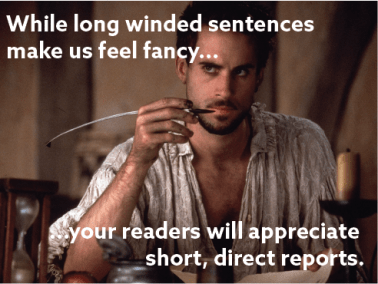 Have you ever read a sentence and thought it was way too long? The author lost you two commas ago, and now you have to go back and read the whole thing again, to try and figure out what’s going on.
 Why do so many perfectly nice people make such pompous asses of themselves when they sit down at a typewriter?-Dean R Koontz.
 Don’t you hate it when you’re talking to somebody and they are all wishy washy? Why can’t they just come out and say it? Most of the time you know what they are getting at and want to spit it out for them. Well the same thing goes for writing.
 It’s a beautiful day in Raleigh, or perhaps I should say morning. I’ve been waiting all winter for the weather to break and an opportunity to sit on my porch and take in the beauty of my surroundings.
 I love reading Jerry Jenkin’s blogs. I always take something away from what he has to say. I don’t know that he offers anything different or new, it’s just the way he says it. I read what he’s written, and a light bulb goes off.
 When you’re writing, you need to mix things up. You don’t want to be the one that puts your reader to sleep.
 I’ve been taking an on-line course that is suppose to help me become a standout writer. Knowledge is power. I spend as much time reading as I do writing, and I’ve learned a lot. Mainly, I’ve become more aware of my own writing. I also notice things in other peoples writing. I use to enjoy reading for pleasure, and I still do, but I see errors that I never noticed before. I guess I’m turning into an editor 🙂
 On more than one occasion I have declared my love affair with the word ‘had’. When you use a word so many times it jumps off the page, you have a problem. It doesn’t matter if the word is used correctly or not. You need to find another way to write the sentence without using ‘the word’. In my case that word is ‘had’.
