 This is one of my favorite blogs. I wish I could claim it, but the post was actually written by Jerry Jenkins. I love his work. If you haven’t visited him, I would highly recommend you do. He did put a disclaimer at the end of this article saying it was ok to share with friends, so I am in no way stealing his work. Hope this helps someone and hope you consider visiting his site.
It doesn’t sound fair.
It doesn’t seem right.
But here’s a dirty little secret of the writing life you need to hear:
Any veteran editor can tell within two minutes whether they’re going to reject your manuscript.
It takes longer to decide whether they’ll recommend it for purchase, of course, but—sad to say—it can, and often does, go into the reject pile just that fast.
“What?” you say. “Before I’ve had a chance to wow them with my stupendous villain? Before my mind-blowing twist? Before my plot really takes off?”
Sorry.
And I’m not exaggerating.
Why?
Because the competition is so stiff and editors have so many manuscripts to read, you have only nanoseconds to grab them by the throat and hang on.
Every writing mentor hammers at this ad infinitum: Your editor is your first reader.
Every word counts. You get one chance. You must capture them from the get-go.
Am I saying editors look for reasons to reject your work?
No, no, a thousand times no! They’re looking for the next Harry Potter!
Editors want you to succeed!
Then how can they know so quickly that your book won’t cut it?
In my lifetime in the business I’ve heard dozens of reasons, but let me give you my personal top five from my experience as both an editor and publisher:
- Throat-clearing
This is what editors call anything that comes before a story or chapter finally, really, begins. It usually consists of a page or two of scene setting and background. Get on with the story. Get your main character introduced, establish and upset some status quo, then plunge him into terrible trouble that reveals the engine of your story. Is it a quest, a journey, a challenge, what?
There’ll be plenty of time to work in all those details that seemed so important while you were throat-clearing that would have cost you a sale. For now, your job is to start with a bang.
- Too many characters introduced too quickly
I’m usually wary of generalizations or hard and fast rules, but almost any time I see more than three characters within the first few pages, my eyes start to swim. If I feel like I need a program to keep track of the players, I quickly lose interest.
Your reader is trying to comprehend the story, and if you ask him to start cataloging a cast of characters right away, you risk losing him. Keep things simple until the story has taken shape.
- Point of View violations
Maintain a single Point of View (POV) for every scene. Violate that cardinal rule and you expose yourself as an amateur right out of the gate. Beginners often defend themselves against this criticism by citing classics by famous authors or citing J.K. Rowling, the exception who proves the rule.
Times change. Readers’ tastes evolve. This is the rule for today, and it’s true of what sells.
- Clichés, and not just words and phrases
There are also clichéd situations, like starting your story with the main character waking to an alarm clock, a character describing herself while looking in a full-length mirror, future love interests literally bumping into each other upon first meeting, etc.
Also avoid beginning with an evocative, dramatic scene, and surprise, surprise, the main character wakes up to discover it’s all been a dream. There’s nothing wrong with dreams, but having them come as surprises has been used to death and takes all the air from the balloon of your story.
It’s also a cliché to have your main character feel his heart pound, race, thud, or hammer; and then he gasps, sucks wind, his breath comes short… If you describe the scene properly, your reader should experience all that and you shouldn’t have to say your character did. Put your character into a rough enough situation, and the reader will know what he’s feeling without having to be told—and hopefully, he’ll share his distress.
- Simply bad writing:
This is what I call that special language we all tend to use when we forget to Just Say It. I recently edited this sentence from a beginner: “The fire drop from the pommel of Tambre’s sword shot past the shimmering silver mist of her involuntary dispersal.”
I had to read a few more paragraphs to have a clue to what it even meant. That’s written-ese.
Hollywood screenwriters coined this term for prose that exactly mirrors real life but fails to advance your plot. There’s nothing wrong with the words themselves, except that they could be synopsized to save the reader’s time and patience. A perfect example is replacing all the hi’s and hello’s and how are you’s that precede meaningful dialogue with something like: “After trading pleasantries, Jim asked Fred if he’d heard about what had happened to Tricia. ‘No, what?’”
Avoid state-of-being verbs. Change sentences like “There was a man standing…” to “A man stood…”
The most famous rule in the bible of writing hints, The Elements of Style, is “Omit Needless Words,” which follows its own advice. This should be the hallmark of every writer.
Example: The administrative assistant ushered me through the open door into the CEO’s office, and I sat down in a chair across from his big, wood desk.
Edit: Obviously, there would be a door. And even more obviously, it would be open. If I sat, I would sit “down,” and naturally it would be in a chair. Because I’m seeing the CEO, a description of his desk would be notable only if it weren’t big or wood.
Result: The administrative assistant ushered me into the CEO’s office, and I sat across from his desk.
Re-examine these 5 common mistakes, and study more self-editing tips here,
-Jan R
 You may have a great elevator speech/pitch for an editor, but that doesn’t mean it will be accepted. Don’t take it personal. There are many reasons your work is rejected,
 If you don’t have that elevator speech, you need to start thinking about it. Just because your plans don’t include a writer’s conference in the near future, doesn’t mean you don’t need one. I definitely don’t want you to fall into the same trap I did. Very embarrassing 🙂
 Over the past few months, I’ve been focusing on word use. Are the words necessary or just taking up space in my work? My blogs usually relate to what I’m working on at the time they are being written. I like to think if I’m having questions about an aspect of writing, you are too. The following blog is an older one I wrote a few years ago, but it is still relevant, and I figure a refresher is good for myself and you.
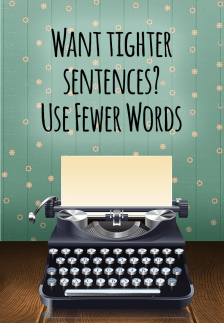 Five adjectives in one sentence are better than six; four adjectives are better than five; three are better than four; two are better than three…By using fewer words to obtain the effect you desire, you will force yourself to use more accurate and more powerful words-Dean Koontz, ‘How To Write Best Selling Fiction’.
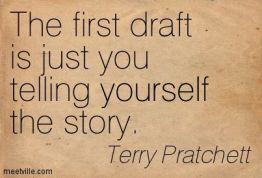 I read a quote a while back and thought I would share it on my blog. I don’t know who wrote it, as a name wasn’t provided. It reads as follows:
 I have been accused and rightly so of on-the-nose-writing, overwriting, redundancies, and throat-clearing. I’ve also had a close relationship with the words “that” and “had”. I blame it on inexperience and just not knowing any better.
 I think one of the best problems an author can have is overwriting. You shared more information than was necessary. It’s a lot easier to go back and cut than it is to add new content. At least it is for me.
 I visited my mother this week and was once again reminded how important writers are to the wellbeing and quality of life of our aging population.
 I spent the last month looking at the characters in my novel. How do they relate? Are they effectively carrying out the roles intended for them? Are they unique and easily identified, or do they all present the same?
