
Surviving The Sting

imagesX0EBMH1NI write a lot about rejection because it’s a part of life if you’re an unpublished author seeking a literary agent or publishing contract. Many would-be authors allow a simple rejection to end their attempts at writing. Their thought – I must not be good enough. Well maybe that’s true, but odds are it is not.

Manuscripts are rejected for numerous reasons, and many have nothing to do with your work. So what are you supposed to do if you receive a rejection?

  • Admit it hurts.
  • Allow yourself time to grieve, but never take more than a week.
  • Nurture your artist. Read a good book, take a walk, eat some chocolate… TLC is a good thing, but don’t wallow in self-pity.
  • Share your news and disappointment with close friends and family who will understand and offer encouragement.
  • If you must, write a rebuttal to the editor or literary agent, but don’t send it. Tear it up and throw it in the trash. Your only response should be a thank you for their time and consideration.
  • Just because your work wasn’t right for that particular editor or agent, doesn’t mean it won’t be right for another.
  • Remember just because it isn’t ready for publication, doesn’t mean you can’t make it publishable.

A writer not being able to deal with rejection, is like a doctor not being able to deal with death. It’s going to happen, and like successful authors, you will have to learn to live with it.

-Jan R

Surviving The Sting

I Thought I knew A Lot – Until I Learned A Little

images1MS72HRNEnough already! At least that’s how I feel sometimes. I’ve been through my book more times than I can count. In my own defense, no one taught me how to write. I had a great story idea and decided to give it a whirl.
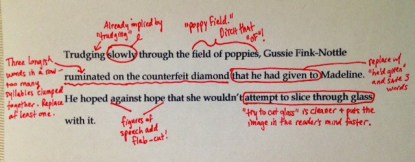
I thought it was ready, and then real life happened.  My wonderful work was rejected by the five agents I sent it to. One of them must have seen something promising, she took it upon herself to provide me feedback about what I was doing wrong (there was a long list), and what I needed to do to improve my work.

I was totally humiliated. Grammatical and Structural errors are kindergarten stuff and completely unacceptable.  My issues with head-hopping and on-the-nose-writing were another story. Those terms were totally foreign to me.  I wasn’t a professional novelist. I thought all you had to do was put words on paper and create a wonderful story that everyone wanted to read. How was I to know there were rules?

And what was the deal with dragging dialogue? My people were talking. How was I suppose to know dialogue moved the story forward or had to have some significance?  I couldn’t believe I sent an agent such inferior work!

When you’re a newbie, you don’t know how bad your work is, because you lack the knowledge and skills necessary to produce publishable work. While there may be a few prodigies out there, chances are, you aren’t one of them. Sorry!
Like myself and many others, you’re going to have to pay your dues and learn the craft. Then you will be ready to write that New York Times bestseller.

One of my favorite sayings is, you don’t know what you don’t know. I’m not sure where I picked that up from, but it’s true. I wasn’t intentionally sending out bad work. I just didn’t know.

-Jan R

I Thought I knew A Lot – Until I Learned A Little

I Hope Red Ink Runs In Your Veins!

the-doormanYou just finished that first novel or at least you thought you did. Now the work begins. Pull out the pen and start cutting. Hopefully, red ink runs in your veins. You’re going to need a lot of it.

How do you know what to cut? You put a lot of thought into those words, and it all sounds good and provides useful information to help the reader follow what’s going on.

It comes down to two things.

  1.  Is it essential to the story?
  2.  Does it move the story forward?

I love Jerry Jenkins. We all have our favorite bloggers and teachers of the craft. Jerry Jenkins is probably my favorite. Why? Because he’s clear, concise, and easy to follow.  I’m using an example from one of his blogs to help you understand editing. I would encourage you to visit his sight. You won’t be disappointed.

Paige’s phone chirped, telling her she had a call. She slid her bag off her shoulder, opened it, pulled out her cell, hit the Accept Call button and put it to her ear.       

“This is Paige,” she said.

“Hey, Paige.”

She recognized her fiancé’s voice. “Jim, darling! Hello!”

“Where are you, Babe?”

“Just got to the parking garage.”

“No more problems with the car then?”

“Oh, the guy at the gas station said he thinks it needs a wheel alignment.”

“Good. We still on for tonight?”

“Looking forward to it, Sweetie.”

“Did you hear about Alyson?”

“No, what about her?”

“Cancer.”

“What?”

Here’s a good example of how that scene should be rendered:

Paige’s phone chirped. It was her fiancé, Jim, and he told her something about one of their best friends that made her forget where she was.

“Cancer?” she whispered, barely able to speak. “I didn’t even know Alyson was sick. Did you?”

We don’t need to be told that the chirp told her she had a call, that her phone is in her purse, that her purse is over her shoulder, that she has to open it to get her phone, push a button to take the call, identify herself to the caller, be informed who it is.  I think you’re getting the point.

This is a good example of dragging dialogue as well.  It’s not necessary and adds fluff without any real purpose. Don’t distract with minutia. Give the reader the adventure they signed up for when they chose to purchase your book. Take the reader with Paige when she says:

“I need to call her, Jim. I’ve got to cancel my meeting. And I don’t know about tonight…”

Something to think about.

-Jan R


I Hope Red Ink Runs In Your Veins!

Be Definite, Specific, And Concrete! (Revisited)

imagesGYL179P1Don’t you hate it when you’re talking to somebody and they are all wishy-washy? Why can’t they just come out and say it? Most of the time you know what they are getting at and want to spit it out for them. Well, the same thing goes for writing.

The surest way to gain and hold a reader’s attention is through definite, specific, concrete writing. Don’t make me as a reader try to figure out what you are trying to say. It’s not my place to write your novel. I just want to read and enjoy it. Allow me to enter the realm of your imagination without trying to figure out every little detail myself.

Examples:

The weather was dreadful. vs. It rained every day for a week.

He was happy to take possession of his well-earned reward. vs. He smiled as he placed the coin in his pocket.

I don’t think I have to point out which sentence in these examples is the more specific and concrete.

Best selling authors are effective because they deal in particulars and report details that matter in a definite, specific, concrete way.

Just something to think about.

-Jan R

Be Definite, Specific, And Concrete! (Revisited)

Thursday Thoughts – Believability

Achieve plausibility through believable character motivation.

If your villain guns down sixty people, blows up an airport terminal, hijacks a jet and then crashes it into the White House – all because his Social Security check arrived one day late, you’re going to have trouble selling your novel.  Dean Koontz – How To Write Best Selling Fiction 

Enough said 🙂

-Jan R

Thursday Thoughts – Believability

Take Your Reader On The Journey

untitledI’ve written several blogs patting authors on the back and thanking them for the joy they provide to people like my mom.

She is elderly and can’t go to the places she would like to visit, but my mom loves books. They take her not only to places she would like to go but places she could only go to in her dreams.

Consider this! Your novel is a journey. You aren’t just walking through that journey; you are the tour guide, and you’re taking your reader with you.

When you write that novel, you are doing at least one of several things.

  1.  Taking the reader somewhere they cannot personally go.
  2. Showing your reader new aspects of a place they are already familiar with.
  3. Suggesting a place your reader could not even imagine existed.
  4. Reflecting on places, people, and situations that your reader may be familiar with, but are unable to put into words with your particular expertise.

Enjoy the journey and be cognizant of those who are with you. Remember, they can’t read your mind. It’s your job to put the story in writing and make sure that your reader is following the intended path. You are the guide! You are their eyes and ears!

Something to think about.

-Jan R


Take Your Reader On The Journey

Thursday’s Thoughts

Post_13-08-760x400I’ve been kicking around the thought of having a ‘Writing Tip’ Thursday for a while, but still haven’t come up with a witty title for the blog. There are so many one-liners out there. Useful information provided by successful authors that grab your attention and make you stop and think. Some may even tickle your funny bone 🙂

So here goes!

Background information:

If your hero is eating dinner in Moscow, you better know that steak is thirty bucks a pound; if he is drinking sake in Tokyo, you better know which hand he should use to hold the cup; and when he is sunning on the beach at Cape Cod, remember that there won’t be palm trees.  Dean R. Koontz – How To Write Best Selling Fiction

I love Dean Koontz. He has a way of getting the point across in a fun, self-explanatory manner.

Something to think about 🙂

-Jan R


Thursday’s Thoughts