Don’t Rush To Get Published

If you’re new to the process, you’re going to make mistakes. I’ve made them all. Well, I haven’t tried to self-publish so maybe that was an over-exaggeration, but not by much:-)

Everybody wants to get published. Once my story was written, I didn’t hesitate to send it out. I knew it had a few grammatical errors. There’s no way you can catch them all. That’s what an editor is for – right? My story was so good, or so I thought, an agent would jump on it and make sure mistakes were corrected so it was ready for publication.

Well, that wasn’t exactly what happened. I’ve written numerous posts outlining the errors I made in that first very rough draft. When you begin your writing career, odds are you don’t know what you don’t know.

I received a rejection letter from every agent I submitted to with the exception of one, who I like to think saw a promising new author in that mess somewhere. She rejected my work as well, but praised what was right and pointed out what was wrong.

Her list was long and I was more than a little shocked once I realized how rough that first draft was. She used words like head-hopping, writtenese, and dragging dialogue. That didn’t even count the grammatical and structural errors. You know, the ones the editor was going to correct 🙂

Do your homework and remember, that the first draft is the first draft. Get it done, then get it good.

Something to think about.

-Jan R
Don’t Rush To Get Published

Write!

I took a few month break from my blog. It was a mistake on many counts. What started out as a need to get away from everything turned into several months of doing nothing.

When I first started this blog about five years ago, I never missed a post. It wasn’t until this year that I got slack and decided it wouldn’t be the end of the world if I skipped a week. Well if you’re following me, you know that week turned into months. The more I skipped the easier it got.

Writing novels, poems, songs, whatever you’re interested in, can become the same way. Especially if you’re dealing with discouragement due to writer’s block, or rejections. If you’ve been around for a while, you’re going to face both of these dilemmas.

One of my favorite blogs is Battlefield of the Mind. I got the title and idea from a Bible study I participated in years ago. The study was wide sweeping, covering every aspect of life, whether you were a Christian or not.

The reason I brought this blog up is our mind is where it all begins. Not just our story ideas, but our motivation and ability to complete what we start.

What is your mind telling you? You’re not good enough? You’ll never have an agent? You might as well give up? It’s okay to take a break?

The problem with taking the break, is you get slack. It’s easier to skip the next time, and the next time, and the next time. Before you know it, you’re not even thinking about that blog or whatever else you’re writing, it’s been put on the shelf to gather dust.

Don’t give up! Keep moving forward! Write! Write! Write!

Something to think about.

-Jan R

Write!

Narrative Versus Exposition-They’re Not The Same (Revised)

NARRATIVE4I remember when I first started taking my writing seriously. I did a lot of research and read a lot of information on how to write a publishable novel. Somewhere along the way, I missed the part were narrative and exposition were not the same. As a matter of fact, I used the two interchangeably.
In response to one of my earlier blogs, a fellow blogger commented that she thought I was wrong in reference to a statement I had made concerning exposition and narrative. She, of course, was right, and as a result, I took a closer look at these two concepts.

Narrative

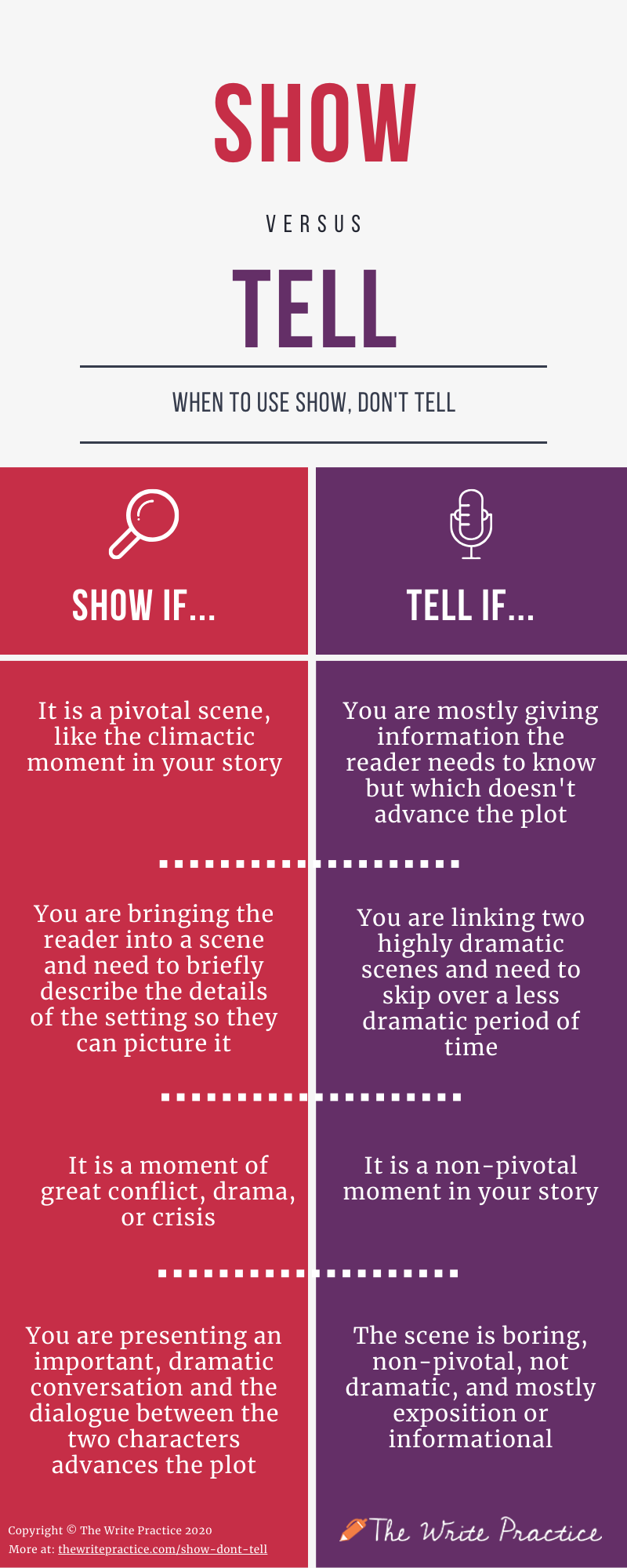
  • Narrative is your voice as the writer sharing information with your readers.
  • It tells the reader instead of showing.
  • Narrative lets you set the scene and give background information.
  • Used for transitions, it moves the reader from one scene to another.
  • It slows the pace.

Exposition

  • Exposition provides the detached, third-party perspective on a story.
  • Shows the reader what is happening, doesn’t tell them.
  • Uses description to inform and move the story forward.
  • Exposition gives the reader more information, more emotion, and helps with active scenes by quickening the pace.
  • Allows us to hear character thoughts.

In a nutshell, narrative is telling, exposition is showing. I found the following example during my research and thought it did a good job of showing what I am trying to explain.

Exposition: Brian stopped and reached into his pants pocket. He pulled out a lighter. Then, he reached into his lapel pocket for his pack of cigarettes and took one out. He placed the cigarette between his lips, cupped his hands, and lit it. After putting his lighter back in his pants pocket, he resumed walking.

Narration: Brian stopped to light a cigarette and resumed walking.

So much info on this subject. It still can be confusing, and it seems everyone has a different opinion. I would encourage you to do your own homework and think twice about using the two concepts interchangeably. They are not the same.

Something to think about.

-Jan R

Narrative Versus Exposition-They’re Not The Same (Revised)

Friends Are Friends – Not Editors

download (3)In a recent blog, Maybe You Should Consider Biting The Bullet!  I talked about my experience with agents and my journey towards getting my book published. Needless to say it was disheartening. The response I got back, was it just wasn’t ready.

I thought about using an editor in the past, but didn’t really think I needed one. I’m very bright. I know how to read and work things out, so why should I  pay someone to edit my book for me?

I had friends read my work and point out mistakes.  After all, everybody knows you need another set of eyes besides your own. You are so close to your work, and have reviewed it so often, the mistakes are all but invisible.

If you have a friend that’s trained and knows how to review and edit manuscripts, that’s awesome, but most of us don’t. Those wonderful friends of ours who have volunteered their time, can read our work, and say yay or nay on the premise. They may catch a couple typos, misspellings, or missing commas. They may offer a suggestion or two to make the story a little more interesting. But it’s not fair or realistic to expect them to churn out a publishable piece of work.

I tried this route for years. I would get friends to read, go in and make the corrections they suggested, along with the ones that I found while making their suggested corrections and would send it in again.

As you probably guessed, it still wasn’t ready. It wasn’t until I got the chapter back from a professional that I realized why the agents, who took the time to comment, were saying it wasn’t ready. It wasn’t.

Something to think about.

-Jan R


Friends Are Friends – Not Editors

Maybe You Should Consider Biting The Bullet!

imageI’ve been working on Always And Forever for about nine years now. Well to be honest, I became discouraged on many occasions. Especially when I received rejections from newly solicited agents. I had gone through the novel for the umpteenth time, and I knew I had corrected every little mistake that could have possibly been overlooked during previous reviews. So, it would probably be more accurate to say I worked on the book for nine years off and on. Some of those offs were many months in duration.
I’ve tried to walk away from the book, but I can’t.  It’s a great story waiting to be told. It’s also a thorn in my side. As much as I try to push it away and move on, I find myself drawn back into the story and a desire to see it published.

One of the Agents I sent my work to, said I had a great premise but the story was riddled with grammatical and structural errors, head hopping, and dragging dialogue. It wasn’t ready for publication.

I took her constructive criticism to heart and took courses, read books, and worked on my manuscript feverishly in an attempt to make it publishable. Well here we are Nine years later and I still have a piece of work riddled with grammatical and structural errors, with no head hopping, and forward moving dialogue.

I’ve had friends read my novel and point out mistakes. I’ve used several online grammar programs, but I still have a piece of work with an unacceptable number of grammatical errors. It’s not ready.

A month ago, a lady that I know started an editing business and said she would love to look at my work. As a favor to me, she reviewed and provided corrections to my prologue and first chapter no charge.

I was appalled at the number of errors she cited. I have no idea how I could have missed so many small things. I was seeing for the first time what the literary agents were seeing when they reviewed my work, and I fully understood what the one agent had offered when she said it wasn’t ready.

Needless to say, I have hired her to help me with the rest of the book. It is an expense, but I’ve come to realize that we can’t edit our own work. As authors, we are to close and can’t see what jumps off the page for people with trained eyes.

Maybe it’s time to bite the bullet. And yes I know that’s a cliché,  but it sums up perfectly what I’m trying to say 🙂

Something to think about.


-Jan R


Maybe You Should Consider Biting The Bullet!