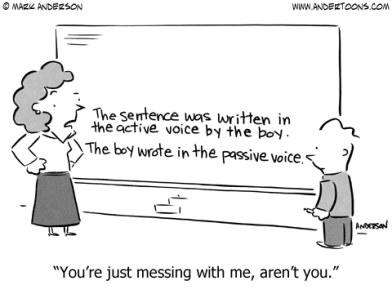
 When you write, you want to use the active voice. It’s clean, concise, and simple. The active voice is easy to read and understand.
Subject + Verb
- Susie sang.
- Michael ate.
- Jeffery kicked.
Subject + Verb + Direct Object
- Susie sang songs.
- Michael ate soup.
- Jeffery kicked cans.
These examples are basic, and can be embellished with adjectives, adverbs, modifiers, etc. to dress them up, but the Subject/Verb order should remain the same.
95% of your sentences should be written in the active voice. You want the doer/subject at the beginning of the sentence.
When you use the passive voice in writing, you have to introduce new parts of speech just to make the sentence mean the same as it would in active voice. The result is a wordy sentence that makes you wait to find out who the subject is.
Direct Object + Dead Verb + Participle form of Verb + optional Preposition + optional Subject.
The winner was written on the community board by Carol. (Passive)
Carol wrote the winner on the community board. (Active)
As you can see, passive voice is not simply a reversal of active voice. It has additions, and I haven’t discussed the fact that many passive sentences are incomplete.
The message was sent.
So the above sentence is grammatically correct, but it’s missing information. Who sent the message, and to whom was it sent?
Why would anybody use the passive voice? Well it comes in handy if you’re a businessman or politician. It allows you to avoid responsibility.
- Your position has been eliminated. vs. I eliminated your position.
- Your taxes will be raised. vs. I will raise your taxes.
When you’re writing a novel, you’re not trying to avoid responsibility. You’re trying to draw your reader into an exciting adventure that keeps them turning pages until the very end.
Keep your sentences active. Something to think about 🙂
-Jan R
 When you are writing a novel, you want to use concrete, everyday verbs. Examples of these are jump, smile, run, look, show, and eat. You can picture the actions in your head and there is no ambiguity.
 Have you heard of the Hemingway Editor App? If you’ve been writing for a while, you know about grammarly and autocrit. Both of these Apps focus on grammar and spelling. Hemingway takes it a step further. The App highlights lengthy, complex sentences and common errors; if you see a
  Are you writing what you meant to write? Is your prose concise, and easy to understand? You may have one thing in mind when you write that sentence, only to discover it’s ambiguous, misleading, and sometimes quite humorous.
 So you’re afraid you might fail. Truth is, you might stumble the first try, the second try, and maybe even the third try, but that’s part of the learning process. If you’re constantly looking over your shoulder, you may not finish your novel. You’ll be too busy battling the thoughts of it not being good enough.
 Does your manuscript have to be perfect? If you’ve already written a best seller, your agent and editor may cut you some slack. If not, yes, that book better be pretty darn near perfect, or nobody is going to look at it. Agents receive hundreds of queries a week. They don’t have time to read everyone. If your work is full of grammatical and structural errors, that’s all the excuse they need to toss it to the side and move on to the next one.
 When you write, do you have an outline? Do you know where you’re going, or do you wander aimlessly? Maybe you do a little of both.
 I’m a little over half way through the revision process of the book I’m working on and dreading the next few weeks.
 Writing your first novel-Things you should know