Take Your Reader On The Journey

untitledI’ve written several blogs patting authors on the back and thanking them for the joy they provide to people like my mom.

She is elderly and can’t go to the places she would like to visit, but my mom loves books. They take her not only to places she would like to go but places she could only go to in her dreams.

Consider this! Your novel is a journey. You aren’t just walking through that journey; you are the tour guide, and you’re taking your reader with you.

When you write that novel, you are doing at least one of several things.

  1.  Taking the reader somewhere they cannot personally go.
  2. Showing your reader new aspects of a place they are already familiar with.
  3. Suggesting a place your reader could not even imagine existed.
  4. Reflecting on places, people, and situations that your reader may be familiar with, but are unable to put into words with your particular expertise.

Enjoy the journey and be cognizant of those who are with you. Remember, they can’t read your mind. It’s your job to put the story in writing and make sure that your reader is following the intended path. You are the guide! You are their eyes and ears!

Something to think about.

-Jan R
 

Take Your Reader On The Journey

Thursday’s Thoughts

Post_13-08-760x400I’ve been kicking around the thought of having a ‘Writing Tip’ Thursday for a while, but still haven’t come up with a witty title for the blog. There are so many one-liners out there. Useful information provided by successful authors that grab your attention and make you stop and think. Some may even tickle your funny bone 🙂

So here goes!

Background information:

If your hero is eating dinner in Moscow, you better know that steak is thirty bucks a pound; if he is drinking sake in Tokyo, you better know which hand he should use to hold the cup; and when he is sunning on the beach at Cape Cod, remember that there won’t be palm trees.  Dean R. Koontz – How To Write Best Selling Fiction

I love Dean Koontz. He has a way of getting the point across in a fun, self-explanatory manner.

Something to think about 🙂

-Jan R


Thursday’s Thoughts

Want To Sell More Books/eBooks?

  1. images09PXA1C7 Is your book available as an ebook?                                         You should definitely produce a print-on-demand book, but so many new authors want that book deal with distribution in bookstores and don’t consider ebooks. Most indie authors make more income from ebooks. Something to think about.
  2. Has your cover been professionally designed?                       That cover matters. When I’m purchasing a book, the first thing to catch my attention is the cover. Book buyers shop with their eyes.
  3.  Has your book been professionally edited so that it reads well?                                         Edit your books until you can’t stand them any longer, and then you should consider hiring a professional. If that’s not in your budget then try using a critique group of readers within your genre.
  4.  Have you submitted the book to the right categories?                                                     It’s important to match reader expectations and the promise of what your book delivers with what your book is actually about. If you’re not sure what categories to use, choose a few books that yours are like and see what their categories are.
  5.  Have you priced your book realistically?                                                                               Get to know your genre and the expectations of your readers.
  6. Have you written, or are you writing, another book?                                                           The more books you have, the larger your virtual shelf space, and the easier it is for people to find you.
  7. Have you done any marketing?                                                                                                 Marketing is sharing what you love with people who want to hear about it.   Build your platform and an email list.
  8. Have you asked for reviews or submitted a review site?
  9. Have you optimized your Amazon sales page with a hook, quote from reviews, or other material?
  10. Are you working your butt off? Have you given it enough time?

Hope this helped. I got most of the information for this article from a free ebook written by Joanna Penn. If you haven’t checked her out, I would highly recommend her blog- joanna@thecreativepenn.com

She provides a library of useful information and many reference books at no charge.

-Jan R

Want To Sell More Books/eBooks?

Just Write!

cha_647_020717110811It seems like it’s been a long time since I truly sat down to write. I’ve been doing posts, but mainly older blogs revisited or simple quotes.

My life has been hectic over the last year or so, and it’s been maybe a little too easy for me to say, “I just don’t have the time to write”. I allowed one day to grow into two days and then three and on and on and on.

Before I knew it, I was barely writing at all. I now fully understand why many professional writers encourage you to write every day.

We all have days or personal situations to arise that hinder us from getting to the keyboard. I’m not condemning anyone for taking a needed day off. Life happens!

The problem I had, was the longer I went without writing, the easier it became to put it off. I had become so engulfed with what was going on around me, that I had pushed writing to the side.

Something that I truly enjoyed doing had become an afterthought. Should I write today or not. The answer was usually not.

I am back in the game and wanted to warn those who follow my blog, listen to the experts.

Write! Write! Write! Hopefully, you got that. Just Write!

-Jan R

Just Write!

Something To Think About # 1

SupermanflyingYour lead character doesn’t have to leap tall buildings in a single bound, and he doesn’t have to stop speeding bullets with his bare hands, but he darn well better know the difference between right and wrong, and he better be kind to animals, and it sure wouldn’t hurt any if he brushed his teeth regularly.  Dean R. Koontz – How To Write Best Selling Fiction

I think you get the picture. Your main character needs to be likable and relatable. It would help if he had a few flaws as well. Nobody’s perfect.

Something to think about 🙂

-Jan R


Something To Think About # 1

Questions To Ask A Perspective Agent

choose-book-confused-student-girl-choosing-two-books-red-blue-left-right-which-one-to-read-difficult-decision-119252584I have to be honest, I just want an agent to say yes, I will represent you. I’ve had my fill of rejections, but I know, just like anything else in life, you need to do your homework.

Don’t be afraid to ask questions of a potential agent. Knowing the agent’s expectations in advance of agreeing to work together will help you avoid a nasty breakup.

Find someone who believes in your work, who loves your voice, and whose vision for your future matches your own.

Questions to ask:

  1. Does the agent require a signed agent-author agreement? If so, ask for a copy in advance and review it carefully. Also, ask for a copy of the agency clause they will place in the publishing contract.
  2. How does the agent prefer to keep authors informed of submissions?
  3. What happens in the event of the agent’s death? Verify that the agent has provisions in place to protect your rights.
  4. How many authors do the agent and agency represent?
  5. Does the agent offer editorial feedback? Some authors like for the agent to critique their work.
  6. Does the agent offer career planning?
  7.  Does the agent handle sub-rights, ancillary rights, and/or movie rights?
  8. What novels have the agent or agency sold in the past year?
  9. What is the agents normal turnaround time for responding to e-mails and phone calls?
  10. How can the agent-author contract be severed?

There’s no right or wrong answer to these questions with the exception of question 8. The purpose of asking questions is to provide you with the information you need to make an informed decision and to clarify expectations for yourself and your agent.

Something to think about.

-Jan R

Questions To Ask A Perspective Agent

Show Don’t Tell

anton-chekhov-moon-is-shining-quote-630x473.pngI can’t count how many times I’ve heard the phrase-show don’t tell. Everybody knows you’re supposed to show and not tell. You want the reader to experience the scene as if they are one of the characters walking through the story besides the hero/heroine.

If you’re like me, you know what you’re supposed to do, but you don’t really understand what to do to make it happen. How do I show and not tell? It’s a lot harder than it seems. Once you start writing that novel, you’ll understand what I’m talking about.

There are 5 tools for showing:

  • Dialogue
  • Action
  • Interior dialogue
  • Interior emotion
  • Description-Sensory

If you’re doing anything that’s not one of these 5 things, you’re not showing.

Why is it so important to show versus tell? Showing provides your reader with a powerful emotional experience.

It doesn’t matter how great you do everything else in that novel if you’re missing that emotional experience, you lose. If everything you did is bad, but you have a great emotional experience, you may still win.

It all comes down to the takeaway. Every great novelist will tell you, you have to give your reader that powerful emotional experience or they won’t be coming back.

-Something to think about 🙂

-Jan R

Show Don’t Tell

Word Echos!

imagesB1G33MWEWord Echo? I’m sure you have an idea of what it is, even if you haven’t heard the term before. It’s the use of the same word in close proximity or in the same sentence.
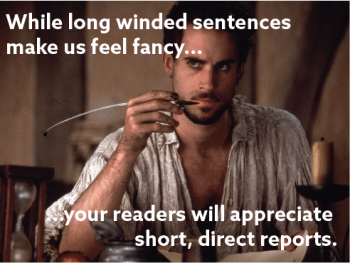
It’s considered ugly and inelegant. Don’t do it! The good news is, it’s probably one of the easiest mistakes to correct.

Just delete one of the repeated words if you can do so without changing the meaning of the sentence. If that doesn’t work, you’ll simply have to replace the duplicate with a new one.

That can be a little tricky. You have permission to pull out the thesaurus, just don’t get carried away, and consider the word you’re using as a replacement.

Example:

Angrily– bitterly, impetuously, tempestuously, threateningly, fiercely, furiously, violently, infuriatingly, tigerishly (I didn’t make this one up)……

Many of the words listed are the same but different. They range from a slight variation in meaning to utterly ridiculous.

Footnote: It’s okay to repeat if you’re writing poems, songs, or emphasizing a point. After I finished this blog, I thought about Martin Luther King Jr’s I Have A Dream speech. His repeats were intentional and poetic.

Just something to think about.

-Jan R

Word Echos!

Sentences – The Long And Short Of It -Revisited

AAEAAQAAAAAAAAiMAAAAJDg5M2Q4NGJiLTBhMTQtNDA5Ni1hNGVmLTM2YWRiZjczMDhjNQHave you ever read a sentence and thought that is way too long? The author lost you two commas ago, and now you have to go back and read the whole thing again to try and figure out what’s going on.
Or maybe you read a short sentence, followed by another short sentence, and another, and you’re thinking whoa, slow down.

There’s not a set rule for short or long. The sentence length you choose depends a lot on what you are trying to accomplish. There are good reasons for those long, lost me a long time ago sentences, and short, what just happened sentences. It’s up to you to decide when to use them, given the context of your writing.

What do short sentences do?

  • Create tension-When an author starts using short sentences, it’s usually a sign that something is about to happen.—-The dog growled. His teeth flashed. Jake turned. It was too late.
  • Call the attention of a reader to a significant detail—She walked past Central Park in Manhattan with her head held high. Gorgeous woman. Long blond hair. Blue eyes. Impeccable taste.
  • Present sudden events-Out-of-the-blue actions that no one was expecting.—-We sat quietly enjoying our meal at the local fast-food restaurant. Boom! “What was that?” I turned to see people rushing toward the gas station up the street.
  • To summarize the ideas presented in the long paragraph or sentence.

What do long sentences do?

  • Develop tension-While the short sentence is imminent, culminating with the actual event being acted out, the long sentence adds to the suspense, hinting at a situation in the process of developing.
  • Give vivid description-depicting a setting, love scene, or someone’s appearance.—Autumn came without special invitation coloring the trees in orange, yellow and red, whispering the cold in our ears and hiding the warm sun rays from our eyes.
  • Investigates arguments, ideas, or facts thoroughly.

Although long sentences have the smell of the old-fashioned 19th-century romantic prose, the usage of the long sentence in modern creative writing has its place. When it comes to writing artistic literature, fairy tales, ghost stories, or mysteries, don’t underestimate the effects of short sentences.

Hope this didn’t confuse you too much. To sum it up, there’s a time and place for everything 🙂

-Jan R

Sentences – The Long And Short Of It -Revisited

You Don’t Know What You Don’t Know

untitled.pngEnough already! At least that’s how I feel sometimes. I’ve been through my book more times than I can count. In my own defense, no one taught me how to write. I had a great story idea and decided to give it a whirl.

I thought it was ready, and then real life happened.  My wonderful work was rejected by the five agents I sent it to. One of them must have seen something promising. She took it upon herself to provide me feedback about what I was doing wrong (there was a long list), and what I needed to do to improve my work.

I was totally humiliated. Grammatical and Structural errors are kindergarten stuff and completely unacceptable. Even I should have gotten those right. I could understand my issues with head-hopping and on-the-nose-writing. Those terms were totally foreign to me.  I wasn’t a professional novelist. I thought all you had to do was put words on paper and create a wonderful story that everyone wanted to read. How was I to know there were rules?

And what was the deal with dragging dialogue? My people were talking. How was I suppose to know dialogue moved the story forward or had to have some significance?  I couldn’t believe I sent an agent such inferior work!

When you’re a newbie, you don’t know how bad your work is because you lack the knowledge and skills necessary to produce publishable work. While there may be a few prodigies out there, chances are, you aren’t one of them. Sorry!

Like myself and many others, you’re going to have to pay your dues and learn the craft. Then you will be ready to write that New York Times bestseller.

One of my favorite sayings is, you don’t know what you don’t know. I’m not sure where I picked that up from, but it’s true. I wasn’t intentionally sending out bad work. I just didn’t know.

-Jan R

You Don’t Know What You Don’t Know