 There are four main dramatic elements to your novel. You probably never thought about it, but if you did it right, they are there. If they’re missing, you need to revisit your work and make some adjustments.
That’s one of the nice things about writing. Nothing is set in stone, and when equipped with time and knowledge, you can change anything.
So back to the blog and the elements that I was referring to.
- Passion – yours not the Novels. Write something that you are passionate about. If you’re not passionate, it will come through. What’s important to you? What are you trying to get across? What do you want to be the takeaway?
- Theme – what your reader takes away from reading your story. Yes, the theme and passion can be the same thing and probably are in a great many cases. Examples of theme would be, belief in yourself or all things work for the good of those who serve the Lord.
- Flaws – your character must have flaws. They don’t have to be exaggerated or grotesque but face it, nobody is perfect. Talk about a boring read. The flaw could be as simple as a lack of confidence or the inability to put the past behind them. The character doesn’t have confidence, so the theme would probably be, believe in yourself. Note how they can work hand in hand and build on each other.
- Premise – What if a (flawed character)(encounters some problem) and had to (overcome the flaw) to (solve the problem). You know your story. Fill in the blanks. Does it make sense? Is it enthralling or boring?
One of the things that the agent wrote to me after rejecting my work, was I had a great premise. It was a silver lining to a dark cloud that sprung up after the initial shock of being rejected. And while I thought the passion and theme were there, my characters were not flawed, which means that my passion and theme were probably weak.
Something to think about.
-Jan R

 Does your plot have missing or broken parts? Does it jump from one idea to another without providing a bridge?

 Waiting for inspiration will kill your novel. It’s also an excuse I have used many times over the years.
 Today’s readers want less description and more action. The strongest stories start with a bang. Readers are drawn to stories where authors pose a question, establish a dilemma, or otherwise inspire curiosity right from the start, creating the turn-the-page urgency that readers crave. Jane K. Cleland Writers Digest
 I write a lot about rejection because it’s a part of life if you’re an unpublished author seeking a literary agent or publishing contract. Many would-be authors allow a simple rejection to end their attempts at writing. Their thought – I must not be good enough. Well maybe that’s true, but odds are it is not.
 Enough already! At least that’s how I feel sometimes. I’ve been through my book more times than I can count. In my own defense, no one taught me how to write. I had a great story idea and decided to give it a whirl.
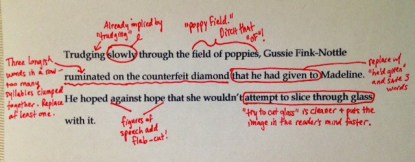 You just finished that first novel or at least you thought you did. Now the work begins. Pull out the pen and start cutting. Hopefully, red ink runs in your veins. You’re going to need a lot of it.
 Don’t you hate it when you’re talking to somebody and they are all wishy-washy? Why can’t they just come out and say it? Most of the time you know what they are getting at and want to spit it out for them. Well, the same thing goes for writing.
 Writing your first novel-Things you should know