 Today as I revised my novel, I noticed something that should have leaped off the page during past reviews, but didn’t. I am having a love affair with ‘ing’. These ‘ing’ words are all over the place.
I stopped the revision process and did some research on ‘ing’. I remembered reading somewhere, that the overuse of ‘ing’ words was not a good thing.
Opportunities to overuse the ‘ing’ word are boundless. There are nouns, adjectives, verbs, and even verbs masquerading as nouns called gerunds, all ending in ‘ing’.
So what’s the big deal? What’s wrong with ‘ing’ words?
The overuse of ‘ing’ words mark you as an amateur – Don’t be alarmed if you see more than a handful on one page. Do take a closer look if you see more than a handful in a single paragraph.
While wrapping a soothing sling around the fledgling’s broken wing, Diana was humming, dreaming of her prince charming. Yet troubling thoughts about his depressing friend Starling kept intruding, interrupting her very entertaining daydreams. There was something intriguing and alarming about him.
‘ing’ verbs weaken your writing and make it clumsy and hard to read . Abigail was walking along the bike trail. There was a boy riding his bike. He was smiling up at her as she passed. She started wondering what the boy was so happy about.
Abigail walked along the bike trail. A boy smiled at her as he rode passed. She wondered what he was so happy about.
Starting a sentence with an ‘ing’ word is the weakest way to begin a sentence.
Hitting the thug in the face with her purse, Josie reached for her phone.
Josie hit the thug in the face with her purse and reached for her phone.
To identify overuse of ‘ing’ words in your writing, try this:
- Use the “search” or “find” function in your word processing app(usually under editing).
- Use ‘ing’ as your search term.
- Examine each ‘ing’ word you find.
- Ask whether the ‘ing’ word is essential to meaning.
- Determine whether a simple past or other tense might work better.
- Decide if a stronger word choice might be the way to go.
Once you identify ‘ing’ words, replace weak or common ones with specific, stronger word choices. Your writing will become more concise, clear, and engaging.
Remember, not all ‘ing’ words are bad. The issue is whether or not you have made the best word choice.
So much info on the internet. You get the cliff notes. Hope they help, or at least get you thinking 🙂
-Jan R
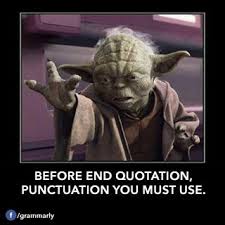 What’s the deal with direct quotes? Why can’t I get the punctuation right? You would think after five years, I would know what I was doing.
 This past weekend I picked up a copy of “The Elements Of Style” at a library book sale for a dollar. If you’ve never heard of the book, I would highly recommend it. It’s one of those books that every writer should own.
 After writing Tuesday’s blog, I got to thinking about all of the words we misuse. The one that I misuse the most is to instead of too. I know the correct one to use, but because I’m on a roll with the words flowing, I’m not always as careful as I would normally be. I have also mixed up it’s/its and pique/peak/peek.
 I recently started a revision on what I thought was a very good first draft of my novel. I was totally flabbergasted at what I found. While I guess I should have been grateful that the errors were leaping off of the page at me, I was very disappointed and frustrated at the number I was finding. How could I have made so many mistakes?
 If you want to be an author, you had better develop a thick skin or at least pretend to. You will be rejected, and you will receive critiques that can be discouraging, but this is part of the process. Being a novice to writing, I probably got a double portion of both. I’m glad people were honest with me. I am a much better writer because my critique partners told me the truth.
 I have been accused and rightly so of on-the-nose-writing, over writing, redundancies, and throat-clearing. I’ve also had a close relationship with the words “that” and “had”. I blame it on inexperience and just not knowing any better.
 I read a quote the other day and thought I would share it on my blog. I don’t know who wrote it, as a name wasn’t provided. It reads as follows:
 About a week ago I wrote a blog on tools I use to help with writing. I included the usual suspects-dictionary and thesaurus, but also included a few that I thought many of my readers probably did not know existed. These included the ’emotion thesaurus’ -yes there is such a thing and it is great to help you get the creative juices flowing when describing your character’s reaction to what is going on in a particular scene.
 Writing your first novel-Things you should know