Commas are an albatross around my neck. Maybe that’s a bit dramatic but they are frequently my downfall in writing prose. Unfortunately, they are the most common punctuation mark within sentences, so you had better learn their proper use.
What’s the purpose of commas?
- Separate main clauses linked by a coordinating conjunction.
example: The house was built, but it had no tenants.
The meal was cooked, and the kitchen was cleaned.
2. Set off most introductory elements.
example: Unfortunately, the rest of the house was a mess.
Of course, I would love to go.
3. Set off nonessential elements (phrases that could be removed from the sentence and
not effect its meaning.
example: The injury, sustained from the fall, needed to be taken care of.
The injury needed to be taken care of-is the actual sentence. The words set
apart by the commas are informative but not necessary to convey the idea.
4. Separate item in a series/list.
example: She had eggs, grits, sausage, and bacon for breakfast.
5. Separate coordinate adjectives.
example: She was an independent, hardworking woman.
The warm, cozy comforter was all I needed.
6. Separate quotations and signal phrases( she said, he wrote, said Elsie).
example: “Knowledge is power,” wrote Francis Bacon.
Lisa said, “Do not walk on the grass.”
There are some exceptions to this rule.
example: “That part of my life was over,” she wrote. “His words had sealed it shut.”
“Claude!” Jamie called.
James Baldwin insists that “one must never, in ones life,
accept…injustices as commonplace.” (It’s integrated into the sentence so
a comma isn’t necessary.)
7. Separate parts of dates, addresses, place names, and long numbers.
example: July 4, 1776, is independence day. December 1941(doesn’t need a comma)
Raleigh, North Carolina, is the location of NC State University.
Do not use a comma between a state name and a zip code.
Use the comma to separate long numbers in groups of three. With numbers of 4 digits, the comma is optional.
Okay, now you know what I know. This exercise was as much for me as it was for you. Hopefully I can retain the information and use it, during my next revision 🙂
 Many of my writer friends are familiar with this title. It’s the number one bestseller by Lynne Truss. If you don’t have it, I recommend that you get it. You can probably find used copies on amazon. I bought mine at a library book sale for fifty cents. If you had to pay full price it would only cost you eleven dollars. That’s not a lot to pay for perfect punctuation.
 So I’m about to submit the first chapter of my novel for a critique. I have to admit I’m a little anxious, scared, and excited all at the same time. This is my baby I’m putting on display what if people don’t like it?
 It’s really easy. Really. Once you’ve identified one just go to the site and register and you are in. Most are free with the option of upgrading and paying a small fee for additional support. I thought about joining an online critique group for years but kept putting it off.
 Starting your story with the mundane. You want to provide a picture of your characters everyday life but it should be clear, concise and short. Provide just enough information about normal so that when the situation changes, there is a notable difference. Don’t bog your reader down with page upon page of happy normal character or backstory. Get to the action. Create the potential for conflict from the very first page-even while sharing normal and backstory. If your story takes forever to warm up, your reader might not make it to the good parts.
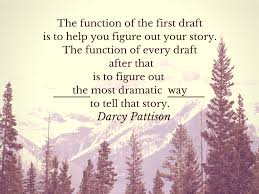 Enough already! At least that’s how I feel sometimes. I’ve been through my book more times than I can count. In my own defense, no one taught me how to write. I had a great story idea and decided to give it a whirl.
