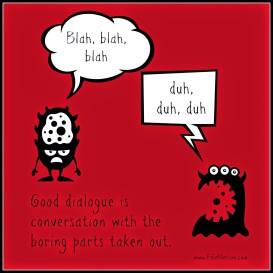
 Writing dialogue isn’t as straight forward as it would seem. It was one of the areas I was dinged on when I first submitted my manuscript. According to a literary agent, my dialogue dragged. Basically I wrote out conversations just like real people talk. After taking a few classes and looking at published authors’ work, I did get a grasp of what the literary agent was saying. My dialogue was weighing the story down and offering unnecessary detail. It caused everything to come to a stop.
Fictional speech is more focused and coherent than real speech. It has a purpose. You can’t just rant and rave about the newest fashion with your friends, unless it’s an integral part of the story that provides information you are going to need later.
It should flow. If you can feel yourself reading, then stopping for a brief conversation, and then reading again, something isn’t quite right.
Conversation works best when combined with thoughts, actions and settings. Don’t separate them, but interweave them. People don’t stop to talk. They keep doing what they are doing, unless it’s something really important that demands their full attention.
Example:
The day had been crazy, but it wasn’t over yet. Walking into the conference room, Mark found Ellen sitting at the head of the table preparing packets for their upcoming meeting.
“Sorry I’m late,” he said, walking over to offer assistance.
Handing him a few, she looked him in the eye, anger and disappointment written all over her face. “Isn’t that your norm?”
Mark grasped for something to say that would ease the tension between them and get him through this day. Staring at the packets he was at a loss. What she said was true, and he couldn’t explain why. At least not now.
Easing herself up, she walked by him without saying another word.
“Well that didn’t go well at all,” he said quietly to himself, as he continued to prepare for the meeting. He would attempt to smooth things over with his secretary later, but for now he had a business to save.
By interweaving thought, action, setting, and dialogue, the scene moved forward seamlessly, pulling your reader into the story 🙂
-Jan R
 I’ve just completed the God knows what number revision of my novel(I lost count a long time ago). While I have to admit it is one-hundred times better than the first draft, it is still not where it needs to be.
 So how do you do it? It’s so easy to write blogs on finding time to write, or finding motivation to write. All of the tips and recommendations sound great, until you’re in the same boat as those people you are trying to help.
 I’ve spent the last few days finalizing the list of agents I have chosen to submit my work to. If you are looking for an agent, I would recommend checking out the Association of Author’s Representatives(AAR). It’s a free database on line that provides a list of literary agents, the genres they represent, and if they are open for submission.
 I love reading Jerry Jenkins blogs. I always take something away from what he has to say. I don’t know that he offers anything different or new, it’s just the way he says it. I read what he’s written, and a light bulb goes off.
 I was reading How to Write Best-Selling Fiction a little while back, when a chapter jumped out at me, and I couldn’t help but smile. It was totally me. I’m ashamed to admit my naivety, but it was like I was reading my story.
 I’m preparing to send my manuscript out to literary agents again. This is the second time it is going out, the first time resulted in rejections, so I have to admit I’m a little apprehensive.
 Enough already! At least that’s how I feel sometimes. I’ve been through my book more times than I can count. In my own defense, no one taught me how to write. I had a great story idea and decided to give it a whirl.
 At this point in the game, you probably know what a dialogue tag is. It is a phrase placed at the beginning, middle, or end of a quote, to identify the speaker.
 I wasn’t an English major, but I never had an issue with stringing words together and making a coherent, easy to read sentence. I know most of the rules, but I also know those rules are meant to be broken, especially if you are writing fiction.
 Writing your first novel-Things you should know