 I had the opportunity to listen to a publisher discuss problems he sees in manuscripts the other day. While he focused on several major components of the novel during his session, I want to talk a little about scenes.
Most of you should have a pretty good understanding about what a scene is and how it fits into the novel. Your story is actually a series of scenes that continue until they reach the climax and finish.
Now there are many ways to mess up a scene, but he called attention to some things I had never really thought about, so I wanted to share them with my readers.
The most obvious mistake is jumping from one scene to the next with nothing in between. John is in the car driving home from work, and then he miraculously appears in the kitchen having an argument with his wife. What just happened? The writer failed to provide a transition.
While some people add a transition at the end of the previous scene, most transitions are provided at the beginning of the new scene. Within the first few lines actually. I never knew how important those lines were, until I saw the podcast.
So what is the purpose of the first few lines of your scene?
- They establish the point of view. With in the first few lines, I should know who’s head I’m in.
- The first few lines should establish the place where the scene occurs. When you open a scene with two people talking, your reader won’t be able to visualize where they are and what’s going on. They could be sitting in John’s living room, or walking the streets of New York City. By forcing your reader to try to figure this out, you are pulling them out of the story.
- Those first few lines should establish a sense of time. Is it day or night? Maybe he’s nervous because he’s suppose to meet someone in 15 minutes and he is 25 minutes away.
Enough about scenes for today. If you need more information, I have a blog post on the anatomy of a scene, and I would highly recommend a visit to Randy Ingermanson’s (the snowflake guy) blog.
-Jan R
 I am doing yet another blog on dialogue. It’s one of the most important parts of your novel and will lead to your downfall if not done correctly.
 I think I’m ready to present my book to literary agents again. I’ve made numerous revisions and had it reviewed one last time by a beta reader- to make sure it flows and there are no plot holes. I have to admit I’m a little anxious, but this time around I know I am presenting a well written, publishable piece of work.
 I’ve been reading literary agent biographies and blogs over the last few days in an attempt to narrow my search and find a few I think would be a good fit for my novel.
 I’m a member of Scribophile. If you don’t know what that is, and you are really interested in writing and getting feedback, Scribophile is the place to be. It’s like Facebook for writers. You do critiques and in turn others critique your work. I wish I had found it years ago. You get some so so critiques, but you also get a lot of good ones from people who know what they are doing. At any rate this blog wasn’t suppose to be an infomercial for Scribophile.
 I started out with a 90,000+ word manuscript and cut it down to a little over 80,000 words. While this is still an acceptable size for a novel, it’s short in length. My initial thought was, I need to go back and add some of the stuff I cut, but then I remembered, there is a reason that I cut that stuff.
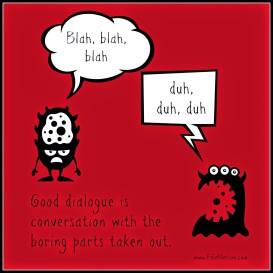 Writing dialogue isn’t as straight forward as it would seem. It was one of the areas I was dinged on when I first submitted my manuscript. According to a literary agent, my dialogue dragged. Basically I wrote out conversations just like real people talk. After taking a few classes and looking at published authors’ work, I did get a grasp of what the literary agent was saying. My dialogue was weighing the story down and offering unnecessary detail. It caused everything to come to a stop.
 I’ve just completed the God knows what number revision of my novel(I lost count a long time ago). While I have to admit it is one-hundred times better than the first draft, it is still not where it needs to be.
 So how do you do it? It’s so easy to write blogs on finding time to write, or finding motivation to write. All of the tips and recommendations sound great, until you’re in the same boat as those people you are trying to help.
 I’ve spent the last few days finalizing the list of agents I have chosen to submit my work to. If you are looking for an agent, I would recommend checking out the Association of Author’s Representatives(AAR). It’s a free database on line that provides a list of literary agents, the genres they represent, and if they are open for submission.
