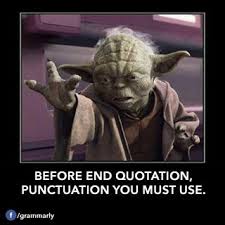
 What’s the deal with direct quotes? Why can’t I get the punctuation right? You would think after five years, I would know what I was doing.
The novel I’m revising has a lot of dialogue, which results in the use of quotation marks and commas following tags(I think).
I’m sure this is elementary to many of my readers, but I base most of my writing on concepts that I’m struggling with. I like to think that I’m not the only person who hesitates and second guesses when it comes to something as simple as writing dialogue.
During my research on this subject, something jumped out at me that I never really thought about before. The lights came on.
What was my biggest problem with quotes and the use of punctuation? I was treating quotes with tags and quotes without tags the same. I also wasn’t sure what to do when a quote ended with punctuation other than a comma.
When a quote ends in a comma and is followed by a dialogue tag, you use a comma.
“I can’t go with you,” she said, wishing he would just leave.
“I can’t go with you,” she said, “but I want to.” **The second part of the quote did not begin with capitalization because it follows a comma and is a continuation of the first quote.
When a quote ends with an exclamation point or question mark, the dialogue tag that follows ends with a period.
“I can’t go with you!” she said. She wished he would just leave.
“Who are you kidding?” he asked. “You can’t run.”
If the quote ends in an action/verbal phrase, it is not a dialogue tag and should not be treated as such. This was a concept I failed to grasp, and I would struggle trying to figure out were to put the comma.
“I can’t go with you.” She pushed past him and headed toward the door.
You have to focus when writing dialogue. You not only have to concentrate on the wording, to ensure it is moving your story forward, you also have to get the punctuation right. Slow down and take your time. Dialogue is complicated and can’t be rushed.
-Jan R
 I’m almost finished with revising my manuscript and plan to get a few well qualified friends to give it a final read through. Their job will be to make sure it is believable, there are no plot holes, and of course, it’s an interesting-grab you by the seat of your pants-type of book.
 I was reading a book on ‘How to Write Best-Selling Fiction’ this past week when a chapter jumped out at me, and I couldn’t help but smile. It was totally me. I’m ashamed to admit my naivety, but it was like I was reading my story.
 If your hero is drinking sake in Tokyo you better know which hand he should use to hold the cup; and when he is sunning on the beach at Cape Cod, remember that there won’t be any palm trees-Dean R. Koontz
 This past weekend I picked up a copy of “The Elements Of Style” at a library book sale for a dollar. If you’ve never heard of the book, I would highly recommend it. It’s one of those books that every writer should own.
 After writing Tuesday’s blog, I got to thinking about all of the words we misuse. The one that I misuse the most is to instead of too. I know the correct one to use, but because I’m on a roll with the words flowing, I’m not always as careful as I would normally be. I have also mixed up it’s/its and pique/peak/peek.
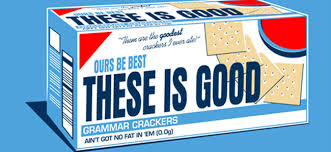 I recently started a revision on what I thought was a very good first draft of my novel. I was totally flabbergasted at what I found. While I guess I should have been grateful that the errors were leaping off of the page at me, I was very disappointed and frustrated at the number I was finding. How could I have made so many mistakes?
 If you want to be an author, you had better develop a thick skin or at least pretend to. You will be rejected, and you will receive critiques that can be discouraging, but this is part of the process. Being a novice to writing, I probably got a double portion of both. I’m glad people were honest with me. I am a much better writer because my critique partners told me the truth.
 I have been accused and rightly so of on-the-nose-writing, over writing, redundancies, and throat-clearing. I’ve also had a close relationship with the words “that” and “had”. I blame it on inexperience and just not knowing any better.
 Writing your first novel-Things you should know