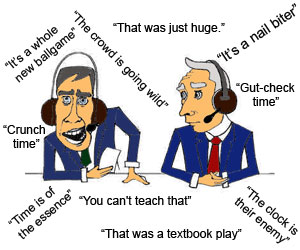
 If you’ve been around the writing world long enough, you know there are no new ideas. Kidnaps, robberies, invisible men, aliens, robots, espionage, vampires, zombies, invasions, war, love…they’ve all been conquered again and again and again.
What’s a writer to do? You have to keep that story about love and war originally you. Use your voice, your words, and your unique spin, to make it sound new.
Novice writers and wannabe authors bend to the ebb and flow of what’s selling. They attempt to emulate other writers and copy their ideas. Well theirs nothing original about that. The agent that’s looking for that fresh new idea, is going to throw the manuscript to the side along with the other copycats in the pile.
Originality doesn’t mean something has never been written about. We have common linguistics, and resources. We are exposed to many of the same things. Writing is not without influence.
Originality is based more so on frequency. How often has an idea been used? What about your spin on the idea? Is your spin used often or infrequently? Hopefully infrequently to not at all.
Now that you have the actual idea as original as possible, look at the words you are using. Stay away from clichés.
It’s easy to borrow language known as cliché. What makes the words or phrases cliché? Overuse. You need to recognize these clichés and get them out of your writing. Too many will cause your readers to tune out.
Avoid words like dude, totally awesome, or bling. They are not unique because of overuse.
I bet you can complete the following sentences:
- An apple a __________
- Once in a blue __________
- It was a dark and stormy __________
- She was the apple of his ____________
- A bed of __________
- They lived happily ever ____________
I don’t think it’s a good idea for your reader to be able to complete a sentence without looking at the words.
If you’re not sure a phrase you are about to write is cliché, go to google and type in ‘cliché sites’. You will be provided with a list of different sites to assist in this area.
Writing cliché is the easy way out. It’s challenging to be original. Be original!
Something to think about.
-Jan R
 We’ve talked about weak and strong verbs, but did you know the same holds true for nouns? I never really thought about it, until I took an online class that talked about strong and weak nouns. My first thought on weak nouns; the instructor has to be referring to pronouns. Well he wasn’t and that is a subject for another day.
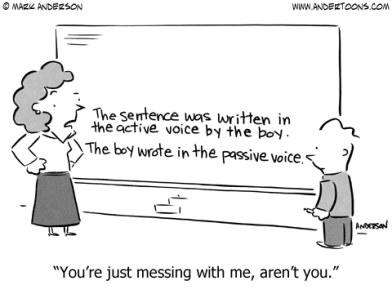 When you write, you want to use the active voice. It’s clean, concise, and simple. The active voice is easy to read and understand.
 When you are writing a novel, you want to use concrete, everyday verbs. Examples of these are jump, smile, run, look, show, and eat. You can picture the actions in your head and there is no ambiguity.
 Have you heard of the Hemingway Editor App? If you’ve been writing for a while, you know about grammarly and autocrit. Both of these Apps focus on grammar and spelling. Hemingway takes it a step further. The App highlights lengthy, complex sentences and common errors; if you see a
  Are you writing what you meant to write? Is your prose concise, and easy to understand? You may have one thing in mind when you write that sentence, only to discover it’s ambiguous, misleading, and sometimes quite humorous.
 So you’re afraid you might fail. Truth is, you might stumble the first try, the second try, and maybe even the third try, but that’s part of the learning process. If you’re constantly looking over your shoulder, you may not finish your novel. You’ll be too busy battling the thoughts of it not being good enough.
 Does your manuscript have to be perfect? If you’ve already written a best seller, your agent and editor may cut you some slack. If not, yes, that book better be pretty darn near perfect, or nobody is going to look at it. Agents receive hundreds of queries a week. They don’t have time to read everyone. If your work is full of grammatical and structural errors, that’s all the excuse they need to toss it to the side and move on to the next one.
 When you write, do you have an outline? Do you know where you’re going, or do you wander aimlessly? Maybe you do a little of both.
 I’m a little over half way through the revision process of the book I’m working on and dreading the next few weeks.
 Writing your first novel-Things you should know