Dialogue Don’ts

images-2I’m still working on the dialogue dos, but I suppose a part of mastering this element is learning what not to do 🙂

  • Don’t use a lot of dialect. It can be really hard to follow and frustrate your reader. Choose one or two words to give the tone and flavor of the dialect you’re going for instead.
  • Don’t repeat in dialogue, what you’ve just said in internal thought. Give your reader a break. Who wants to hear the same thing twice.
  • Don’t let a character explain to another character what they already know. Delete any lines of dialogue that start with “I know you already know this…
  • Don’t allow your character to tell the entire story again to another character when the reader already knows it. Opt to fade out of the conversation. “I went to the gym….” Jason told Marsha the entire story.
  • Don’t us million dollar words or avoid contractions, unless it is a character trait.
  • Don’t repeat names in dialogue. It’s annoying. Once the reader knows you are talking to Marsha, don’t use her name again.
  • Don’t allow your character to give a speech. You have to break it up. use internal thought, other people’s dialogue, or action.
  • Don’t allow everyone to sound the same. Use different speech patterns and word choices to make your characters unique.
  • The biggest don’t- Don’t be boring!

Remember your dialogue should be exciting and provoking. It should keep the story moving forward. Don’t stall out with the everyday humdrum. You don’t have time for pleasantries, and you will lose your reader.

Something to think about.

-Jan R

Dialogue Don’ts

Mistakes In Word Choice

untitled.pngI was reading comments from a copy editors’ camp this week, and I thought I would share what was identified as the most common error they cite: mistakes in word choice.
The most common mistakes in word choice are as follows:

  • using which for that and vice versa
  • using affect for effect and vice versa
  • confusing they’re, their, and there
  • confusing your with you’re
  • overusing utilize
  • using between you and I instead of between you and me
  • using compare to when compare with is correct
  • using convince someone to  instead of persuade someone to
  • using its for it’s and vice versa (by far the most common mistake)

There you have it, something else to look for during that revision 🙂

-Jan R

Mistakes In Word Choice

5 Common Mistakes New Authors Make In Their Opening.

  1. Unknown1Leading with the setup. If you’re like me, you thought you needed to give your reader some information up front so they would understand what was going on. I guess it was a little boring, but my reader was well prepared for the good stuff they never got to 🙂 Setup, regardless of how well written, is boring.
  2. Telling too much. Yes, I’m guilty of this one too. Remember backstory and passive voice distance the reader from the action. If your reader’s sense of immediacy is lost, meaning she can’t visualize the events as they occur, you may lose her.
  3. Scenes that lack conflict. You probably guessed I was guilty of this one too 🙂 I had scenes that were nothing but backstory and setup. I really feel bad for the family members and friends I asked to read my finished manuscript.
  4. Writing unsympathetic characters.  Yes, I got this one right 🙂 Readers want to connect emotionally with the heroine and hero. They want to root for them, laugh with them, cry with them. Clearly establish the character’s motivation for behaving in any manner that might make them appear unsympathetic.
  5. Giving the reader a reason to stop reading. Don’t allow a chapter or scene to end on an anticlimactic moment. Always end scenes/chapters with a hook. And yes, I’m guilty of this one too 🙂

Something to think about.

-Jan R

5 Common Mistakes New Authors Make In Their Opening.

Misused Phrases

d4d6ee1756f63c3e26588969cfe33815.jpgWe have all heard phrases that stuck with us. We use them in our writing and speech. Problems arise when we either misheard or remembered the phrases incorrectly. The results  range from humorous to downright confusing.

The Correct Phrase                                           What You’ll Sometimes See or Hear

all it entails                                                            all it in tails

by and large                                                         buy in large

chock full of                                                          chaulked full of

in cahoots with                                                     in cohorts with

amusing anecdotes                                              amusing antidotes

beck and call                                                         beckon call

bated breath                                                         baited breath

beside the point                                                   besides the point

can’t fathom it                                                     can’t phantom it

down the pike                                                      down the pipe

far be it from me                                                 far be it for me

for all intents and purposes                             or all intensive purposes

home in on                                                          hone in on

got my dander up                                              got my dandruff up

had the wherewithal                                        had the where with all

I couldn’t care less                                             I could care less

in like Flynn                                                      in like Flint

moot point                                                         mute point

whet my appetite                                             wet my appetite

up and at ’em                                                   up and adam

tough row to hoe                                            tough road to hoe

supposedly                                                       supposably

shoo -in to win                                                shoe-in to win

over the airwaves                                          over the airways

of utmost importance                                   of upmost importance

recent poll                                                      recent pole

dyed in the wool                                            died in the wool

en route                                                          in route

I think you’re getting the picture.  Before you use those all too common phrases, make sure you have them down. I know I’m guilty of using several of the phrases listed above in the ‘what you’ll sometimes see or hear‘ list.

Something else to check during the revision process 🙂

-Jan R

Misused Phrases

Ask Questions!

imageI have to be honest, I just want an agent to say yes, I will represent you. I’ve had my fill of rejections, but I know, just like anything else in life, you need to do your homework.
Don’t be afraid to ask questions of a potential agent. Knowing the agents expectations in advance of agreeing to work together will help you avoid a nasty breakup.

Find someone who believes in your work, who loves your voice, and whose vision for your future matches your own.

Questions to ask:

  1. Does the agent require a signed agent-author agreement? If so, ask for a copy in advance and review it carefully. Also ask for a copy of the agency clause they will place in the publishing contract.
  2. How does the agent prefer to keep authors informed of submissions?
  3. What happens in the event of the agents death? Verify that the agent has provisions in place to protect your rights.
  4. How many authors does the agent and agency represent?
  5. Does the agent offer editorial feedback? Some authors like for the agent to critique their work.
  6. Does the agent offer career planning?
  7.  Does the agent handle sub-rights, ancillary rights and/or movie rights?
  8. What novels has the agent or agency sold in the past year?
  9. What is the agents normal turnaround time for responding to e-mails and phone calls?
  10. How can the agent-author contract be severed.

There’s no right or wrong answer to these questions with the exception of question 8. The purpose of asking questions is to provide you with the information you need to make  an informed decision and to clarify expectations for yourself and your agent.

Something to think about.

-Jan R

Ask Questions!

Love, Joy, and Peace-Sounds Good, Reads Bad

conflictI pray often for my home to be blessed with love, joy, and peace. For those who are wondering, it is. Who wouldn’t want a peaceful stress-free home environment, especially after a crazy day at the office?

However, I don’t want love, joy, and peace, in the novels I read. I want action, adventure, and adversity. Who wants to read a hum drum book about a couple meeting, falling in love, and getting married? That’s sweet, but it’s a little too sweet.

Without conflict, your story is going to be rejected. We all want the happily ever after ending. So make sure you have it, but it’s the conflicts and challenges your couple faces along the way that keeps your reader turning the page.

Keep in mind, conflict shouldn’t be something that shows up at the climax of your novel, you are going to lose your readers before they get that far.

Conflict should be evident in every scene and practically every page. It’s the engine that propels your story forward and keeps your reader engaged.

Most novels have one major conflict, but then each character will have one or two of their own conflicts. All of these conflicts go hand in hand to create an even bigger problem.

When you do introduce conflict,  it has to be a natural extension of your plot or your character. The conflict has to be something that prevents your hero or heroine from achieving their goals. It can’t be something you just magically pull out of the air.

It’s okay to have a flat tire or an unforeseen traffic jam that prevents your character from making that all important meeting. Just remember, too many coincidences like these are not directly related to your character or plot and can sound contrived.

One flat tire is acceptable, but if you are going to have more, then you had better find a way to make it a part of your story. Maybe someone is purposely flattening the tires of the main character to prevent them from meeting their goal.

Something to think about.

-Jan R


Love, Joy, and Peace-Sounds Good, Reads Bad

Are Your Scenes Dead?

Rip-clipart-rip-gravestone-mdAre your scenes dead, or do they just need a little get up and go? If you want to turn off an agent, front load your work with backstory and boring narrative.
I know from personal experience. That’s what I did. I thought the reader needed ‘a little’ back story before jumping in, so they would better understand what was happening later in my story. The prose was so boring they just chucked it to the side. They never got to the good stuff.

My scenes weren’t working as I intended, they were all but dead. One of the things I’m doing with my current revision is taking a closer look at those scenes. Are they really needed? How can I get them moving?

In order to correct a problem, you have to be able to identify it. What are the characteristics of dead and sluggish scenes?

Dead Scene

  • Contains repeated information. Give your reader a break. They don’t need to hear the same thing over and over.
  • There’s no conflict. What’s the purpose of this scene? It’s only adding word count but no meat.
  • A scene whose sole purpose is to set something up. This is the one I fell into. I wasn’t giving my readers the credit they deserved. I thought I had to spell everything out for them.
  • A scene lacking a goal. Why is it there? Where is it going?
  • A scene that doesn’t encourage your reader to turn the page. Words are your weapon. Leave the reader wanting.

 Sluggish Scene

  • Too much casual chit chat. Remember dialogue isn’t conversation as we know it. It has to move your story forward.
  • Too much description and narrative. Provide the reader with what they need, and don’t bog them down in what you consider interesting facts and details that aren’t necessary. The story should not stop to allow you the opportunity to show off  what you learned during research. Who cares how many gold buttons ran down the back of the heroine’s gown. Unless it’s involved in a crime scene, don’t do it.
  • Not enough emphasis on the scenes goal. Each scene should have a purpose. Don’t wonder off on tangents unrelated to what you are trying to convey. Keep your eye on the target.
  • Not enough conflict. The reader needs a reason to pick up your book. They are looking for action. Even Cinderella had an evil stepmother determined to keep her from the prince.
  • A scene written from the wrong point of view. This is another one I’ve struggled with. Maybe the scene should be from the heroine’s point of view versus the hero. She may be able to provide more insight into what’s going on in that particular situation.

Some things to look for and think about. Hope this helped.

-Jan R

Are Your Scenes Dead?

Who or Whom?

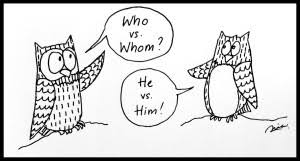
imagesFOEFOFTLAm I the only person who has a problem with who versus whom? Fortunately, I don’t use sentences requiring these words that often, but when I do, I become paralyzed. I’m not sure. I usually read through the sentence a few times using both words and pick the one that sounds better to me. There is nothing scientific about that. It simply boils down to preference.

This week I ran into a method to determine which word is correct, who or whom, and thought I would share my findings on this blog.

  1. Look at the clause associated with the who or whom. A clause is a set of words with a subject and a verb.
  2. Scramble the words of the clause (if you have to), so that they form a statement and not a question.
  3. Substitute either he or him for who or whom. If your sentence is about females, substitute males for the sake of your mnemonic.

Examples

  • (Who, Whom) called you last night?                                                                                     This sentence has only one clause, so all you need to do is see if it’s necessary to scramble the words to make a statement. You don’t. Once you substitute he or him you have a statement.                                                                                                                  He called last night.                                                                                                                      Him called last night.                                                                                                                    He called last night is the obvious choice. Who is the correct answer.                     Who called last night?          

***Look at the last letter of he and him to determine if you are using who or whom.

he = who

him = whom (they both end with the letter ‘m’)

  • (Who, Whom) were you calling last night?                                                                         This sentence has only one clause, but it does need to be scrambled to make a statement.                                                                                                                                       You called he last night.                                                                                                         You called him last night.                                                                                                      You called him last night is correct, so the original sentence reads as follows:   Whom were you calling last night?

Let’s try a trickier example:

  • Sarah was concerned about (Who, Whom) her daughter would be paired off with in the dance competition.                                                                                               This sentence has two clauses, but you’re only concerned with the one containing Who,Whom.                                                                                                                      Scramble the words to make a statement, and substitute he, him for who, whom.         Her daughter would be paired off with him in the dance competition.                            Her daughter would be paired off with he in the dance competition.                                   Him was the obvious substitute, so we are going to use Whom.                                         Sarah was concerned about whom her daughter would be paired off with in the dance competition.

Still a little complicated, but hope this helps 🙂

-Jan R


Who or Whom?

Times Are Changing-Stay Neutral

untitled.pngSeveral years back I was doing a critique on a ladies work, and the number of times she entered his or her, he or she, was distracting and cumbersome. In my write up of suggestions, I recommended she go with the masculine pronoun to refer to either sex.

Well guess what, I was wrong. The practice of using the masculine pronoun was acceptable back in the day, but as you may know, times change.

So what’s a person to do? Writing his or her, he or she will get old really fast. I can attest to that.  You have to start looking for more gender neutral terms.

                 Sexist Term                                                             Substitution

  • chairman/chairwoman                        chair, chairperson, presiding officer
  • coed                                                          student
  • congressman/congresswoman           congressional representative, legislator
  • forefathers                                             ancestors
  • layman                                                     layperson
  • man/woman                                           person/people, individual
  • man-made                                               synthetic
  • policeman                                               police officer
  • salesman                                                 sales clerk
  • mankind                                                 humanity, humankind, human race

I think you’re getting the picture.

Other options…….

  • Change your wording to plural pronouns.                                                                                 Each teacher should greet all of his or her students by name.                                          Teachers should greet all of their students by name.
  • Substitute he or she with a noun.                                                                                                She needs to go to the back of the line.                                                                                   The doctor needs to go to the back of the line.
  • Reword your sentence to use the first or second person.                                                        If she loses her ticket, she can’t get in.                                                                                     If you lose your ticket, you can’t get in.

I’m a little older, so to be honest, using a masculine pronoun to refer to all sexes does not bother me. However, I do realize we have to change with the times.

As an author you may not have to many situations arise in your novel related to gender specificity, but if you do, this is something to think about .

-Jan R

Times Are Changing-Stay Neutral

Does That ‘But’ Really Need A Comma?

imagesZGN867X5I like to highlight my mistakes. I guess my thought is, if I’m doing it, there are plenty of newbies out there doing the same thing. I like to think I’m not alone 🙂

I noticed something during my current revision that I never saw before. I’m having a  love affair with but. That wasn’t the only problem. There were a lot of commas following that but that shouldn’t have been there. My sentences weren’t compound, but they did have compound verbs.

Compound sentences are made up of two independent clauses that could stand on there on.

We went to a restaurant, and I ordered the chicken salad.

Simple sentences with compound verbs are not compound sentences and shouldn’t be divided by a comma. (This sentence is a great example.) Don’t you want to put a comma after and?

I knew I was wrong but couldn’t help myself.

She ran through the woods and jumped over the fence.

If these simple sentences bother you that much, you can make them compound.

I knew I was wrong, but I couldn’t help myself.

She ran through the woods, and she jumped over the fence.

Something to think about.

-Jan R

Does That ‘But’ Really Need A Comma?