 I have to be honest, I just want an agent to say yes, I will represent you. I’ve had my fill of rejections, but I know, just like anything else in life, you need to do your homework.
Don’t be afraid to ask questions of a potential agent. Knowing the agents expectations in advance of agreeing to work together will help you avoid a nasty breakup.
Find someone who believes in your work, who loves your voice, and whose vision for your future matches your own.
Questions to ask:
- Does the agent require a signed agent-author agreement? If so, ask for a copy in advance and review it carefully. Also ask for a copy of the agency clause they will place in the publishing contract.
- How does the agent prefer to keep authors informed of submissions?
- What happens in the event of the agents death? Verify that the agent has provisions in place to protect your rights.
- How many authors does the agent and agency represent?
- Does the agent offer editorial feedback? Some authors like for the agent to critique their work.
- Does the agent offer career planning?
- Does the agent handle sub-rights, ancillary rights and/or movie rights?
- What novels has the agent or agency sold in the past year?
- What is the agents normal turnaround time for responding to e-mails and phone calls?
- How can the agent-author contract be severed.
There’s no right or wrong answer to these questions with the exception of question 8. The purpose of asking questions is to provide you with the information you need to make an informed decision and to clarify expectations for yourself and your agent.
Something to think about.
-Jan R
 I pray often for my home to be blessed with love, joy, and peace. For those who are wondering, it is. Who wouldn’t want a peaceful stress-free home environment, especially after a crazy day at the office?
 Are your scenes dead, or do they just need a little get up and go? If you want to turn off an agent, front load your work with backstory and boring narrative.
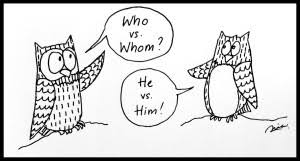 Am I the only person who has a problem with who versus whom? Fortunately, I don’t use sentences requiring these words that often, but when I do, I become paralyzed. I’m not sure. I usually read through the sentence a few times using both words and pick the one that sounds better to me. There is nothing scientific about that. It simply boils down to preference.
 Several years back I was doing a critique on a ladies work, and the number of times she entered his or her, he or she, was distracting and cumbersome. In my write up of suggestions, I recommended she go with the masculine pronoun to refer to either sex.
 I like to highlight my mistakes. I guess my thought is, if I’m doing it, there are plenty of newbies out there doing the same thing. I like to think I’m not alone 🙂
 Not to long ago I picked up my first completed manuscript, shook off the dust, and began the revision process yet again. I had become discouraged and didn’t want anything to do with the story.
 I got tickled when I first saw this word. I have to admit, I have dealt with rewrite-itis. What is it? It’s a severe condition that effects both published and unpublished writers according to The Everything Guide To Writing A Romance Novel. It means your are unable to call a book, chapter, or even a scene finished. So what causes the condition? A fear of failure or success. For me it is definitely failure.
 Writing your first novel-Things you should know