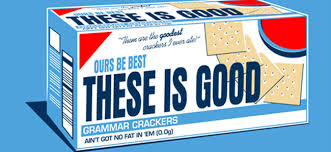
 I recently started a revision on what I thought was a very good first draft of my novel. I was totally flabbergasted at what I found. While I guess I should have been grateful that the errors were leaping off of the page at me, I was very disappointed and frustrated at the number I was finding. How could I have made so many mistakes?
When we think of grammatical errors, we think of the obvious : missing or overused punctuation, the wrong tense of a verb, mixing singular and plural, run-on-sentences or simple misspelling. All of these are grammatical errors that have to be corrected before your manuscript is submitted for publishing, but what about the other common mistakes that we make everyday?
‘Who’ or ‘Whom’– Who is used for the subject of a sentence and whom for the object. If you can substitute “he”, “she”, or another noun, ‘Who’ should be used. If instead you would use “her” or “him” then ‘Whom’ should be used.
‘Lay’ or ‘Lie’– This is a common error because the past tense of “lie” is “lay”. In the present tense, “Lie” is something the subject of the sentence does, and it does not require an object. “Lay” in the present tense is a transitive verb, however, and this is used to describe an action done to someone or something. I lie on my back. I lay my purse on the table.
‘Like’ or ‘As though’– These two are not interchangeable, but ‘like‘ is often used in place of ‘as though’. Like can only be followed by a noun or pronoun. ‘As though’ only precedes a verbal clause, because ‘as though’ creates the expectation of an action based event. She looks like my mother. I cried as though I had lost my bestfriend.
‘I’ or ‘Me’– Use ‘I’ only when it is the subject of the sentence, not the object. ‘I’ is the doer of the action. I went to the store. I couldn’t believe what I was hearing. ‘Me’ is the object of the sentence. It is the receiver of the action. She handed me the purse. The doctor gave the medication to me.
‘Who’ or ‘That’- Use ‘who’ for people and ‘that’ for things. She is the one ‘who’ gave me the purse. This is the purse ‘that’ I wanted.
Dangling modifiers-The clause that begins a sentence has to have the same subject as the sentence itself. ie Walking down the street, the trees were battered by last night’s storm. Wow, I didn’t know trees could walk. It could be corrected to read: Walking down the street, I noticed the trees had been battered by last night’s storm.
I’m not sure if this is my top 10 grammar peeves list, but I am familiar with and have observed most of these in my writing as well as the writing of people I critique. Thought I would share them. There are just so many. It would be impossible to cover them all in one blog.

What do you think? What are some of the common mistakes that you make or have observed?
-Jan R
 If you want to be an author, you had better develop a thick skin or at least pretend to. You will be rejected, and you will receive critiques that can be discouraging, but this is part of the process. Being a novice to writing, I probably got a double portion of both. I’m glad people were honest with me. I am a much better writer because my critique partners told me the truth.
 I have been accused and rightly so of on-the-nose-writing, over writing, redundancies, and throat-clearing. I’ve also had a close relationship with the words “that” and “had”. I blame it on inexperience and just not knowing any better.
 After I completed the first very rough draft of my manuscript, I couldn’t wait to send it out to literary agents. It was a great story and I was soooo excited. What if I got more than one offer. I am a realist but a very positive one and I new that story was great.
 I’m in the revision process with my novel and one of the areas I am focusing on is character development. When you hear character development, you usually think of main characters or supporting characters. Well my main characters do need some work, but for this particular blog I was talking about those ‘fly by’ characters that step into your novel, do what you want them to do, and then disappear never to be heard of again.
 Anybody that has read my work, knows that most of my blogs spin off of my own weaknesses. And there are many. I figure if I’m having problems with a certain aspect of writing, there are probably many others who are too.
 Hope this helped. I pulled most of my information off of the ‘advancedfictionwriting’ web site. That’s hosted by Randy Ingermanson-“the snowflake Guy”. He provides some great information for writers of all levels. You should check him out.
 What makes a blog post great? I wish I had the answer. I know some of the recommendations that professional writers and bloggers give. I try to abide by those rules and will share them with you today, but that still doesn’t cover why some blog posts do so much better than others.
 I read a quote the other day and thought I would share it on my blog. I don’t know who wrote it, as a name wasn’t provided. It reads as follows:
 I hope you all had a great New Year and are preparing yourselves for what awaits you in the upcoming year. Like many of you, I have a book I hope to have completely finished and submitted this year, but keep in mind it will take more than hope to get that book published.
 Writing your first novel-Things you should know