Be Transparent!

492914170Write with your reader in mind. You want to keep things simple: no over the top flowery sentences, that belong in poetry, not in a novel, no run on sentences that are a paragraph long, or clumsy writing that is hard to understand.

When you write this way, you are making your reader aware. Aware of what you might ask? Your writing. You don’t want your reader cognizant of the fact that they are reading a book, you want them intensely focused on the story to the point they are walking beside the characters and experiencing their every emotion.

You want them to continue reading until the end, accepting every coincidence and slightly questionable story line written. We often refer to this as suspension of disbelief. If the reader is focused on the story and not the writing, they will accept most of what you throw at them without stopping to question it.

 Remember: Clumsy writing that’s hard to understand, makes readers aware. Keep it simple-transparent writing keeps words from getting in the way.

-Jan R

Be Transparent!

Are You Too Close?

make-text-largerI think I’m ready to present my book to literary agents again. I’ve made numerous revisions and had it reviewed one last time by a beta reader- to make sure it flows and there are no plot holes. I have to admit I’m a little anxious, but this time around I know I am presenting a well written, publishable piece of work.

After my first round of rejections, I had my  manuscript critiqued by other aspiring authors on Scribophile. I know I’ve already promoted the site, but let me say it one more time. If you have started a novel, or want to start a novel, sign up. It’s free. They do offer extras for a $65 dollar a year fee, but you don’t need to bother with that. You can post work and do critiques without the membership. Your cost is time. You critique other people’s work and they critique yours.

At any rate, I developed a relationship with one of the members who far surpassed my writing skills, I might add, and we critiqued each others work.  I messaged her when I posted a new segment and  apologized in advance.

I was always amazed at the number of errors I missed. I would wonder if I was getting any better. Truthfully yes, but my work still looked like a Christmas tree when she finished marking it up. The bad part is, the mistakes were so obvious when she pointed them out.  I’m a pretty smart lady. Why couldn’t I see them? The only thing I could come up with, is I was too close to the story.

Are you too close to your story? I can’t emphasize enough the importance of having others review your work. I’m not talking about family and friends, I’m talking about people who will be honest and know what they are looking for.

I push scribophile because I’ve used the site and know it works. There are other groups out there that provide the same service. Just sign up with one, or join a group in your community. Get another set of eyes on your work.

-Jan R

Are You Too Close?

Dialogue Vs. Conversation: They’re Not The Same!

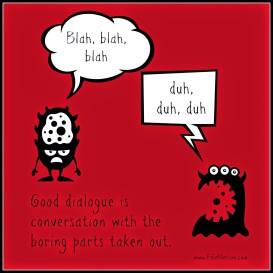
good_dialogueWriting dialogue isn’t as straight forward as it would seem. It was one of the areas I was dinged on when I first submitted my manuscript. According to a literary agent, my dialogue dragged. Basically I wrote out conversations just like real people talk. After taking a few classes and looking at published authors’ work, I did get a grasp of what the literary agent was saying.  My dialogue was weighing the story down and offering unnecessary detail. It caused everything to come to a stop.

Fictional speech is more focused and coherent than real speech. It has a purpose. You can’t just rant and rave about the newest fashion with your friends, unless it’s an integral part of the story that provides information you are going to need later.

It should flow. If you can feel yourself reading, then stopping for a brief conversation, and then reading again, something isn’t quite right.

Conversation works best when combined with thoughts, actions and settings.  Don’t separate them, but interweave them. People don’t stop to talk. They keep doing what they are doing, unless it’s something really important that demands their full attention.

Example:

The day had been crazy, but it wasn’t over yet. Walking into the conference room, Mark  found Ellen sitting at the head of the table preparing packets for their upcoming meeting.

“Sorry I’m late,” he said, walking over to offer assistance.

Handing him a few, she looked him in the eye, anger and disappointment written all over her face. “Isn’t that your norm?”

Mark grasped for something to say that would ease the tension between them and get him through this day. Staring at the packets he was at a loss. What she said was true, and he couldn’t explain why. At least not now.

Easing herself up, she walked by him without saying another word.

“Well that didn’t go well at all,” he said quietly to himself, as he continued to prepare for the meeting. He would attempt to smooth things over with his secretary later, but for now he had a business to save.

By interweaving thought, action, setting, and dialogue, the scene moved forward seamlessly, pulling your reader into the story 🙂

-Jan R


Dialogue Vs. Conversation: They’re Not The Same!

Grammatical Errors Are The Unforgiveable Sin!

imagesWPQO2IDQI was reading How to Write Best-Selling Fiction a little while back, when a chapter jumped out at me, and I couldn’t help but smile. It was totally me. I’m ashamed to admit my naivety, but it was like I was reading my story.

Dean Koontz, the author, tells a story about an unpublished author. He had agreed to look at the man’s manuscript and got a little more than he bargained for. For the purpose of his story, he decided to call the man Bubba.

Bubba was very excited about his work, and said writing was the easiest thing he had ever done. All he had to do was sit down and type. The story just flowed off the top of his head. He wondered why everyone wasn’t doing it.

Well Bubba did give him a manuscript, but it was nowhere near publishable. In fact, according to Koontz, “In the first chapter of that novel, Bubba commits virtually every grammatical error known to English-speaking people.”

Like Bubba, I finished my first novel and was eager to put it out there. It was a great story. I knew I had a best seller. I sent it out to literary agents and waited for my offer. I of course, got a number of rejections. One very gracious agent took the time to review at least a portion of my work, and provided me with a list of reasons why my novel wasn’t ready.

Grammatical and Structural errors were at the top of the list. Dean Koontz calls these the unforgivable sins. New writers may need pointers on pacing, transitions, POV, backstory… but if you’re calling yourself a writer, you should know and follow the basic rules of grammar.

There you go. I’m a sinner, but I have worked hard to redeem myself 🙂

One of the myths that I fell into, was that it didn’t matter if my grammar was perfect or even approaching perfect. The publishers had editors that would go through and correct all of my mistakes. Right? Wrong!!!


-Jan R

Grammatical Errors Are The Unforgiveable Sin!

Don’t Believe Everything You Think!

imagesEX1UP1B8I’m preparing to send my manuscript out to literary agents again. This is the second time it is going out, the first time resulted in rejections, so I have to admit I’m a little apprehensive.

I saw a blog I had written almost a year ago and decided to republish it. It is exactly where I am right now and serves as a reminder to control my inner critic. You know, the one that tells you your work isn’t good enough or ready to be sent out. Most of us writers have one.

No one wants to be humiliated or rejected. Your inner critic will paralyze you by telling you just how bad your work really is (even if it’s not) .  Don’t listen!!! If you’ve gotten this far, you have hopefully addressed all areas that could be in question, and the novel should be pretty doggone close to perfect. If you haven’t done you due diligence and know your work has flaws, fix them before sending it out-common sense right.

I remember doing a Bible study on the battlefield of the mind. Though it’s primary purpose was dealing with spiritual warfare, it also related to many of the issues that we deal with in our everyday lives. Our mind is a battlefield. In writing for example, all of us worry about looking dumb and never getting published. Fiction writers make a business out of being scared, and not just looking dumb.

It took me six months from the time I started writing my novel, to tell my husband what I was doing. When I finally told him, I was a mess. I knew he would be excited for me and encourage me in my endeavor, and I didn’t want to let him down.

For the longest time I treated my novel as a hobby. That’s not a mindset that will get you published. When I finished and sent it out to literary agents, I was more than a little anxious, but the first few rejections confirmed my beliefs. I just wasn’t good enough.

Note that I said, “I wasn’t good enough.” Well that’s not exactly true. The truth is the novel wasn’t good enough. The fact is, it was filled with grammatical and structural errors, there was some serious head hopping going on, and my on-the-nose writing was all but bringing the story to a complete halt.

I don’t know that the inner critic will ever go away. So how do you combat it? You keep moving forward and growing in your craft. Don’t stop writing. I still question my novel, but I know, that I know ,that I know, that it’s a lot better than it was after the unofficial first draft. I’ve learned the hard way and hope you avoid some of my pit falls.

-Jan R

Don’t Believe Everything You Think!

You Don’t Know What You Don’t Know!

CO2wAusWIAAc7Uc.pngEnough already! At least that’s how I feel sometimes. I’ve been through my book more times than I can count. In my own defense, no one taught me how to write. I had a great story idea and decided to give it a whirl.

I thought it was ready, and then real life happened.  My wonderful work was rejected by the five agents I sent it to. One of the them must of seen something promising, she took it upon herself to provide me feedback about what I was doing wrong (there was a long list), and what I needed to do to improve my work.

I was totally humiliated. Grammatical and Structural errors are kindergarten stuff and completely unacceptable. Even I should have gotten those right. I could understand  my issues with head hopping and on-the-nose-writing. Those terms were totally foreign to me.  I wasn’t a professional novelist. I thought all you had to do was put words on paper and create a wonderful story that everyone wanted to read. How was I to know there were rules?

And what was the deal with dragging dialogue? My people were talking. How was I suppose to know dialogue moved the story forward, or had to have some significance?  I couldn’t believe I sent an agent such inferior work!

When you’re a newby, you don’t know how bad your work is, because you lack the knowledge and skills necessary to produce publishable work. While there may be a few prodigies out there, chances are, you aren’t one of them. Sorry!
Like myself and many others, you’re going to have to pay your dues and learn the craft. Then you will be ready to write that New York Times best seller.

One of my favorite saying is, you don’t know what you don’t know. I’m not sure were I picked that up from, but it’s true. I wasn’t intentionally sending out bad work. I just didn’t know.

-Jan R

You Don’t Know What You Don’t Know!

Dialogue Tags: The Good, The Bad, And The Ugly!

images9d0tdr1tAt this point in the game, you probably know what a dialogue tag is. It is a phrase placed at the beginning, middle, or end of a quote, to identify the speaker.

When using dialogue tags, it is  recommended that you keep them simple. There is nothing wrong with the word ‘said’.  Don’t give in to the urge to use every big word you know. The wrong tag can overshadow the words spoken and draw your reader out of the story.

I critiqued a scene for a fellow writer this week and found myself annoyed at her use of tags. Her characters said flatly, said agreeably, said gruffly, said sharply, and said sourly. And if they weren’t saying things with mannerisms, they growled, cried, or added an impatient sigh.

People say things; they don’t wheeze, gasp, sigh, laugh, grunt, snort, reply, retort, exclaim, or declare them.

Josh dropped onto the couch. “I’m beat.”

Not: Josh was exhausted. He dropped onto the couch and exclaimed tiredly, “I’m beat.”

“I hate you,” Samantha said, narrowing her eyes.

Not: “I hate you,” Samantha blurted ferociously.

Sometimes people whisper or shout or mumble, but let your choice of words imply whether they are grumbling, etc. If it’s important that they sigh or laugh, separate the action from the dialogue:

Amy sighed. “It’s going to be a long day,” she said. [Usually you can even drop the attribution she said, if you have described her action first. We know who’s speaking.]

Keep in mind, when you use the words ‘he said’ or ‘she said’, they are so familiar to your reader, that they blur into the background and become invisible. This allows the dialogue itself to come to the forefront. You can also drop tags entirely when it’s clear who’s speaking. Overuse of tags can be just as annoying as using the wrong tag.

-Jan R

Dialogue Tags: The Good, The Bad, And The Ugly!

Grammar Is A Must-But Lose That English Teacher Writing!

English teacherI wasn’t an English major, but I never had an issue with stringing words together and making a coherent, easy to read sentence. I know most of the rules, but I also know those rules are meant to be broken, especially if you are writing fiction.

The purpose of English Teacher grammar is to understand how to create sanitized, standardized, easy to understand, impersonal, inoffensive writing. If you’re looking for a job writing pamphlets for the government, instructional manuals, or news reports, then that’s the way to go.

These rules aren’t meant for fiction. That does not mean your story shouldn’t be grammatically and structurally sound. We are talking about styles here, not mechanics.

Fiction writing is nonstandardized, complex, personal, and occasionally offensive. It is the best way to reach into your readers head and show him your words. In order to bring your voice to life and get your world on the page, you need to say goodbye to English Teacher writing.

Fiction Writing Vs. English Teacher Writing

Fiction Writing-fits the world of the book, the mouths of the characters, and the writer who wrote it. English Teacher Writing– incorporates a specific, caricatured, extreme form of writing without regard to the story’s world, characters, or even the writer and what he or she is like.

Fiction Writing changes with the situation. English Teacher Writing is unchanged.

Fiction Writing does not look to impress, it’s sole purpose is to present the story. English Teacher Writing is self-conscious, self-important, and looks and feels forced and out right silly at times.

Fiction Writing is not always pretty, but it always fits the circumstances, characters, and story. English Teacher Writing is always pretty and always smooth, but rarely fits anything.

Example:

Fiction Writing

“Get away! Don’t touch me! Leave me alone!” The girl in the alley curled into a tighter ball, her scarred, skinny arms pulling her knees up against her chest, her eyes white-rimmed, her hair wild.

English Teacher Writing

“Get away from me! Don’t lay a hand on me! Leave me alone!” The girl in the alley, already in a fetal position, pulled her knees tighter to her chest. she wore an expression of dazed panic, and radiated the signs of post-traumatic stress disorder.

-Jan R

Grammar Is A Must-But Lose That English Teacher Writing!

Distinguish Your Characters With Dialect

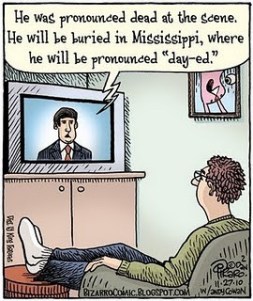
BizarroDay-edDo your characters have their own voice or do they sound the same? I had a critique partner tell me that she couldn’t distinguish characters in my manuscript based on dialogue. They all sounded the same. If I hadn’t provided a dialogue tag, she would have had no idea which character was speaking. She was right.

This was something I definitely had to correct. So I did some research, watched a webinar, and took a class on dialogue. Distinguishing between characters is a lot easier than you would think.

One way to differentiate characters and determine who they are is through dialect.  We can learn a lot about a person based on their accent, grammar, and choice of words.

You don’t have to ask a person if they are from the North or South-just listen to how they speak and note their word choices.  While this is one of the most obvious examples for me, you can also distinguish education level, social status, race, and ethnicity from the way a person speaks.

One thing you want to avoid is coming across offensive or stereotypical(racist).  Look at your word choice or variation of syntax as tools to differentiate your characters and suggest their ethnicity.

Use slang, nonstandard syntax, or grammar to suggest race, social class, education i.e. gonna vs. going to,  kinda vs kind of,  holler vs hollow, don’t matta vs It doesn’t matter. If you have a character from abroad throw in some regional slang ( Scottish say-aye for yes and bairns for children).

The next time you read a book take a close look at your characters and their dialect. You will learn a lot, and the fact that you didn’t even think about it while reading the novel is a plus for the author. It was woven seamlessly into the story.

Creating a characters speech pattern is less about reproducing dialect and more about knowing your character. If your character is……

  • terse                –   short burst of speech
  • angry               –   speaks through clinched teeth
  • nervous           –  stammers or rambles
  • domineering  –  silent and threatening or rages

If you’re writing science fiction you can develop you own language and your own rules. There is no limits. Just be consistent.

Hope this gives you something to think about when writing dialogue. Remember to differentiate using dialect, and the dialect should match your characters position in society. Also remember to be consistent with speech patterns, unless an evolution in speech pattern is an integral part of the story (Flowers for Algernon, My fair lady).

-Jan R


Distinguish Your Characters With Dialect

On The Nose Writing (Repost)

editing-tips-300x230What is on-the-nose writing? It’s prose that mirrors real life without advancing your story. No one chooses to write this way. It has nothing to do with your ability to put together a sentence, paragraph, or scene. Even pros have a hard time with it.

I’m a big fan or Jerry Jenkins and recommend his blog to anyone reading my posts. I have gained so much useful information from him and he writes in a way that anybody can understand. He’s a great teacher.  With this being said, I’m using an example that he gave to help you understand on-the-nose writing.

Paige’s phone chirped, telling her she had a call. She slid her bag off her shoulder, opened it, pulled out her cell, hit the Accept Call button and put it to her ear.       

“This is Paige,” she said.

“Hey, Paige.”

She recognized her fiancé’s voice. “Jim, darling! Hello!”

“Where are you, Babe?”

“Just got to the parking garage.”

“No more problems with the car then?”

“Oh, the guy at the gas station said he thinks it needs a wheel alignment.”

“Good. We still on for tonight?”

“Looking forward to it, Sweetie.”

“Did you hear about Alyson?”

“No, what about her?”

“Cancer.”

“What?”

Here’s a good example of how that scene should be rendered:

Paige’s phone chirped. It was her fiancé, Jim, and he told her something about one of their best friends that made her forget where she was.

“Cancer?” she whispered, barely able to speak. “I didn’t even know Alyson was sick. Did you?”

We don’t need to be told that the chirp told her she had a call, that her phone is in her purse, that her purse is over her shoulder, that she has to open it to get her phone, push a button to take the call, identify herself to the caller, be informed who it is.  I think you’re getting the point.

This is a good example of dragging dialogue as well.  It’s not necessary and adds fluff without any real purpose. Don’t distract with minutia. Give the reader the adventure they signed up for when they chose to purchase your book. Take the reader with Paige when she says:

“I need to call her, Jim. I’ve got to cancel my meeting. And I don’t know about tonight…”

-Jan R

On The Nose Writing (Repost)