Description Overloads/I Get It Already!

untitledI love doing critiques. Sometimes I think I should have been an editor or professional proofreader.

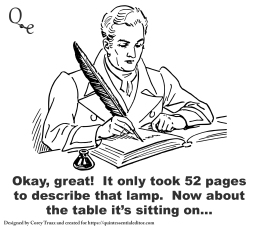
The one issue that bothers me more than any other when I do critiques, is description overloads, dumps, whatever you want to call them. If you are reading this, you know exactly what I’m talking about. I realize some description and imagery are necessary to help the reader visualize the story, but some people provide page after page of it.

I’m a skipper/skimmer. I own up to it and have stated it as fact in many of my blogs. I don’t want to be, and I don’t like the idea of skimming through pages of writing to get to the good stuff. As a matter of fact, if I pick up a book or go to someone’s writing posted for critique and all I see is paragraph after paragraph of description, I’m not touching it.

Jerry Jenkins says it’s a sin to ask a paragraph of description to stand on its own. Your readers eyes glaze over and then they are gone. He’s written nearly 190 books, including the best selling Left Behind series, so I listen when he speaks.

So, what’s the solution? It’s your job to set the scene, but you want to make sure your readers aren’t skimming the descriptions, or worse, skipping them altogether.

You have to make the description part of the action:

Randall wanted only David to know his scheme, so he pulled him away from the others and onto the deck where he had to raise his voice over the pounding waves. He hunched his shoulders against the whipping wind and wished he’d thought to grab a jacket, knowing they wouldn’t be able to stand it out there for long.

In this example we know the setting because it was incorporated into the action. The author did not take a paragraph to discuss the severity of the storm that was causing massive waves and packing winds at 20 miles an hour.  While Randall is whispering his nefarious plan, your reader is skipping nothing.

I wish I could say I’ve mastered this skill, but I have not. It is a technique I continue to work on. A place I aspire to be one day.

-Jan R
Description Overloads/I Get It Already!

I Thought I Knew A Lot, Until I Learned A Little.

Enough already! At least that’s how I feel sometimes. I’ve been through my book more times than I can count. In my own defense, no one taught me how to write. I had a great story idea and decided to give it a whirl.

I thought it was ready, and then real life happened.  My wonderful work was rejected by the five agents I sent it to. One of the them must of seen something promising, she took it upon herself to provide me feedback about what I was doing wrong (there was a long list), and what I needed to do to improve my work.

I was totally humiliated. Grammatical and Structural errors are kindergarten stuff and completely unacceptable. Even I should have gotten those right. I could understand  my issues with head hopping and on-the-nose-writing. Those terms were totally foreign to me.  I wasn’t a professional novelist. I thought all you had to do was put words on paper and create a wonderful story that everyone wanted to read. How was I to know there were rules?

And what was the deal with dragging dialogue? My people were talking. How was I suppose to know dialogue moved the story forward, or had to have some significance?  I couldn’t believe I sent an agent such inferior work!

When you’re a newby, you don’t know how bad your work is, because you lack the knowledge and skills necessary to produce publishable work. While there may be a few prodigies out there, chances are, you aren’t one of them. Sorry!
Like myself and many others, you’re going to have to pay your dues and learn the craft. Then you will be ready to write that New York Times best seller.

One of my favorite saying is, you don’t know what you don’t know. I’m not sure were I picked that up from, but it’s true. I wasn’t intentionally sending out bad work. I just didn’t know.

I Thought I Knew A Lot, Until I Learned A Little.

How Long Do You Wait?

7

I recently picked up a novel I had worked on for six years. I can’t count the number of revisions I completed on the manuscript. Yet nothing seemed to help. I got discouraged and put it away.

My life had gotten pretty complicated during that time, so I used it as an excuse.  As the weeks went on, I found it easier and easier to let it go. I did  not want to pull that manuscript out. It was a mess and a waste of my time. That’s how I felt anyway.

I didn’t stop writing. I picked up a new project. I had an idea for another novel and began to flesh it out. I also continued reading books written by successful novelists and took some more on-line classes. From my perspective, that first book had a great premise (a fact confirmed by one of the agents who rejected my work), but I just couldn’t see what was going on that made it unpublishable.

So as I stated at the opening, I picked up that novel I had placed on the shelf a year ago and started cutting. I was looking at that work through fresh eyes, and enjoyed muddling through the mess and reorganizing my work.

Most of the blogs I read recommended setting a finished piece of work to the side for a few weeks or a few months, based on the premise it would give you a fresher look at your work and allow you to see those areas that were problematic.

Well, that didn’t work for me. I followed the recommendations, but a few months wasn’t long enough. I know everyone is different, and a more experienced writer may only need a few weeks to a few months before they are ready to roll again. So I am in no way saying you should put your work to the side for a year.

What I am saying, is if you have that masterpiece that started your dream sitting on a shelf, or stored in a remote area of your computer, maybe you should consider pulling it out and reassessing. You may be pleasantly surprised at how quickly the issues that caused that manuscript to fail come to light.

So how long do you put a completed manuscript to the side before the final edit?

Just something to think about.

-Jan R


How Long Do You Wait?

Antagonist-Friend or Foe (Revisited)

1-darth-vadar-skull

My main focus for this particular blog is antagonists. I have two in my novel. One is amnesia, and the other is a young woman determined to marry the man of her dreams, even if he belongs to someone else. She uses his amnesia to her advantage, manipulating and deceiving him.

When you are creating antagonists, you must remember they are people too. Help your reader to empathize with them and understand why they act the way they do. Even bad people have weaknesses and can show love towards others. They are more than just a device to move your plot in a certain direction. Flesh them out!

Get into your antagonists head. Help people to see things from his/her point of view if possible. I write in third person omniscient, which allows me to get into the head of any character I choose, as long as I limit myself to one per scene. If this doesn’t work for you, have your point of view characters mull over and try to understand the antagonist’s point of view. You don’t want him/her to be seen as pure evil.

I have to admit, I’m a ‘Star Wars’ geek. If you’re a follower, you know who Darth Vader is. From my perspective, he is the perfect antagonist. The creator of this series, put a lot of thought into this bad guy. He is pure evil, but as Luke stated, “There is good in you, I can feel it.” Luke was right. Vader wasn’t all evil, as a matter of fact, he started out as a good guy. His motivation for turning to the dark side, was to save his wife.

You want your antagonists to be strong, smart, and capable. At least as much so as your protagonist. This serves to give the story balance and maintain interest.  It also helps to increase tension and suspense. You know the antagonist is capable of defeating the protagonist. The story could go in many different directions.

Back to the ‘Star Wars saga, Darth Vader was  the most powerful of all the Jedi, even though he turned to the dark side and fell under the control of the Sith Lord. His downfall in the end wasn’t his lack of strength, but his return to the light.  He sacrificed himself to save his son. In a split second decision, he destroyed the empire and brought balance to the universe.

Many professionals recommended that you not use abstractions, such as corporations, disease, or war as your antagonists. They are unrelatable, but that’s a blog for another day.

If you do feel the need to use an abstraction, put a human face to it.  Instead of organized religion, you may consider a resentful pastor seeking revenge. Instead of corporate greed, you may consider a Bernie Madoff type. One of my antagonists is a medical condition that a second antagonist exploits to get what she wants.

Hope this post provided a couple nuggets and got you thinking 🙂

-Jan R

Antagonist-Friend or Foe (Revisited)

Friends Don’t Let Friends Use Filler Words!

imagesW5P4TYLKI’ve been a little busy the last few months and have revisited some of my favorite posts. I hope you enjoy this one. Most of the concepts I write about are simple. I just never really gave them a lot of thought before I started writing my novel.

When writing, remember less is more. Stay away from qualifiers. They weaken your prose, and the result is the exact opposite of what your were trying to achieve. I know why you use them. I’m hooked on ‘very’. Other people are hooked on the word ‘too’. If you are resorting to qualifiers for emphasis, odds are, you are using the wrong word in the first place.

These qualifiers are the words your English teacher dreaded seeing, such as very, too, really, and sort of. When you overuse these words, your writing will seem lazy, as if you haven’t taken the time to look for the right word.

This pasta dish is very good.
This pasta dish is superb. (Better)
I’m feeling sort of sick.
I’m feeling nauseous. (Better)
You look really nice!
You look radiant. (Better)

Since ‘very’ is my nemesis, I thought I would provide a list of more powerful words to use to replace ‘very’ ___________.

  • very fast                    quick
  • very dry                    parched
  • very dirty                  squalid
  • very afraid               terrified
  • very angry                furious
  • very hot                    scolding
  • very hungry             ravenous
  • very large                 colossal
  • very clean                spotless
  • very clever              brilliant
  • very beautiful        exquisite
  • very ugly                 hideous
  • very pretty             beautiful
  • very thin                 gaunt
  • very tired               exhausted

I think you get the picture. Thanks for stopping by, and I hope this got you thinking.

-Jan R

Friends Don’t Let Friends Use Filler Words!

Don’t Make Your Reader Wade Through The Mud!

d63d56ca3a55bcf3abe7ed97f24b4eb0I picked up my first completed manuscript yesterday. It had been hibernating in my computer for almost a year. It’s a beautiful story, but for some reason wasn’t getting any traction. I have to admit, I was a bit discouraged. Something all writers go through at some point.

So I have to decide if the story is worth my time, or if I should put it on a shelf and move forward. I’m not a quitter. In all fairness, I can be pretty stubborn. That square peg will fit in the round hole if I push hard enough 🙂

The first thing I did was delete the first two chapters. I know that sounds pretty radical, but I decided to take my own advice. I’ve spent the last six years learning how to write a publishable novel. When I started writing this manuscript, I knew nothing, except I had a great story.

The first few chapters are hum drum everyday life stuff. I wanted my reader to have a little backstory, so when they got to the action, they would have a better understanding of what was going on and why my characters were acting the way they were.

According to Jerry Jenkins and other published authors, beginning with boring is not the way to go. As a matter of fact, it flags you as an amateur. You sprinkle those little details in as you go. I’ve known this for a while, but ignored their wisdom.

I thought the story was so good people would wade through the mud to get to the other side. Problem-people are not going to wade through the mud. They will never know how good your story is if you don’t get their attention from the get go. Solution-make sure the good stuff is up front and pepper the boring, but necessary details in when you can.

Just something to think about.

-Jan R


Don’t Make Your Reader Wade Through The Mud!

What’s Your Character’s Core Desire?

800x800-the-desire-map-ombre-on-white_4How well do you know your main character? Do you know his/her deepest longing? If your answer is no, you need to stop and take a closer look at your character arc. What is motivating your character? If you can identify that, you know their core desire.

Does he/she want to be loved or save the world? Does he/she want to be respected or rich? Whatever the desire, it has to be something your reader can relate to.

Your character may have more than one desire. I know most of us do, but our minor desires usually lead us to our core desire. That one thing that we really want more than anything.

A great example I read described a young girl who was abused by her father. As you probably guessed, her core desire was to be loved by him, or maybe you thought to get even. Not sure how your mind works 🙂 At any rate, the only thing he seemed to be interested in was astronauts and space exploration. So the young girl set her sights on becoming an astronaut. Now she may have found her studies fascinating and developed an interest in space along the way, but her goal was to earn her father’s respect and love by becoming the one thing that piqued his interest.

After you’ve identified your main character’s core desire and put him/her on the path of achieving it, the fun begins. What can be thrown in to threaten his/her core desire? What can throw him/her off, and how can it be fixed?

You have to know your character’s core desire. It helps you understand what kind of things he/she will seek in life, and what kind of things can mess his/her life up.

Something to think about.

-Jan R


What’s Your Character’s Core Desire?

Word Echo?

imagesB1G33MWEWord Echo? I’m sure you have an idea of what it is, even if you haven’t heard the term before. It’s the use of the same word in close proximity or in the same sentence.

It’s considered ugly and inelegant. Don’t do it! The good news is, it’s probably one of the easiest mistakes to correct.

Just delete one of the repeated words, if you can do so without changing the meaning of the sentence. If that doesn’t work, you’ll simply have to replace the duplicate with a new one.

That can be a little tricky. You have permission to pull out the thesaurus, just don’t get carried away, and consider the word you’re using as a replacement.

Example:

Angrily– bitterly, impetuously, tempestuously, threateningly, fiercely, furiously, violently, infuriatedly, tigerishly (I didn’t make this one up)……

I just took a sample off of a thesaurus website. Many of the words listed are the same but different. They range from slight difference in meaning to utterly ridiculous.

Footnote: It’s okay to repeat if you’re writing poems, songs, or emphasizing a point. After I finished this blog, I thought about Martin Luther King Jr’s I Have A Dream speech. His repeats were intentional and poetic.

Just something to think about.

-Jan R


Word Echo?

Setting The Scene

Dynamite-Scene-3-D-BookAnybody that has read my work knows that most of my blogs spin off of my own weaknesses. And there are many. I figure if I’m having problems with a certain aspect of writing, there are probably many others who are too.

So today I thought I would focus on writing scenes. As you may have guessed, I was shredded to pieces  in a critique, and rightfully so.

I presented a 3000 word excerpt from my novel for review, I did say 3000 words, and a friendly critic (she really was nice), pointed out that I had managed to squeeze 10 different locations/scenes into those 3000 words. It was overwhelming, and the scenes were like flybys.

I have a very complicated novel, with many twists and turns, which could be a good thing. But, in my haste to get through them all, I failed to provide a cohesive story, and many of my scenes were lacking.

So how did I correct my mistakes? I put together a scene and a sequel. They work together to form one cohesive scene. A scene leads naturally to a sequel. At some point, you will end the cycle. The POV character will either succeed or fail. I would opt for succeed:-)

Scenes are as follows:

  1. Goal- What the POV person wants at the beginning of the scene. It must be specific and clearly definable.
  2. Conflict- The series of obstacles your POV character faces on the way to reaching their Goal.  There has to be conflict or your reader will be bored.
  3. Disaster- Is a failure of you POV person to reach his goal. This is a good thing in writing. Hold off on success until the very end. If you allow your POV to reach his goal to early, then your reader has no reason to go on.

***All three of these are critical to make the scene successful.***

Sequels are as follows:

  1. Reactions- Is there emotional follow through to a disaster. Show your POV acting viscerally to his disaster, but remember he can’t stay there. He has to get a grip.
  2. Dilemma- A situation with no good options. A real dilemma gives your reader a chance to worry. That’s good, you want them emotionally involved. At the end let your POV choose the least of the bad options.
  3. Decision- Your POV has to make a choice. This lets your POV become proactive again. People who never make decisions are boring.

Hope this helped. I pulled most of my information off of the ‘advancedfictionwriting’ web site, that’s hosted by Randy Ingermanson-“the snowflake Guy”.  He provides some great information for writers of all levels. You should check him out.

Something to think about.

-Jan R

Setting The Scene

Be Consistent!

120822_consistency-is-key_500_youanew1-300x300Have you ever heard someone refer to writing as elegant. It’s orderly and graceful. It flows.

By adding elegance to your writing, you can turn clear, precise, but clunky prose into a musical composition.

Elegance gives your writing a tangible feeling of beauty. It makes people say wow. Elegance isn’t just the wording, but the way it is presented.

Is your style disciplined and orderly, or is it inconsistent? Presentation elegance requires consistency from the beginning of your novel to the end.

When you use dashes, do you leave spaces between the words or not?

  •  second-handed
  • second – handed

When you write titles of books, do you italicize or enclose using quotation marks?

  • Little Women
  • “Little Women”
  • ‘Little Women’

Do you use the oxford comma to separate the last item in a list?

  • She brought apples, bananas, and grapes to the picnic.
  • She brought apples, bananas and grapes to the picnic.

When you use numbers, do you spell them out using letters or simply write them out?

  • twenty-seven
  • 27

When you abbreviate countries, do you use periods following the letters or leave them out?

  • U.K. vs UK
  • U.S. vs US

I think you’re getting the picture. None of the above examples are wrong. Just remember, however you decide to express yourself in writing, be consistent.

Something to think about.

-Jan R

Be Consistent!