Edit, Edit or Edit?

Well that is true, but it’s only one type of editing, and there are three different types listed in the article. The article also noted that a novel length manuscript needed to go through all three types before it was submission ready.

Developmental Edit – better known as the content editing, story editing, structural editing or substantive editing. This edit looks at the big picture of your novel and focuses on

  • character arcs/development
  • pacing
  • story structure
  • pot holes or inconsistencies
  • strong beginning, middle and end
  • plausibility/believability
  • clear transitions
  • point of view
  • showing vs. telling
  • dialogue

Copy Edit – copy editing is the one most of us think of when we hear editor. He comes on the scene after the developmental editor and cleans things up. He is the one who does the line by line with a focus on

  • grammar
  • punctuation
  • spelling
  • redundant words
  • inconsistencies/continuity errors
  • awkward sentence structure

The proofread- I never thought of a proofreader as an editor, but in all reality he is. The proofreader checks your manuscript for lingering errors, missed commas, and typos. It may be tempting to skip this step or do it yourself. Keep in mind, you’ve read the book so many times you will be blind to many lingering errors. You need an unfamiliar eye.

I thought this was an interesting article. I’m not sure where you are in the writing process, but you do need to know  the proper steps to take before submitting your work. Remember as stated above you don’t see the errors. You are so familiar with your work the errors become invisible. Your brain actually fills in the holes as you read.

I didn’t have this information and submitted my work to several different agencies after I ‘edited’ it and had a few friends read through it. Needless to say I got nothing but rejections. I followed up on suggestions, and that’s when I realized just how bad the manuscript was. I couldn’t believe I sent such shoddy work to an agent. I was embarrassed and glad I hadn’t met them in person.

Hope this helped!

-Jan R

Edit, Edit or Edit?

It’s Your Story (Revised)

I was sitting on my couch reworking a scene in the novel I’m writing when I stopped right in the middle of it. What am I doing? I asked myself. The purpose of the rewrite was to make some changes based on a critique I received earlier in the week.

The person that critiqued my book is very good at the craft, and I respect  her opinion. There were others who critiqued the piece and loved it, offering a few comments here and there to correct grammar or replace a word. So who was right? The three people who loved it, or the one who thought I needed to go back and make some significant changes.

The more I thought about the changes this person suggested,  and there have been quite a few throughout the time period I’ve posted my work, the more I realized she had her own idea of the way my story needed to go, and I had mine.

With this being said, she’s made some great suggestions. Because of her my story is more believable,  my dialogue more natural, and my POV more consistent. Her critiques have been invaluable.

However, I had to remind myself that this is my story. Nobody has a better understanding of the dynamics than I do. Nobody knows it from beginning to end but me. Nobody can tell it better than me.

Weigh comments and suggestions you receive from others and ask this question. Is it making my story better or changing it into something it is not? Remember: It’s your story.

I’m a Merry Christmas kind of person, but I know not all of my readers celebrate the holidays as I do. However you celebrate, I pray you have a wonderful holiday season. Be safe and thank you for stopping by!

-Jan R

It’s Your Story (Revised)

What’s In Your Toolbox?

tools-for-insights-into-your-display-advertising-compete-pulse-kwccu6-clipartSo as a writer I find myself relying on numerous sources for information. I need to know how to write a cohesive, well written sentence, but I also need facts, and I need to know what to look out for. We all make errors when writing and goodness knows I will never be perfect, but I do have some reference sites I use to make my writing better.

I thought I would share those with you and ask that you share sites that have been helpful to you as you navigate the world of writing fiction.

I’m not going to include a dictionary or thesaurus in my list, as I feel they are a given. I would recommend if  you have access to a smartphone to ask Siri for spelling, definitions and synonyms. She can find the information and give it to you in a matter of seconds. I keep her next to me while I write.

Other tools that I use include:

  • Emotion Thesaurus – Look up the emotion you are trying to express and you get a list of actions, facial expressions, and sounds commonly associated with the emotion. Example:  Shock/Surprise-  small gasp, heavy feel in the stomach, reaching hand up to lightly clasp throat, flayed hands across chest, a shaky voice-soft-halting-unbelieving.

I found a free emotion thesaurus online but was unable to locate more than excerpts while writing this blog. They aren’t expensive and can be purchased on line and saved to your laptop for easy access.

  • grammar.about.com-200 common redundancies – is another great site for writers. I was amazed at how often I added redundancies to my writing. Examples: (brief) moment, circulate (around), (current) incumbent, disappear (from sight)-I think you get the gist.

You can find this one online for free. It gives an extensive list and gets you to think about what you are writing. Are you using redundant words?

  • worldatlas.com – get the facts about the countries your characters are moving through. You want to pull your readers in and make the settings believable. The world atlas provides information such as weather, language, currency, time zones, religious beliefs.

My main character spends a brief period of time in Afghanistan. The world atlas along with other research, provided information I needed to make that chapter believable.

  • wsu.edu/brians/errors/errors.html- is another great site that provides common errors made in English writing.

Hope these sites are helpful to you. I have visited and used them all. The only caution I would give is with the ‘world atlas’ site. I get a lot of pop-ups and advertisements while navigating through for information. I’m not sure if it’s just my computer or if it’s common to this site.

-Jan R


What’s In Your Toolbox?

Thesaurus-Friend or Foe?

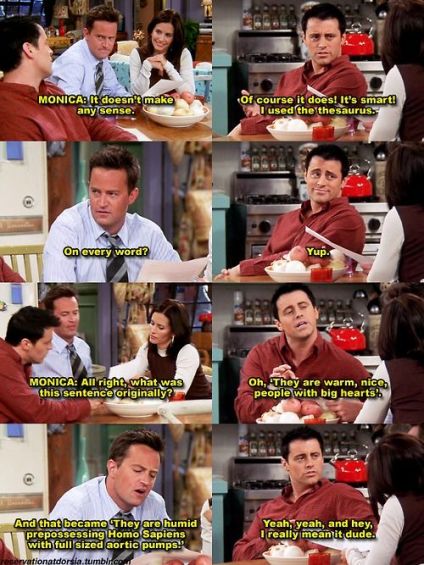
6207da0c9e08fd20a96cc7bf70033c98I’ve read over and over that the thesaurus is a ferocious enemy of the novice writer. As a new writer, we want to impress others with our command of the English language. Often times to the detriment of ourselves.

Do you use the Thesaurus for bigger better words to make yourself look smarter and more professional? STOP!

Not all synonyms are created equal-just because the thesaurus says a word is a synonym doesn’t mean it’s the exact counterpart. Some words when replaced with a synonym no longer mean the same.

Stop peppering your writing with ‘big words’-using ‘big words’ can make your writing sound fake. No normal person uses those words. Get real.

Embrace your vocabulary as it is-this will help you develop your voice and sounds authentic.

We are not walking dictionaries or thesauri but having a large vocabulary is definitely helpful which is why extensive reading is a prerequisite for a writer.

I use my thesaurus but not to replace my words with ‘big’ more impressive ones. Keep in mind, if you don’t know what a word means, your reader may not either. I find it very annoying when I’m reading a novel and run across a million dollar word that I have never heard before. I find myself reading the sentence over and over, trying to figure out the gist of the meaning through the words surrounding it. If this doesn’t work, I usually suck it up and move on. But give me too many of these words and I will probably put your book down and avoid your books in the future. You are writing over my head.

I use the thesaurus when I realize I’ve used the same word twice in close proximity, or when I’m looking for a way to say something a little bit differently. An example would be a replacement for the word ‘angry’. Some synonyms would be: annoyed, bitter, enraged, exasperated, furious, irate…I know and use all of these words but when writing sometime I have a mental block. The thesaurus helps me find the words I can’t quite put my finger on.

Remember, big words don’t mean big emotions. Good writing is choosing the right word for the situation-Hemingway

-Jan R

Thesaurus-Friend or Foe?

Fiction Writing Vs. English Teacher Writing

images-2I wasn’t an English major, but I’ve never had an issue with stringing words together and making a coherent, easy to read sentence. I know most of the rules, but I also know those rules are meant to be broken, especially if you are writing fiction.

The purpose of English Teacher grammar is to understand how to create sanitized, standardized, easy to understand, impersonal, inoffensive writing. If you’re looking for a job writing pamphlets for the government, instructional manuals, or news reports, then that’s the way to go.

These rules aren’t meant for fiction. That does not mean your story shouldn’t be grammatically and structurally sound. We are talking about styles here, not mechanics.

Fiction writing is nonstandardized, complex, personal, and occasionally offensive. It is the best way to reach into your readers head and show him your words. In order to bring your voice to life and get your world on the page, you need to say goodbye to English Teacher writing.

Fiction Writing Vs. English Teacher Writing

Fiction Writing-fits the world of the book, the mouths of the characters, and the writer who wrote it. English Teacher Writing– incorporates a specific, caricatured, extreme form of writing without regard to the story’s world, characters, or even the writer and what he or she is like.

Fiction Writing changes with the situation. English Teacher Writing is unchanged.

Fiction Writing does not look to impress, it’s sole purpose is to present the story. English Teacher Writing is self-conscious, self-important, and looks and feels forced and out right silly at times.

Fiction Writing is not always pretty, but it always fits the circumstances, characters, and story. English Teacher Writing is always pretty and always smooth but rarely fits anything.

Example:

Fiction Writing

“Get away! Don’t touch me! Leave me alone!” The girl in the alley curled into a tighter ball, her scarred, skinny arms pulling her knees up against her chest, her eyes white-rimmed, her hair wild.

English Teacher Writing

“Get away from me! Don’t lay a hand on me! Leave me alone!” The girl in the alley, already in a fetal position, pulled her knees tighter to her chest. she wore an expression of dazed panic, and radiated the signs of post-traumatic stress disorder.

-Jan R


Fiction Writing Vs. English Teacher Writing

Plot Holes?

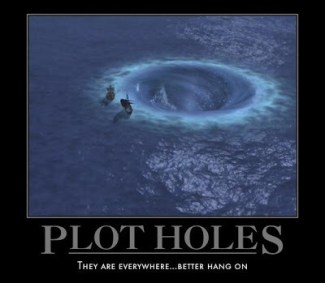
plot-holesI’m revising my manuscript soon and one of the things I’ll be looking for is plot holes. Does your plot have missing or broken parts?

I know  I have missing parts and jumps in action before I even go through it. I had the entire manuscript critiqued through a group at Scribophile and there were times critique partners would point out areas where I jumped from one idea to another without providing a bridge.

When you are writing, you know what’s happening and you may not question why Suzie is talking to Jeff about needing a job in one paragraph and working for him in the next. I’m not saying you need every little step in order for your reader to follow what’s going on. I’m sure most people don’t want to know she woke up, took a shower, put on her favorite dress, ate some Cheerios and brushed her teeth with Crest toothpaste before walking out the door to go to work, but if Jeff gave her a job, I think that’s pretty darn important. This is a missing plot piece.

Your readers will do a double take and have to try to resolve the inconsistency for themselves without the knowledge of how the scene was suppose to go. All it will take is a few of these before your readers are calling you names and tossing your work to the side.

When you read through your manuscript, look for areas where something important has happened and your reader didn’t see it. Try to put yourself in their shoes and see the story through their eyes. They don’t have access to your brain and thoughts, so they can’t fill in the missing holes.

I talked about plot holes in this blog but there are also broken plots, which can be quite amusing. I plan to address them in my Thursday blog.

-Jan R

Plot Holes?

Cut? Or Not To Cut?(Revised)

imagesSo I’ve been married to my novel for five years. I’ve made some changes along the way, but one thing that has been a constant, is my main character going to Fallujah Iraq.

Anybody that’s been around for a while, knows that Fallujah played a big role in the Iraq War. Camp Baharia was set up just outside the city. It was one of the nicer camps, and the playground of Sudam Husseins son’s, prior to their demise.

Well, when I wrote the framework of my novel five years ago, it was set at the end of the war .  Fallujah had been won by the allies, and our marines were still there to maintain order, and ensure no further uprisings. That was the reason my main character had been sent there.

Since that time, Fallujah has been taken over by Isis and there is major fighting going on, as the Iraqi forces, along with the US and other allies, attempt to take it back.

It was the perfect setting when I started my novel, but it has evolved into the exact opposite of what I intended it to be. When people read Fallujah today, they don’t think about five years ago; they think about here and now and all of the turmoil in the region.

With that being said, my husband encouraged me a year ago to rethink Fallujah. He thought the current conflicts and notoriety of the region would cause serious doubts and credibility issues with my story.  Well I didn’t want to listen to him, Fallujah was in my story, it had been there all along, and I didn’t want to change it.

Not to long ago I received a critique from a very skilled writer. Her main problem with the story, as you probably guessed already, was Fallujah, Iraq.

My husband loved that, and gave me the told you so look. I wish I could say he rose above it and didn’t say anything, but he quickly reminded me that he wasn’t a dummy. He knew what he was talking about:-)

One of the things I’ve heard time and time again from experienced writers, is sometimes you have to throw the baby out. That’s part of writing, but it doesn’t make it any easier.

So I’m throwing the baby out and looking for another Camp, maybe in Afghanistan.

If you’re on the fence, just do it. The sooner you let go and move on, the sooner you’ll get that novel completed. You might miss your baby for a while, but I’m thinking you’ll get over it, especially when your story comes together the way it was meant to be.

-Jan R

Cut? Or Not To Cut?(Revised)

Description is Icing on the Cake

ccf_lindasfudgecakeI’m not very good at writing description and have a tendency to avoid it. This is reflected in critiques that I receive on my work. ‘You need to help me picture the setting in my mind. Where is your MC? It’s like looking at a blank canvas. There’s nothing there’.

You may be like me or you may be on the opposite side of the spectrum. I have critiqued some beautifully ridiculous descriptives. I’m sure many of you know what I’m talking about. Imagine your reader picking up a book at the bookstore and reading page after page of description on the gowns at a regency ball or the inner hull of a slave ship. They, like me, would probably put it down immediately.

Think of bad description as that one teacher you had in high school who went on and on putting the class to sleep. Good description is more like the teacher that got everybody involved in the action. She provided the information we needed but didn’t bog us down with a lot of fluff.

Avoid Huge Lumps of Description

In the past, Authors could get away with this but in today’s society, unless a reader was actively seeking out writers known for lyrical descriptive passages, they wouldn’t put up with it. That doesn’t mean there aren’t a few who get away with it, but it’s only because they are really good, and in all reality, many of their fans are skimming those passages.

Make Description an Active Part of Your Story

You must find a way to use description in combination with action . Descriptions that come out of nowhere and do nothing but describe, are known as ‘narrative lumps’. A great example I read during this research is as follows:

Zara grabbed her mug and gulped it down, shivering when a few drops of the ale trickled under her leather top. I didn’t have to say….The ale was cold or She wore a leather top. That information was provided in the action sequence.

Describe what your Characters Would Notice

Remember you are seeing the world through the eyes of your main character. If that character works and goes to the same office everyday, they aren’t going to stare at the craftsmanship and detail of the bookshelf housing a  wall of books in the office library. They see it everyday, but they are going to notice if a substantial number of volumes were removed. They aren’t going to look around their office and go on and on about the lavishly decorated room-unless they just had it up fitted. They will notice  a vase of red roses sitting on their desk.

Words, Words, Words

Use Strong, active, concrete words. The stronger the writing the better the description. Remember, nouns and verbs are your friends. Adjectives and adverbs can be your friends, depending on how you use them.

Avoid adjectivitis. I wish I could claim this word, but again I read it during my research. Adjectivitis is when you use to many adjectives to describe something. The rule of thumb is no more than two.

And you also want to limit your trips to the thesaurus. I know what it’s like to try to come up with different words, to avoid overuse. But when I have to stop reading a prose to look up the word the author has written, or I stumble over a  rarely used word, chances are, that author took one to many trips to the thesaurus.

Use all the senses

Most writers concentrate on sight and sound but you can really bring a scene to life by incorporating the other senses. Don’t forget about touch, smell and taste.

Fit the Description to the Type of Story

Fast paced action novels will have less descriptive as you are trying to get your main character from point A to point B in a hurry. Slower paced novels may take the opportunity to smell the roses, but be mindful of how long they are smelling them.

Avoid Excessive Name-dropping

It’s all right to use brand names in your story. But there are a few basic rules: Get the name right and do not portray the product in a disparaging light. Do not say your main character got food poisoning from the Golden Corral. (Go to the Publishing Law Center website for more information)

You don’t want to go overboard with brand names, but it is a  way to provide your reader with a good concrete description. When you say Chevy Silverado-people know instantly and can picture it in their minds.

Don’t Let Description Hang You Up During a First Draft

Remember you can always go back and add it later. When I started writing my novel, I had a great plot idea and my characters sketched out in my head. I put pencil to paper and wrote until completion.

As a matter of fact, that is were I am, and why I am writing this article. I have completed my first draft and am now beginning the process of icing my cake.

I hope this review on description helps you as much as it helped me.

-Jan R
Description is Icing on the Cake

Writer or Author-You Decide

Authors who are published take the craft of writing seriously.  They understand the work involved to prepare your manuscript and aren’t afraid to roll up their sleeves and dive in. So what do they do?

They read countless stories and analyze what’s going on in them to make them successful. When they read, they  ask themselves the following questions.

  • How does the author make me want to turn the page?images-8
  • Why am I drawn to the lead character?
  • What makes the scene work?
  • What’s the key conflict?
  • How does the author handle dialogue?
  • How does the author integrate minor characters?
  • How’s the pace, can you feel the tension building?

Authors also read books on writing, take classes, and apply what they have learned. They have people give them feedback-editors, critique groups(Scribophile, Writers.com), trusted and objective friends. They work at becoming better writers.

You will never get where you need to be to publish that first novel, if you don’t learn your craft. Like any other job, writing requires work. You don’t wake up one day  and you’re an author, just like you don’t wake up one day a brain surgeon.  Just because you want it to be doesn’t make it so. Pay your due diligence and learn the craft. It will save you so much time and heartache in the long run.

Being the novice with a really good idea, I thought all I had to do was write my story down on paper. I knew how to string sentences together.  I did a minimal amount of research, and got a mediocre story set up for rejection.  The responses I got from the literary agents shocked me and hurt my feelings. I didn’t realize how bad the work was at the time, because I didn’t know any better, and I obviously didn’t take the time to learn the rules. Yes there are rules! Hard fast rules! I broke every one of them.

One of my rejections letters was from an agent who I’m sure knew I was new at this writing thing, and she took the time to point out the major issues with my work. “It’s just not ready. You have a really good premise, but it is riddled with grammatical and structural errors. You are head hopping,  and your dialogue is dragging.”

What was I suppose to do with that? I didn’t even know what head hopping was, and I understood dialogue, but I never knew it could drag. If I had researched and taken the time to learn the proper way to write a novel, I would have known exactly what she was talking about.

The question you need to ask yourself: Do I want to just write or do I want to be published?


-Jan R

Writer or Author-You Decide

Are Readers Skipping Crucial Parts Of Your Story?

images-11I love doing critiques. Sometimes I think I should have been an editor or professional proofreader.

The one issue that bothers me more than any other, when I do critiques, is descriptive overloads, dumps, what ever you want to call them. If you are reading this, you know exactly what I’m talking about. I realize some description and imagery are necessary to help the reader visualize the story, but some people provide page after page of it.

I’m a skipper/skimmer. I own up to it and have stated it as fact in many of my blogs. I don’t want to be and don’t like the idea of skimming through pages of writing to get to the good stuff. As a matter of fact, if I pick up a book or go to someone’s writing posted for critique and all I see is paragraph after para graph of descriptive, I’m not touching it.

Jerry Jenkins says it’s a sin to ask a paragraph of description to stand on its own. Your readers eyes glaze over and then they are gone. He’s written nearly 190 books, so I listen when he speaks.

So, what’s the solution? It’s your job to set the scene, but you want to make sure your readers aren’t skimming the descriptives, or worse, skipping them altogether.

You have to make the description part of the action:

Randall wanted only David to know his scheme, so he pulled him away from the others and onto the deck where he had to raise his voice over the pounding waves. He hunched his shoulders against the whipping wind and wished he’d thought to grab a jacket, knowing they wouldn’t be able to stand it out there for long.

In this example we know the setting because it was incorporated into the action. The author did not take a paragraph to discuss the severity of the storm that was causing massive waves and packing winds at 20 miles an hour.  While Randall is whispering his nefarious plan, your reader is skipping nothing.

I wish I could say I’ve mastered this skill, but I have not. It is a technique I continue to work on. A place I aspire to be one day.

-Jan R


Are Readers Skipping Crucial Parts Of Your Story?