
-Jan R
-Jan R
 I know that title sounds crazy, but it can actually happen. Once you start writing that best-seller, you’re going to have some characters that arise and try to take you in a direction you hadn’t planned on going. Your novel and characters take on a life of there own.
If you are to have any chance as a writer, you must embrace the plot. Consider your plot as the skeleton of the novel. It’s the bare bones that keep everything from collapsing.
You must maintain control. Don’t give your plot over to a character who would gladly pick it up and carry it into directions you never intended to go.
Fictional characters can become so vivid, so alive, that you find yourself altering the plot to accommodate their growth and the direction they want to go.
I got caught up in the excitement of following one of my characters through a storyline that I didn’t write. It was as if the novel was writing itself. The problem was, it was veering from my original intent and messing up my plot.
Most authors will tell you that allowing your characters that much freedom is disastrous. That doesn’t mean you can’t allow some revisions to your plot to accommodate growth. It does mean you don’t alter your entire storyline at the urging of a character that has no idea where you are going with your story.
Something to think about.
-Jan R
 Like many of you, I am having problems concentrating on my writing endeavors during this Covid 19 crisis.
I don’t know that it’s anxiety. I don’t think so. Maybe it’s more like nervous energy. I just can’t seem to concentrate or focus.
One thing I have been able to do is read. I’ve pulled out my favorite books and started reading a lot.
What is it about these books that draw me to them? What skills is the author using that have not only grabbed my attention, but pulled me back into the story again and again?
I need to acquire these skills if I’m going to be successful at my craft.
Can’t write? Read!
Something to think about.
-Jan R

Something to think about.
-Jan R
 I have a prologue in one of my works in progress, but I have questioned if I should keep it or not, and at one time deleted it. Why, because like many of you, I ‘ve heard that prologues are out. Most agents hate them.
I’m still contemplating if I should keep the prologue in my story or not. It raises questions, conveys some sense of mystery, and launches the reader into the story in a compelling way. I think it adds to the story and provides need-to-know information.
Prologues aren’t all bad. They can help or hinder your book, according to Ryan G. Van Cleave, Writer’s Digest.
Good Prologues
Bad Prologues
So what’s the answer? Do we or do we not use Prologues? There isn’t a one size fits all to this question. The choice must be made on an individual basis using the best sense of what makes your story work. With that in mind, most professionals would say leave it out.
Maybe the best solution, and the one I’m working on, is to incorporate my prologue into the story by making it Chapter One.
Something to think about.
-Jan R

Something to think about.
-Jan R
 I read a comment I received on a post yesterday and I have to admit it really rattled me. The individual who posted the comment was brash and unpleasant, however, I understood where he was coming from and chose to give him the benefit of the doubt. The post was on rules for writing a successful piece of work.
I didn’t actually write the post, but I agreed with the person who wrote it. He is a successful author and many of his statements I have read numerous times over the years from other successful authors.
So what was the problem? The person who read my post took everything literal. He saw everything black and white. There were no shades of gray.
That got me thinking about my posts and new writers. When you research and step out to learn a new skill, you are going to find a lot of good advice, but you have to look at how it applies to what you are writing.
There are exceptions to the rule. For example: If you’re writing a Sci-fi novel or Fantasy, you are going to have parts of your novel that are bogged down in description. You are creating a new world for goodness sake. Just try to make it interesting and give us a few spoonfuls at a time when possible 🙂
Something to think about.
-Jan R

-Jan R
Something to think about.
-Jan R
 Just recently I received a ‘like’ on this blog and I reread it. I needed a reminder myself to keep writing.
You would think with the coronavirus and shelter in place order, I would have plenty of time to write. Fact is, as many of you probably know, the news and everything else going on is consuming my waking hours. I need to recalibrate.
Maybe all those tips about writing every day and setting quotas was right. Not to say that you can’t take time off to enjoy a special evening or life, but you have to stay motivated or you will lose the desire, momentum, will to write.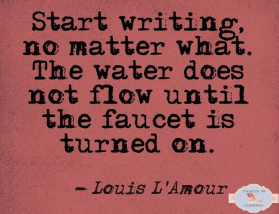
Something to think about
-Jan R

