
Something to think about.
-Jan R
Something to think about.
-Jan R
I have to admit I’m a hopeless romantic. I just love stories where boy meets girl, you throw in a little conflict (okay a lot), but everything works out in the end, and of course, they live happily ever after.
There’s nothing wrong with romance and wanting the happily ever after, but if you’re only reading one genre (romance, scifi, mystery, horror) you’re limiting yourself. I never really thought that much about it, until I read a blog on why I should be reading all genres.
From my perspective, I write romance. I need to know what’s out there and what’s selling. How do other romance authors handle the physical and emotional sides of the relationships?
All of these reasons are valid, and I should be reading romance. But you know what? That novel has a lot more than romance in it. At least it had better have, if I want to keep my readers’ attention.
I may be great at developing a romantic relationship between my hero and heroine, but I had better be able to create the mystery and suspense necessary to keep my readers’ turning the page.
Maybe you write sci-fi, but odds are there’s a romance between your two main characters, and no one can explain why the lab assistant is lying on the floor dead, and there’s a hole in the wall leading into the parking lot.
You can’t just read sci-fi and expect to be a well rounded writer. You might find yourself creating awesome aliens, but lacking when it comes to developing a relationship between the hero and heroine. I think you’re getting the picture.
Reading different genres will make you a stronger writer. You’ll be introduced to new worlds and situations that you would have never experienced if you limited your reading to one genre. Reading different genres will open your mind and encourage you to take risks that you may have never considered. If that’s not enough, reading different genres will also allow you to read as a reader. Instead of focusing on the author’s style, you can simply enjoy the experience of reading 🙂
Hope this helped.
-Jan R

-Jan R

-Jan R
About a six months ago I wrote a blog on biting the bullet. I had done everything I knew to do to get a novel that I had put years of blood, sweat, and tears into, published. It was a great story. I even had that confirmed by a literary agent, who gave it more attention than it deserved. It was time to get some help.
I had run into a brick wall and placed the piece of work to the side to gather dust. Maybe it was never suppose to get published. Maybe it was just a platform for me to sharpen my writing skills and produce the novel that was screaming to get out. As much as I tried to move on, I kept coming back to my flagship.
I finally turned it over to an editor not knowing what to expect. She started feeding me a couple chapters at a time with revisions and suggestions to make my work more marketable. She cleaned up the numerous structural and grammatical errors that I as well as friends had overlooked.
One thing that I learned through this process, is you can’t write in a vacuum. I produced a great story, but it wasn’t publishable. I couldn’t see the mistakes. I put years into editing, revising, and just trying to do everything myself. I did eventually reach out and pull in a couple of my closest friends, but they didn’t have the trained eye of an editor. They caught quite a bit, but they missed even more.
I should be submitting the story to literary agents again in the next few months. I have to admit, I’m both excited and anxious. But however it goes, if you follow my blog, you will hear about it.
Thanks for your continued support. I hope that the blogs I share help you to avoid some of my mistakes and are worthy of the time put into reading them.
-Jan R

-Jan R

What’s a word echo? I’m sure you have an idea, even if you haven’t heard the term before. It’s the use of the same word in close proximity or in the same sentence.
It’s considered ugly and inelegant. Don’t do it! The good news is, it’s probably one of the easiest mistakes to correct.
Just delete one of the repeated words if you can do so without changing the meaning of the sentence. If that doesn’t work, you’ll simply have to replace the duplicate with a new word.
That can be a little tricky. You have permission to pull out the thesaurus, just don’t get carried away, and consider the word you’re using as a replacement.
Example:
Angrily– bitterly, impetuously, tempestuously, threateningly, fiercely, furiously, violently, infuriatingly, tigerishly (I didn’t make this one up)….
Many of the words listed are the same but different. They range from a slight variation in meaning to utterly ridiculous.
Footnote: It’s okay to repeat if you’re writing poems, songs, or emphasizing a point. An example would be Martin Luther King Jr’s I Have A Dream speech. His repeats were intentional and poetic.
Just something to think about.
-Jan R
Something to think about.
-Jan R
Writing can be both rewarding and frustrating. I’ve been around the block a few times and have had my share of rejections. Don’t judge me, get used to it. If you are out to write that best selling blockbuster, and know I’m cheering for you, you’re going to have to develop some tough skin.
I’ve stated in previous blogs, that there are a lot of reasons why your manuscript was passed over, and many have nothing to do with the manuscript itself, but I thought it would be nice to hear from an agent.
You just submitted a query for an awesome piece of work. You’ve had several agents request full manuscripts and one even gave you a call, but just like that it was over. What happened?
You may have submitted an amazing piece of work, but the submission before yours hit the ball out of the park, and the one after yours did likewise. Those two works raised the bar and affected the impact you novel had on the agent.
Maybe you presented a very well written novel, but the market is saturated with the genre you are offering. Agents may have manuscripts for the particular genre you submitted on hold for the next few seasons.
You made it to the personal phone call. Where did you go wrong? Maybe you were missing the synopsis or logline for your next novel. Agents don’t want to just sell a book, they want to represent a career. Another guess would be that you were resistant to editorial thoughts presented by the agent.
While all of the aforementioned obstacles are factual, they are not your biggest obstruction. What’s the biggest obstacle to you getting published? It’s you!!!!!
The biggest obstacle one can have in getting a novel published is quitting. If you’re going to do a little bit right, have that little bit be the fact that you don’t quit. – Barbara Poelle, agent
Something to think about.
-Jan R
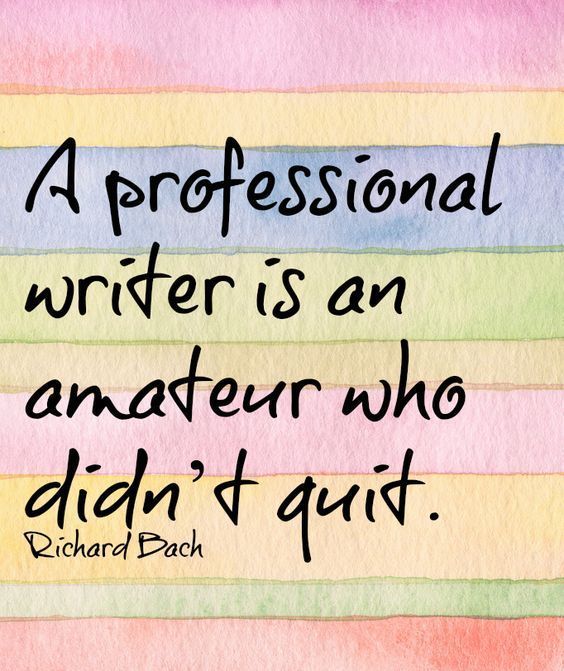
Something to think about.
-Jan R

