Remember – Pacing Is a Tool!

Pacing sets the tempo of your novel. How fast or slow it moves depends on the function of the scene and the intent of the author. As discussed in a previous blog, you can speed your story up or slow it down depending on how you use exposition and action.

Intensely dramatic or violent scenes can be either fast or slow depending on your intent. If you slow down the scene, you can ring out the last bit of suspense and mystery, as well as heighten the drama by stretching out something that occurs in seconds.

Sudden shifts in pacing from slow to fast can shock your reader and make your book memorable. Nicholas Spark’s books are a great example of sudden shifts in pacing. In his books, Message In a Bottle and The Best Of Me, he uses the entire book to build a relationship between the main characters only to kill one of them off on the last page. I was totally shocked and a little mad after reading those books. I like happy endings. But he achieved what he set out to do. They evoked strong emotions and I’ve never forgotten them.

Tolkein’s, The Lord Of The Rings vacillates between exposition and action. The varied pace and information provided, allows us to visit middle earth and participate in its history.

Remember, fast pacing is action-packed leaving your reader breathless, and slow pacing is meditative and dramatic.

While I love action-packed, fast-paced books, I realize we need exposition to give the reader a breather and prepare them for what comes next. Balance is the key.

Pacing is an important part of your novel, and if you are a novice, it’s something you probably haven’t given much thought too.  I know I didn’t. I love to read and knew that some of the books I read were more fast-paced than others, but didn’t stop to think that the author intentionally wrote them that way.

When you begin the editing process, pacing is another fundamental to add to your list of things to review.

Hope this helped.

-Jan R

Remember – Pacing Is a Tool!

Common Mistakes New Authors Make

  1. Leading with the setup. If you’re like me, you thought you needed to give your reader some information up front so they could better understand your characters and what was going on. I guess it was a little boring, but my reader was well prepared for the good stuff they never got to 🙂 Setup, regardless of how well written, is boring. Try to weave in small amounts at a time.
  2. Telling too much. Yes, I’m guilty of this one too. Remember backstory and passive voice distance the reader from the action. If your reader’s sense of immediacy is lost, meaning she can’t visualize the events as they occur, you may lose her.
  3. Scenes that lack conflict. You probably guessed I was guilty of this one too 🙂 I had scenes that were nothing but backstory and setup. I really feel bad for the family members and friends I asked to read my finished manuscript.
  4. Writing unsympathetic characters.  Yes, I got this one right 🙂 Readers want to connect emotionally with the heroine and hero. They want to root for them, laugh with them, and cry with them. Clearly establish the character’s motivation for behaving in any manner that might make them appear unsympathetic.
  5. Giving the reader a reason to stop reading. Don’t allow a chapter or scene to end in an anti-climactic moment. Always end scenes/chapters with a hook. And yes, I’m guilty of this one too 🙂

Something to think about!

-Jan R

Common Mistakes New Authors Make

Are You Sure It’s Ready?

Everybody wants to get published. Once my first manuscript was completed, I didn’t hesitate to send it out. I knew it had a few grammatical and structural errors. There’s no way you can catch them all. That’s what an editor is for, right? My story was so good, or so I thought, an agent would jump on it and have their editors correct my mistakes.

Well, that wasn’t exactly what happened. I’ve written numerous posts outlining the errors I made in that first very, very rough draft. When you begin your writing career, odds are you don’t know what you don’t know. Writing a publishable piece of work isn’t easy.

I received a rejection letter from every agent I submitted to with the exception of one, who I like to think saw a promising new author in that mess somewhere. She did reject my work as well, but instead of sending a form letter, she praised what was right and pointed out what was wrong.

Her list was long, and I was more than a little shocked once I realized how rough that first draft really was. She used words like head-hopping, writtenese, and dragging dialogue. That didn’t even include the grammatical and structural errors. You know, the ones the editor was going to correct :-), although she pointed those out too.

Do your homework and remember, that first draft is the first draft. Get it done, then get it good.

Something to think about!

-Jan R

Are You Sure It’s Ready?

You Can’t Do This Alone!

I remember my middle sister as a child. She would often be found sitting in the corner with her nose in a book. She didn’t play well with others. Well to be honest, she didn’t want to play with anyone at all.  Her friends were imaginary. I always thought that she was a little strange, and she probably was, but she is also one of the most talented writers I know.

You haven’t heard of her or read any of her work. Why? Because she writes in a vacuum. I have encouraged her for years to reach out and join the writing community.

She is an introvert, like most of us who seem to enjoy the keyboard much more than a group of pretentious people. I would be okay with that if she belonged to writing groups, or had people she related to that could help motivate her to move forward with her craft.

You don’t have to interact with others face to face, at least not at first. If that’s not your cup of tea, go online. Join writing groups and form relationships with other author want-to-bes. There are some great ones out there that cater to just what you’re looking for.

Critique groups:

  • Scribophile.com
  • AbsoluteWrite.com
  • CritiqueCircle.com

I am a member of Scribophile. It’s a great site to seek critiques and suggestions from fellow writers. Members on this site operate at different levels of expertise. I have gotten some great feedback, but I have also received feedback that was not up to par. I was pleasantly surprised at the community in the group and the willingness of total strangers to help me with my work.

Genre-Specific groups:

  • Romance Writers of America  rwa.org
  • Mystery Writers of America    mysterywriters.org
  • Science Fiction and Fantasy Writers of America   sfwa.org

I think you’re getting the picture. I was a member of Romance Writers of America and need to renew. You can get excellent information and discounts from these sites. They will keep you informed on contests, conferences, writing groups/forums, what’s selling, agents looking for new works, and information on how to improve your craft.

Remember, you can’t do this alone!

Something to think about.

-Jan R

You Can’t Do This Alone!

The Best Advice I Was Ever Given!

DON’T GIVE UP!!!!

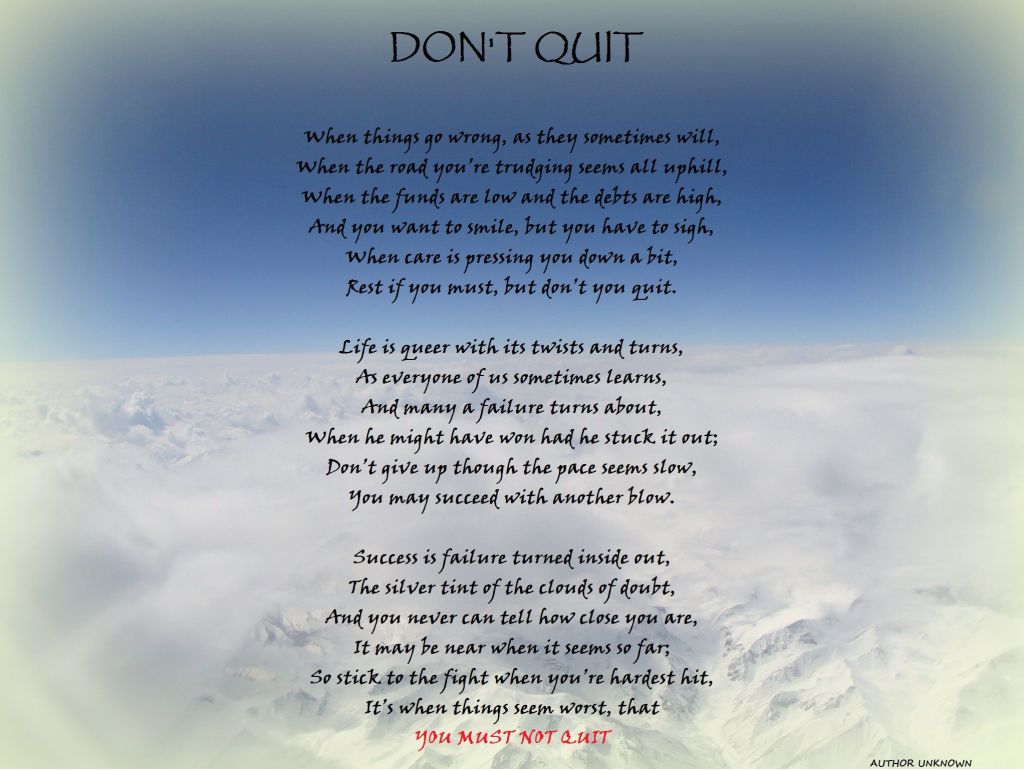
Hands down the best advice ever. A friend gave me a beautiful plaque that I sat on my desk at work and read often to remind myself that success was just around the corner. Failure was simply a steppingstone. I would like to share it with you today and hopefully provide some encouragement and motivation to keep moving forward.

Pursue your dreams! Prepare yourself for success! Pick yourself up when you fall! Don’t you quit!!!

-Jan R

The Best Advice I Was Ever Given!