Pacing-Fast Or Slow?

controllingthepaceinyournovelPeople who love to read but have never written books are cognizant of the pacing. Pacing sets the tempo of your story. Is it a fast read or did it seem to drag on for days? Hopefully you’ve found a balance between the two and they perform like a fine tuned orchestra.

I have read many good books that I skipped portions of, because I was tired of reading about the duchess’s frilly dress or  inner hull of a slave ship. I’m glad the authors did their homework and provided historical information, but sometimes it can be a bit much and totally bog down your story. I have read other books that were nonstop action that left me wanting; they were missing the details that made the story real and the characters endearing.

So how do you control the pacing of your story since once you start writing it seems to take on a life of it’s own? Be cognizant of the tempo and your audience. You have to strike a balance between the amount of information in the pages you are given and the patience of your reader.

There are three main attributes that effect the pace of your novel.

  1. The number of pages/words in the novel vs. the time period covered – Long books that depict a short period of time are going to move at a slower pace.  you’re going to be providing a lot of detail and back story to fill up all those pages. Short stories depicting long periods of time are going to move at a faster pace. In order to cover everything you have to cover, you’re not going to have time to stop and smell the roses. There’s just too much happening and not enough pages/words to expound-talk about making every word count 🙂
  2. The density of the narrative – The length of the story versus the number of twists and characters within. If you have a simple story with maybe one subplot and a handful of characters, you should be able to move along at a fairly steady pace. You start going all Lord Of The Rings on that book with numerous subplots and characters that are a product of your imagination-you’re going to have to slow down and figure out a way to keep it moving forward without getting too bogged down in the details.
  3. Scenes vs. Exposition                                                                                                          Scenes are the important events that move the story forward.  They are the action and dialogue that occur during the course of the story.                                                    Exposition is the back story or descriptive information that stands outside of the story and slows things down.

I love this chart. It provides some great examples of ways to control the pace of your novel and is very user friendly:-) Some more things to think about when you are addressing pacing.

controlling-the-pace-of-a-story


I hope this helped.

-Jan R


Pacing-Fast Or Slow?

Character-It Matters!

imagesRJ7UAQQJHeroes and heroines, or your lead character, doesn’t have to leap tall buildings in a single bound, and he doesn’t have to stop speeding bullets with his bare hands, but he darn well better know the difference between right and wrong, and he better be kind to animals, and it sure wouldn’t hurt any if he brushed his teeth regularly… Dean Koontz

Funny but true. There are five traits that you should consider carefully when creating your lead characters.

  1. Virtue and no I am not saying that your character should be sexually virtuous, nor am i saying he/she can’t drink, smoke or curse. What I am saying, is he/she should be an upright citizen. They should understand right and wrong, good and evil. They should always come down on the side of right. If at all possible they should never do anything illegal, unethical, or immoral. If your hero does kill someone in self defense or by accident, they had better feel really bad about it.
  2. Competence Your reader doesn’t want to read a book full of idiots, fools, and wimps, unless it’s a comedy, and those idiots, fools, and wimps are funny. Your reader wants a hero who is capable of standing up to a situation. They want a hero who can think on their feet. Most readers would have a difficult time identifying with, or caring for, a hero who is an ineffective, whimpering victim of fate.
  3. Courage Readers also find it difficult to identify with cowards. This does not mean they have to be brave to the point of foolhardiness. If your hero shows courage, your reader will feel he is worth cheering for.
  4. Likeability From my perspective this is the most important of the characteristics necessary for a successful  hero/heroine. Your character can be virtuous, competent, and courageous, but if he’s proud and arrogant, readers will not identify with him. As a matter of fact, they will dislike him to the point, that they close your book and put it away. You are finished! What makes you like a person? Think about it. Is it their ability to laugh at their self? Is it their acts of kindness? Are they sensitive and caring?  Caution-Readers have as much of a problem identifying with a saint as they do with a liar or thief.
  5. Imperfections Nobodies perfect. We all have issues. By making your character perfect, you may fall into the saint category. Who can identify with that? Readers want characters that are real, three dimensional, who could be the neighbor next door. Think hard and choose you flaws wisely. You do not want anything so terrible that it turns your reader against your hero/heroine.

Note- In a genre novel you can get away with an almost flawless hero/heroine, but mainstream readers demand more. With this being said, flaws make your characters more interesting and relatable. It’s your story. You decide.

-Jan R

Character-It Matters!

To Adverb Or Not To Adverb?

adverbsI do a lot of critiques for different writers during the week. Some of the writers are very polished; others, not so much.
The one thing I’ve noticed in all levels, is an abundance of adverbs. I must admit, I get jealous at how prettified some of those sentences read. I can’t write like that. My brain isn’t wired that way.

According to William Noble, many inexperienced writers, and I will add unpublished- but have been around the block a few times writers, throw in “pretty” words(adverbs or adjectives) to make their prose more dramatic and meaningful. These cosmetic touch-ups often turn out to be  redundant or simply uninspiring.

Adverbs bog down your story without adding meaning.

He zoomed around the oval speedily.-Is it possible to zoom without speeding?

He stuttered haltingly.-Can you stutter without doing it haltingly?

Adverbs tell/ You want to show  Adverbs encourage lazy writing.

He whispered to her lovingly. (Telling)

He whispered words of love…my sweet, dear lover, my angel…(Showing)

Remember, there are better ways to prettify your prose and using adverbs isn’t one of them. You’re going to have to roll up your sleeves and get to work. Start showing not telling.

Adverbs are a dumping ground. Adverbs can be a way of dropping in that really fancy word that the writer wanted to use, but we all know should have been left undone.

“I’ll give you a hint,” she replied uxoriously.

“I don’t get it,” he responded zealously.

Adverbs get lost. Literally! Truly! Actually they do. We use them so often that we don’t even notice them, until somebody points it out.

I am not a NEVER ADVERBS person. Sometimes they are necessary to provide detail or clarity.

The man sang loudly.

The girl was really cute.

What’s wrong with Adverbs? Nothing as long as you don’t abuse them.

-Jan R

To Adverb Or Not To Adverb?

The Anatomy Of A Scene (repost)

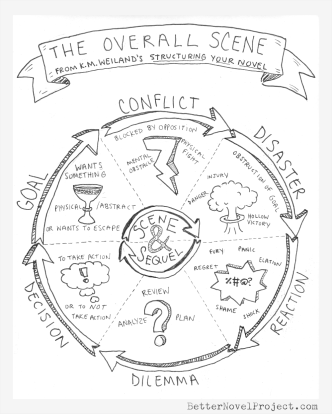
The-Overall-Scene-Structure-by-Better-Novel-ProjectAnybody that has read my work, knows that most of my blogs spin off of my own weaknesses. And there are many. I figure if I’m having problems with a certain aspect of writing, there are probably many others who are too.
So today I thought I would focus on writing scenes. As you may have guessed, I was shredded to pieces  in a critique, and rightfully so.

I presented a 3000 word excerpt from my novel for review. I did say 3000 words, and a friendly critique (she really was nice), pointed out that I had managed to squeeze 10 different locations/scenes into those 3000 words. It was overwhelming, and the scenes were like flybys.

I have a very complicated novel, with many twists and turns, which could be a good thing. But in my haste to get through them all, I’m not providing a cohesive story. Many of my scenes are lacking.

So how do I correct my mistakes? I put together a scene and a sequel. They work together to form one cohesive scene.  At some point,  this cycle of scenes and sequels will end, and my POV character will either succeed or fail. I would opt for succeed:-)

Scenes are as follows:

  1. Goal- What the POV person wants at the beginning of the scene. It must be specific and clearly definable.
  2. Conflict- The series of obstacles your POV character faces on the way to reaching their Goal.  There has to be conflict or your reader will be bored.
  3. Disaster- Is a failure of you POV person to reach his goal. This is a good thing in writing. Hold off on success until the very end. If you allow your POV to reach his goal to early, then your reader has no reason to go on.

***All three of these are critical to make the scene successful.***

Sequels are as follows:

  1. Reactions- Is the emotional follow through to a disaster. Show your POV acting viscerally to his disaster, but remember he can’t stay there. He has to get a grip.
  2. Dilemma- A situation with no good options. A real dilemma gives your reader a chance to worry. That’s good, you want them emotionally involved. At the end let your POV choose the least of the bad options.
  3. Decision- Your POV has to make a choice. This lets your POV become proactive again. People who never make decisions are boring.

Hope this helped. I pulled most of my information off of the ‘advancedfictionwriting’ web site, that’s hosted by Randy Ingermanson-“the snowflake Guy”.  He provides some great information for writers of all levels. You should check him out.

If you have any comments, I would love to hear from you. Happy Writing!

-Jan R

The Anatomy Of A Scene (repost)

Setting-It’s Not Just A Place

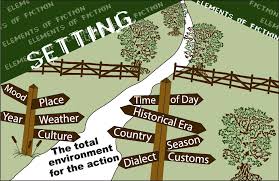
settingWhen you hear the word setting, you probably look around the room. Where are you? What do you see? And while I agree that, that is a part of the picture, there is so much more to setting than your location.

Settings establish context for characters and plot. They don’t come out of nowhere. Well if yours do, you have a problem 🙂

Settings should be visceral and vivid and allow us to experience the world the author is building as if we are one of the characters within the narrative.

How much detail is necessary? It depends. You should provide lavish detail for  important scenes, settings that you will be going back to time and time again, and settings that are new to the reader requiring more detail to visualize in their minds.

Use only a line or two for less important settings that you will only be visiting once or settings your reader is already familiar with.

With Sci-Fi and Historical novels, setting becomes an important part of the story. The setting doesn’t have to be real but it does have to be believable.

Writing historical novels, do your research and throw in some things that you would expect during the time period. Not just the architecture and furnishings, but what was the culture like? What customs did they follow?

Writing Sci-Fi, keep in mind you’re creating a world. Your setting needs to be very detailed. Help your reader to see what you see!

The novel I am writing is set in the present and uses settings that are familiar to the people who would be reading the story. For instance, my main characters meet at IHOP. When I say IHOP, I don’t have to provide a lot of detail because everybody knows IHOP and immediately conjures it up in their mind.

While I am in no way putting myself on the same level as the writer Jane Austin, I found it amusing that in her book Pride and Prejudice, she didn’t put a lot of detail in her settings. Why you may wonder. She knew her readers at the time the book was written, and knew they would be able to visualize the places she referred to without a lot of detail.

Settings also evoke mood. In horror stories, your description of a haunted house should evoke fear in your readers.  In a mystery your setting should evoke suspense and  curiosity. In a comedy your setting should evoke laughter or an anticipated thrill.

Settings provide information about your character. How does their home look? Is it messy, neat, compulsively organized? Do they surround themselves with darkness or light?

Settings can be used to foreshadow and to provide a metaphor(Animal Farm and The Majestic are  good examples).

Settings evoke the passage of time.

Settings incorporate culture and customs familiar to the place and time period you are working with.

Never underestimate the importance of your setting! There is so much information on the subject. You once again get the cliff notes, but I hope they spark your interest, and get you thinking about your own settings, and how they are used in your work.

-Jan R

Setting-It’s Not Just A Place

I’m Having a Love Affair With ‘Had’!

aid174983-v4-728px-Stop-Saying-the-Word-_Like_-Step-4-Version-2On more than one occasion I have declared my love affair with the word ‘had’. When you use a word so many times it jumps off the page, you have a problem. It doesn’t matter if the word is used correctly or not. You need to find another way to write the sentence without using ‘the word’. In my case that word is ‘had’.

What’s wrong with using the word ‘had’ over and over, besides making it an awkward read?

  • If you are using ‘had’ a lot, odds are you have a lot of backstory/info dump, because it specifically details things that happened before the current action. In some circumstances, that can seem dull, or like the focus is in the wrong place. Why spend so much time on something that’s not happening right now?
  • Using ‘had’ too much can also indicate you are telling vs. showing.
  • ‘Had’ is also rather formal. People rarely say ‘he had put on weight’- you say ‘he’d put on a bit of weight’ or ‘he was looking fatter’ something to that effect.
  • If it’s overused to the point that it becomes noticeable to the reader. It is bad.

For this blog, I’m focusing on ‘had’ because it’s a problem word for me. Most of us have them. They could be words like but, although, because, however, that, and if you’re writing dialogue–so(another one of my favorites that I know to look out for 🙂

To a certain extent, this is a matter of style. Plenty of writers have these little tics. You may find a turn of phrase that you fall in love with, or it may be a word that carries over from the way you speak. As I stated above with ‘had’, only if a word or phrase is overused to the point that it is noticeable to the reader, does it become a bad thing.

Noticing that you use a particular word frequently, is the first step to improving your writing. If you realize you are in the process of abusing a word while you are writing, make some adjustments, but don’t get bogged down for a half an hour trying to decide if ‘your word’ is really necessary.

The best time to work on these tics, is after you’ve written a chunk of prose. Go back through and look for your problem word. You can use the find feature on your computer (Usually ctrl-F or command-F). As you edit, double-check to see if the word is really necessary, or if it can be changed. If you have to, rewrite the entire sentence.

Food for thought. I bet I’m not alone in my love affair with certain words 🙂

-Jan R


I’m Having a Love Affair With ‘Had’!

Keep It Simple-Use Nouns and Verbs!

untitledLess is more. Five adjectives in one sentence is better than six; four adjectives are better than five; three are better than four; two are better than three…By using fewer words to obtain the effect you desire, you will force yourself to use more accurate and more powerful words-Dean Koontz, ‘How To Write Best Selling Fiction’

Write with nouns and verbs, not with adjectives and adverbs. The adjective hasn’t been built that can pull a weak or inaccurate noun out of a tight place-Strunk and White, ‘The Elements Of Style’

These are two great sources with amazing advice. They are not alone in their philosophy. I have read this time and time again and I understand completely were they are coming from. I am a self designated skipper. Some of you know exactly what I mean. I couldn’t care less the lady has diamond encrusted buttons running down the back of her evening gown. Unless it winds up in a murder scene, don’t go there.

I love Jerry Jenkins. He has written numerous blogs on the importance of simplicity and avoiding the urge to prettify your prose. He calls it written-ese. It’s a special language we use when we forget to Just Say It.

He provided the following example from a beginner’s work he was editing.

“The firedrop from the pommel of Tambre’s sword shot past the shimmering silver mist of her involuntary dispersal.”

Whoa! How many times did you have to read that?

None of these authors disparage adjectives and adverbs. They see them as indispensable parts of speech. The problem is when, why, and how many times we use them. Rich ornate prose is hard to digest.

Anything that interferes with communication-excessive adjectives and adverbs, overly complicated phrasing, too elaborate metaphors and similes presented soley for the fact that the writer wants to show off his/her skills, should be omitted.

The best way to communicate with your reader, is to keep your writing simple and direct.

-Jan R

Keep It Simple-Use Nouns and Verbs!

Is Your Story Believable?-It’s All In The Details


untitledWriting fiction can be fun. You get to create your own world with your own characters and you can take your story anywhere you want to go. Right?
Well that statement is true to a certain degree. You do have a lot of leeway, but keep in mind, your story has to make sense. It has to be believable to your readers. That’s were research comes in. Your plot may be fictitious but your details had better be correct.

Anachronisms-details out of place and time-can break a readers suspension of disbelief if they notice the error. If for example, a character in ancient Egypt consults his watch, a reader would instantly be drawn out of the story and roll his eyes. This is an extreme example, but I think it helps you get the point.

There’s no excuse for anachronisms or lack of detail.  Once you know what you are writing about, immerse yourself in the subject. If you want to write about police, you do a ride along or shadow a precinct. If your novel takes place in a school, interview teachers or volunteer.

You can also use social media to learn about people and places, by watching videos or listening to interviews.  My novel is set primarily in the Carolinas but my main character is deployed to Afghanistan for a short period of time. I’ve never been to Afghanistan and have no intention of ever going there.  For that short but important segment of my book, I watched a documentary and actual footage. I also read pages set up on the internet by marines returning from the area that described what it was like for them. I found the information I needed to make that portion of my story believable through research on-line.

It is always best to set your novels in cities that you know.  A good example of this would be Nicholas Sparks. Most of his novels are set in North Carolina. That’s where he lives. He understands the culture and can provide the details his readers expect.

One word of caution is to remember your research and detail are the seasoning for the story, don’t make them center stage. Resist the urge to show off how much research you have done. You don’t want to overwhelm your readers with unnecessary information.

-Jan R

Is Your Story Believable?-It’s All In The Details

The Title Of Your Book Is What?!!!

imagesFFT3CQY4I was looking at some of my older blog posts this past week, when something jumped out at me.

Nine months ago I wrote a blog titled, “Is your manuscript ready for submission?” It didn’t get much attention, as a matter of fact only 5 people viewed the blog and 2 of those liked it. Needless to say, I was pretty disappointed. It was a great blog.

Five months later I was busy and didn’t  have time to research and write a quality blog. I decided to repost, “Is your manuscript ready for submission?” I made a few changes to some of the sentences, so they reflected the new time period, but other than that, the blog read word for word.

I also did one other thing; I changed the title. It was the same blog, only it’s new title was, “Edit, Edit or Edit?” The blog did exceptionally well for someone who has been blogging  less than a year. It had 99 views, 50 likes and 3 or 4 reblogs.

I shared this story to make a point. Your title really does make a difference. It’s the first thing your reader sees or hears about your book/blog/poem. Your title creates anticipation and expectation, or, perhaps disinterest. Often your title determines whether or not someone reads your work.

A good title should have the following attributes:

  • Attention grabbing
  • Memorable
  • Informative (gives idea of what book is about)
  • Easy to say
  • Not embarrassing or problematic for a person to say aloud to their friends.

Also keep in mind, that the title you start with, may not be the title you end up with. Getting the title right, may be the most important book marketing decision you make. Many well known authors have had their titles changed by publishers and editors before print. Here are a few you may recognize:

F. Scott Fitzgerald/  The Great Gatsby — Trimalchio in West Egg, On the Road to West Egg, Among Ash-heaps and Millionaires, Under the Red, White, and Blue, Gold-hatted Gatsby, or The High Bouncing Lover. I think he made the right choice 🙂

George Orwell/ 1984 — The Last Man in Europe

Ayn Rand/ Atlas Shrugged –The Strike

Harper Lee/ To Kill a Mockingbird — Atticus

Jane Austin/ Pride and Prejudice — First Impressions.

Frances Hodgson Burnett/ The Secret Garden — Mistress Mary

The title matters!!! Get it right!!!

-Jan R


The Title Of Your Book Is What?!!!