 When you write a novel, you need to get the facts and details right. Who has ever heard of Bombay, NC or Mount Sanai, Oklahoma? They don’t exist, or if they do, I’ve never heard of them.
Sure you’re writing a fictional novel and you can do what you want. Wait a minute. You can do what you want, but if it doesn’t make sense to your reader, they’re going to shake their head and throw the book to the side. Don’t expect a recommendation.
When you write fiction, you’re already asking your reader to accept numerous situations that could occur, but odds are won’t. My novel’s hero is one of two identical twins. He was switched at birth and never knew he had a brother. They meet in Afghanistan and are blown up when one steps on an IED. One dies and the other is misidentified, taking on his brothers identity and life.
Now that’s asking a reader to accept a lot of ‘could happens’ but odds are they never would. In order to balance the story and help my readers maintain their suspension of disbelief, I did my homework to make sure all of the facts surrounding these situations made sense.
What’s suspension of disbelief? It’s your reader’s ability to suspend critical faculties and accept the surreal; sacrifice of realism and logic for the purpose of enjoyment. However, as stated, your reader will only accept so much. Even fantasy and sci-fi need to read as real.
You have to get the facts and details right. With today’s technology and the information available, there is no reason why the details should be inaccurate. I love Google and Youtube. They are your friends.
I’m never going to Afghanistan, and I definitely want be serving in the marines. I do have a son who went to Afghanistan and was a sergeant in the marines. That helped. I also found more information than I could possibly use on Afghanistan, Camp Leatherneck, and the daily life of marines who resided at the camp through google searches, interviews with my son, and youtube videos.
Get the details right and you can get away with a lot of make believe. It doesn’t have to be real, but it does have to read real.
Something to think about.
-Jan R
 I was lying in bed last night thinking about what I would write about today. I’ve been writing this blog for two years, and I have to admit, there are times when I’m at a loss. I want to share useful information, but I don’t want to sound like a broken record, and I don’t want to duplicate what someone else is writing.
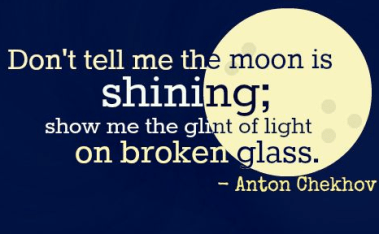 I can’t count how many times I’ve heard this phrase. You probably saw the title and questioned reading it. Everybody knows you are suppose to show and not tell. You want the reader to experience the scene as if they are one of the characters walking through the story beside the hero/heroine.
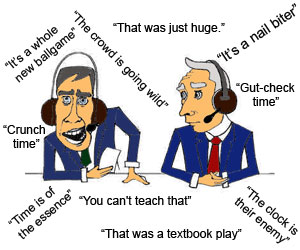 If you’ve been around the writing world long enough, you know there are no new ideas. Kidnaps, robberies, invisible men, aliens, robots, espionage, vampires, zombies, invasions, war, love…they’ve all been conquered again and again and again.
 We’ve talked about weak and strong verbs, but did you know the same holds true for nouns? I never really thought about it, until I took an online class that talked about strong and weak nouns. My first thought on weak nouns; the instructor has to be referring to pronouns. Well he wasn’t and that is a subject for another day.
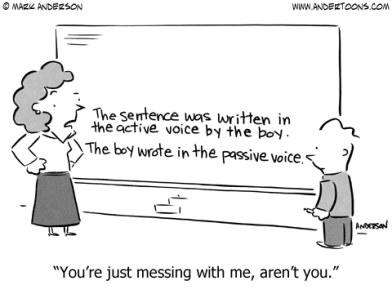 When you write, you want to use the active voice. It’s clean, concise, and simple. The active voice is easy to read and understand.
 When you are writing a novel, you want to use concrete, everyday verbs. Examples of these are jump, smile, run, look, show, and eat. You can picture the actions in your head and there is no ambiguity.
 Have you heard of the Hemingway Editor App? If you’ve been writing for a while, you know about grammarly and autocrit. Both of these Apps focus on grammar and spelling. Hemingway takes it a step further. The App highlights lengthy, complex sentences and common errors; if you see a
  Are you writing what you meant to write? Is your prose concise, and easy to understand? You may have one thing in mind when you write that sentence, only to discover it’s ambiguous, misleading, and sometimes quite humorous.
 So you’re afraid you might fail. Truth is, you might stumble the first try, the second try, and maybe even the third try, but that’s part of the learning process. If you’re constantly looking over your shoulder, you may not finish your novel. You’ll be too busy battling the thoughts of it not being good enough.
 Writing your first novel-Things you should know