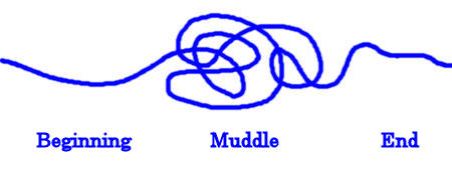
 It’s been a while, so I have to ask. Are you muddling through the middle? If you’ve been around the block a few times, you know exactly what I’m talking about. We all experience it. You have a great idea for a novel, which includes in detail the beginning and end, and you have to figure out how to connect the two without putting your reader to sleep.
I call it the mayhem in the middle. The problem is, you haven’t thought about what happens when you get there.
Most people who fail to complete their novel, become lost in the middle. They bail when they realize they don’t have enough cool stuff to fill the pages. They may attempt to add scenes, but become bored, and know readers will be too.
Every book becomes a challenge a few chapters in. You’re not alone. Trying to keep up the tension and pace gets harder and harder. But don’t panic or do anything rash, like give up.
What can you do? If you’re one of those people who hasn’t developed an outline, thinking it would just come to you as you muddled through, maybe you should consider backing up and doing one.
An outline to set every scene gives you a blueprint of what will happen next. If the action starts to wane, think about a subplot, or introduce tension between your main characters.
Maybe there was a misunderstanding, or maybe that one minor character that was supposed to be the good guy isn’t what he appears. Maybe the butler did it, but nobody knows.
You can have so much fun with subplots. Just keep them believable and resolve them all in the end.
I hope this helped.
Jan R
 I’ve been reading literary agent biographies and blogs in an attempt to narrow my search and find a few I think would be a good fit for my novel.
 When you’re writing, you need to mix things up. You don’t want to be the one that puts your reader to sleep.
 I can’t count how many times I’ve heard the phrase, ‘show don’t tell’. We all know you’re suppose to show and not tell. Why? You want the reader to experience the scene as if they are one of the characters walking through the story with the hero/heroine.
 Most people think writers live the life. Writers lay around in pajamas writing stories and making millions of dollars. They control their schedule, and of course, travel to exotic places all over the world.
 Writing your first novel-Things you should know