-Jan R
-Jan R

Are you writing what you mean? Is your prose concise and easy to understand? You may have one thing in mind when you write that sentence, only to discover it’s ambiguous, misleading, and sometimes quite humorous.
Dangling modifier- When a sentence isn’t clear about what’s being modified it dangles. Keep in mind modifiers should be near what they modify. These are probably my favorite messed up sentences. While I hope I haven’t written or submitted any for publishing, I’m sure I’ve dangled a few in my time. They are confusing, but on the bright side, very funny. The company’s refrigerator held microwavable lunches for 18 employees frozen in the top compartment.
Misplaced modifier- A phrase or clause placed awkwardly in a sentence so that it appears to modify or refer to an unintended word. Lex called to talk about the meeting yesterday. Did Lex call yesterday or was the meeting yesterday? I’m confused.
Ambiguous writing– It’s not spelled out. You didn’t provide enough information for your reader to understand what you were trying to say. Ambiguous writing can leave your reader more confused than a misplaced modifier . My older students know I say what I mean. Are the student’s older in age or have they just been in his class a lot longer? It could mean either of the two.
Make sure you are saying what you mean. Be concise!
Something to think about.
-Jan R

-Jan R
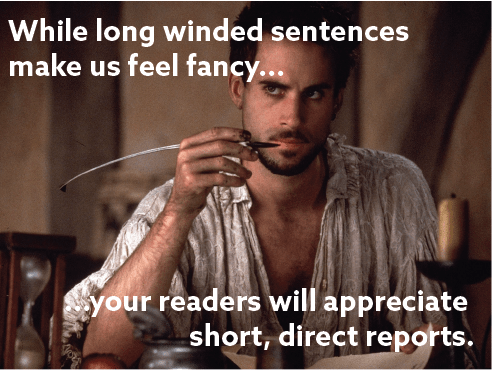
Have you ever read a sentence and thought that is way too long? The author lost you two commas ago, and now you have to go back and read the whole thing again to try and figure out what’s going on.
Or maybe you read a short sentence, followed by another short sentence, and another, and you’re thinking whoa, slow down.
There’s not a set rule for short or long. The sentence length you choose depends a lot on what you are trying to accomplish. There are good reasons for those long, lost me a long time ago sentences, and short, what just happened sentences. It’s up to you to decide when to use them, given the context of your writing.
What do short sentences do?
What do long sentences do?
Although long sentences have the smell of the old-fashioned 19th-century romantic prose, the usage of the long sentence in modern creative writing has its place. When it comes to writing artistic literature, fairy tales, ghost stories, or mysteries, don’t underestimate the effects of short sentences.
Hope this didn’t confuse you too much. To sum it up, there’s a time and place for everything 🙂
-Jan R

Something to think about!
-Jan R

You’re an aspiring author. Your ultimate goal is to find a great agent and get published. Who doesn’t want to be the author of that blockbuster book/movie of the year with a million-dollar payout?
Newbies have a tendency to set unrealistic expectations. I’m not saying you won’t achieve your goal, but odds are, you’re going to have to start at the bottom and work your way up like the rest of us.
I’m not trying to discourage you. You can do this. I’m just trying to help you set realistic goals. I want you to be prepared not only for successes but the failures that you will most likely incur along the way.
There are some things you can and should be doing as you build your platform and prepare that first novel for publishing.
Some things to think about 🙂
-Jan R
-Jan R

Yes, I have written about this before, but these elements are important and deserve a second look. There are four main dramatic elements to your novel. You probably never thought about it, but if you did it right, they are there. If they’re missing, you need to revisit your work and make some adjustments.
That’s one of the nice things about writing. Nothing is set in stone, and when equipped with time and knowledge, you can change anything.
So back to the blog and the elements that I was referring to.
One of the things that the agent wrote to me after rejecting my work, was I had a great premise. It was a silver lining to a dark cloud that sprung up after the initial shock of being rejected. And while I thought the passion and theme were there, my characters were not flawed, which means that my passion and theme were probably weak.
Something to think about.
-Jan R
Something to think about
-Jan R

Something to think about!
-Jan R
 Writing your first novel-Things you should know