 When you are ready to submit your work, who are you going to send it to? Have you done your research? Do you know which literary agents are accepting manuscripts? Do you know which agents work within your genre? How long have they been agents? Who are their clients? Are there any outstanding complaints about them? Are they legitimate, or are they scammers that reel you in and try to take your money?
Do your homework. Find out as much as you can about the agents you are soliciting for business. Just like any other occupation, some are great at what they do and others are not.
New literary agents shouldn’t be written off for lack of experience. Remember they all started somewhere, and just because they are new, doesn’t mean they can’t get you that big advance with the iron-clad contract.
Resources to help you in this endeavor are as follows:
QueryTracker-A searchable database of literary agents and publishers, including tools for tracking query letters and viewing statistics about agent’s response time, preferences, and history. This is a free site! You can pay $25 for more advanced tools, but that’s up to you, and even without upgrading, you are going to find so much valuable information.
Association of Authors’ Representatives-A not-for-profit organization of independent literary and dramatic agents. The AAR or literary agents guild has some of the worlds most famous literary agents as members. It is a free resource and provides information to help you find that agent that would be the perfect fit for you.(This addition to the list actually came from a fellow blogger-Sheryl- who read my blog and offered this site as another great resource to include in the hunt.)
Literary Agency Websites/Agent Websites-You already have a couple agents in mind. Then go to their sites and the agency website they work for. Learn as much about them as you can. Are they new? Who do they represent? What types of work are they seeking? Don’t waste your time or theirs by sending in an inspirational romance, when they are looking for fantasy.
Predators & Editors-has been a great resource in the past. The site highlighted troubled agencies and agents to avoid. It is currently down for updating. Not sure if it will be revived or not.
Writer’s Digest’s New Agency Alerts-WD highlights a new literary agent every week.
Publisher’s Weekly-Is another great free resource that shares all of the latest news in the publishing world.
Jeff Herman’s Guide to Publishers, Editors and Literary Agents-At one time, this gigantic book was the best way to find an agent. It is still available and updated annually. You can purchase your own copy for around $25.00. Of course, all of the information it provides is now online for free. But still, there may be people out there who prefer a hard copy with all the information pulled together. I actually own this book 🙂
Remember choosing an agent will be one of the most important things you do to further your career. Get it right!
-Jan R
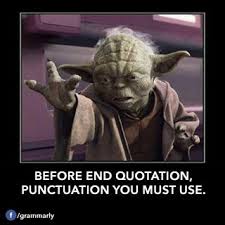 What’s the deal with direct quotes? Why can’t I get the punctuation right? You would think after five years, I would know what I was doing.
 I’m almost finished with revising my manuscript and plan to get a few well qualified friends to give it a final read through. Their job will be to make sure it is believable, there are no plot holes, and of course, it’s an interesting-grab you by the seat of your pants-type of book.
 I was reading a book on ‘How to Write Best-Selling Fiction’ this past week when a chapter jumped out at me, and I couldn’t help but smile. It was totally me. I’m ashamed to admit my naivety, but it was like I was reading my story.
 If your hero is drinking sake in Tokyo you better know which hand he should use to hold the cup; and when he is sunning on the beach at Cape Cod, remember that there won’t be any palm trees-Dean R. Koontz
 This past weekend I picked up a copy of “The Elements Of Style” at a library book sale for a dollar. If you’ve never heard of the book, I would highly recommend it. It’s one of those books that every writer should own.
 After writing Tuesday’s blog, I got to thinking about all of the words we misuse. The one that I misuse the most is to instead of too. I know the correct one to use, but because I’m on a roll with the words flowing, I’m not always as careful as I would normally be. I have also mixed up it’s/its and pique/peak/peek.
 Writing your first novel-Things you should know