
Character Development

imagesyf49r9sdIt’s hard to overstate the importance of strong characters in a narrative. Think of all of the characters from your favorite novels (Scarlett O’Hara-Gone With the Wind, Sherlock Holmes, Robin Hood, King Arthur, Dorothy-Wizard of Oz).

Your goal as a writer should be to have your characters stay with the reader long after they finish the story. The reader should connect with them, see them as real people, and feel as if they know them…or wish they did.

You have to know your characters before you introduce them in your story.  J K Rowling spent 5 years doing complete biographies on all of the characters in her Harry Potter series before she even started writing the novels. It’s that important.

  • What does your character look like?
  • What are your characters’ thoughts?
  • What actions and deeds are typical of your character?
  • How does your character talk?
  • What is your character’s name?

Love your characters, but don’t be afraid to let one go if he or she isn’t working for you. When you lovingly create a character, warts and all, it shows. Take your time and be thorough. Chances are, if you fall in love with your character, the reader will too.

Make every character unique. This may seem like an obvious thing to do, but it’s important that even minor characters have something that distinguishes them from everyone else in the story-something to make them more than a name on a page. This distinguishing trait or tag could be anything, and as insignificant as chewing a toothpick or always saying, “exactly!” Perhaps the character has flaming red hair or walks with a limp.

Your minor characters only need one distinguishing trait/tag but your main characters need to be more complex. They should have 4-5 distinguishing traits and at least one on the negative side. Nobody’s perfect. You want your characters to be believable and relatable. The negative trait doesn’t have to be a serious flaw, just one that makes the character real.

Writing a novel can take a long time, and it is important to be able to quickly remind yourself what traits a particular character has without having to thumb through pages  of work. Creating character profiles can save time, prevent inconsistencies, and  help you build upon individual journeys. I remember thumbing through pages of my manuscript looking for character information, then I got smart and started cheat sheets/ profiles for each character.

-Jan R
Character Development

Are You Overwriting?

images open bookDuring the editing process, take a closer look at the wording of your sentences. Are all of those words really necessary, or are they just adding fluff to increase your word count? This is what we refer to as overwriting. Overwriting can result from several fundamental errors:

  • Too many adjectives and adverbs.  i.e. When the yellow, round orb of the sun stealthily and smoothly creeps into the azure blue early morning sky- one may wonder why the sun didn’t simply rise.  If you feel the need to modify every verb with an adverb, or every noun with an adjective, chances are, you’re not picking the right words-Max Keele.
  • Using big words when simple ones will do. i.e. Ascending the stairs instead of walking up the stairs. Seeking alternatives for “said”is another common error, that leads characters to “expostulate” or “riposte”.
  • Too much detail or backstory. Describing the color and length of your protagonist’s hair is fine but it had better be relevant to the storyline, otherwise, it’s fluff you can cut out. Most of us deplore long exposition “dumps” that stop the action dead in its tracks. I love reading inspirational romance novels, but I can’t count how many paragraphs I have skipped getting from the mundane to what really matters.

Remember every word has to do a job. If it’s just taking up space, then it has to go.

Something to think about.

-Jan R

Are You Overwriting?

Need Motivation To Write?

a31a6f5f02dd05c74298a2b61d753962.jpgWe all need motivation and encouragement to write sometimes.  Especially when it feels like we’re spinning our wheels and not getting anywhere. Are you worried about taking too long? I’ve been at this for seven years.  I feel like a pro but I still don’t have a published novel to show for it. I recently ran across an article that made me feel a little better about my situation. Thought it might offer some encouragement to my readers as well. It listed best selling Authors who took more than five years to publish their work.

  1. Margaret Mitchell took 10 years to write Gone With the Wind.
  2. Maya Angelou took 15 years to write the final volume of her autobiography.
  3. J.K. Rawling took 5 years to just plan the story of Harry Potter-her extensive notes included biographies of each character and plot diagrams.
  4. J R R Tolkien took 7 years to release the Hobbit and another 16 to release the sequel.

For those of you who may be a little shocked at these numbers, the average amount of time it takes to get a novel written and published is 7 years.  Don’t beat yourself up for slow progress.  Just keep typing one word after another and you will get there. And for those of you that get your book finished and published in less than 7 years, I say good for you!

Suggestions that may help keep you motivated.

  • Create a writing schedule that really works for you. If there’s a time you’re naturally more creative, like when you first get up or when everyone has gone to bed, then that’s when you should be writing.
  • Remove all distractions. Switch off your electronic devices.  Remember you are writing not socializing on facebook or twitter.  All it takes is one good distraction to make you lose your train of thought and that great idea you had a few minutes ago.
  • You need an accountability partner.  It could be your spouse or friend.  Share your writing dreams with them.  A real friend will support you in your venture.  We all need a cheerleader or two to keep us motivated and writing. Mine is my husband.  Every day he asks me how my writing is going.  That’s all I need to keep me moving forward.
  • Write! Write! Write! even if you don’t feel like it.
  • Remember the first draft is the first draft.  Give yourself permission to err. Don’t bog yourself down with editing.  Get it down then get it good.  Just make sure it’s great before you submit it.

I hope this post was helpful.

-Jan R.

Need Motivation To Write?

Are You Sure You Want To Write A Novel?/ Revised

Unknown3If all you want to do is write, go for it.  You don’t have to get permission or a license.  All you need is a pencil and paper or maybe a computer depending on how serious you take your endeavor.

Many professionals recommend that you start out small.  You could write an article for the local paper, a magazine, and even consider a blog. These avenues not only improve your writing skills but builds up the resume that you will need later when approaching an agent/publisher.

If you do want to write a novel, you should know it’s hard work. Those people who say, “Anybody can write a book, how hard can it be?” They’ve never written a novel and most definitely never had one published.

You have to research, outline, draft, and redraft, not to mention the countless revisions.  I have probably done a complete revision of my book 4-5 times.  I’ve lost count, to be honest, and these revisions don’t include the numerous times I’ve reworked scenes or random sentences that didn’t read well. Did I mention combing it for grammatical and structural errors? That’s a lot of fun, especially if you aren’t an English major.  I can’t count the number of times I’ve had to stop writing to google simple questions on grammar.

Another thing to keep in mind, your first novel probably won’t be a masterpiece. This is true of every writer of every first novel. That does include Nicholas Spark and J.K. Rowling. Keep in mind you are learning the craft as you write. You will need to understand how to work dialogue, pace your book, construct a plot that is plausible and cohesive, build tension, and create characters that your reader likes and can relate to. Experts say it takes about 10,000 hours of writing to prepare you to write a publishable novel.

I don’t mean to discourage anyone. I just want to make sure you know what you are getting in to.  Most books take 5-10 years to get published.  I’m on year 7 so maybe I’m approaching the finish line.  I sure hope so.

If this is what you want to do, improve your skills by reading and writing. Yes, you need to read. I would also recommend that you take classes, attend seminars, and join writing groups (Scribophile.com, WritersWrite.com).

You will get there. The biggy is DON’T GIVE UP!

-Jan R

Are You Sure You Want To Write A Novel?/ Revised

Don’t Forget Your Platform!

blogSo you’ve spent the last year or so writing your first novel.  It may be a great story, but it won’t make the cut if it’s poorly written.  Great stories with a significant number of structural and grammatical errors get tossed to the side every day.  How’s your dialogue? Does it move your story forward or just sit like a rock slowing things down and encouraging the reader to skip it completely. What about the pace? Do you have the right POV? Have you considered your platform?
You probably stopped after that last sentence. What do you mean Platform? Great manuscripts of first time authors get pushed to the side every day because the aspiring author doesn’t have a solid platform.

Most newbies know the story has to be great and error free. One thing they may not be aware of is the need for a platform.

An agent who seemed genuinely interested in my work rejected it because of my lack of a solid platform. I spent time editing and rewriting major portions of my manuscript to address the issues mentioned above.  I was confident and looking forward to a request for a full manuscript. Well, what I got wasn’t a request but a rejection.  The reason had nothing to do with my novel.

I had focused so much time on preparing it for publication that I failed to do one of the most important things, build an audience of potential customers. Is it necessary? Unfortunately yes, especially for first-time authors. The agent who rejected me apologized for not delivering better news. She said it was hard to place new authors, and especially those who did not have a solid platform. While she recommended that I send my work to other agents, she emphasized the importance of building a platform.

The good news is, with technology it is a lot easier than you would think.  Google ‘building a platform’ and you’ll find all kinds of information.  I would personally recommend looking into Michael Hyatt. He is an author, blogger, speaker, and a former chairman and CEO of Thomas Nelson Publishers, so he knows a little bit about what we are trying to accomplish here. I would also recommend his book ‘PLATFORM GET NOTICED IN A NOISY WORLD’. He provides all the information you need to get started, including websites that assist with the creation of your online presence.

I hope this helps someone out there.

-Jan R

Don’t Forget Your Platform!

Who Versus Whom (Revisited)

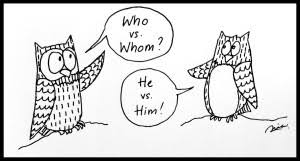
imagesFOEFOFTLAm I the only person who has a problem with who versus whom? Fortunately, I don’t use sentences requiring these words that often, but when I do, I become paralyzed. I’m not sure. I usually read through the sentence a few times using both words and pick the one that sounds better to me. There is nothing scientific about that. It simply boils down to preference.

This week I ran into a method to determine which word is correct, who or whom, and thought I would share my findings on this blog.

  1. Look at the clause associated with the who or whom. A clause is a set of words with a subject and a verb.
  2. Scramble the words of the clause (if you have to), so that they form a statement and not a question.
  3. Substitute either he or him for who or whom. If your sentence is about females, substitute males for the sake of your mnemonic.

Examples

  • (Who, Whom) called you last night?                                                                                     This sentence has only one clause, so all you need to do is see if it’s necessary to scramble the words to make a statement. You don’t. Once you substitute he or him you have a statement.                                                                                                                  He called last night.                                                                                                                      Him called last night.                                                                                                                    He called last night is the obvious choice. Who is the correct answer.                     Who called last night?          

***Look at the last letter of he and him to determine if you are using who or whom.

he = who

him = whom (they both end with the letter ‘m’)

  • (Who, Whom) were you calling last night?                                                                         This sentence has only one clause, but it does need to be scrambled to make a statement.                                                                                                                                       You called he last night.                                                                                                         You called him last night.                                                                                                      You called him last night is correct, so the original sentence reads as follows:   Whom were you calling last night?

Let’s try a trickier example:

  • Sarah was concerned about (Who, Whom) her daughter would be paired off with in the dance competition.                                                                                               This sentence has two clauses, but you’re only concerned with the one containing Who,Whom.                                                                                                                      Scramble the words to make a statement, and substitute he, him for who, whom.         Her daughter would be paired off with him in the dance competition.                            Her daughter would be paired off with he in the dance competition.                                   Him was the obvious substitute, so we are going to use Whom.                                         Sarah was concerned about whom her daughter would be paired off with in the dance competition.

Still a little complicated, but hope this helps 🙂

-Jan R

Who Versus Whom (Revisited)

Looking For An Agent?

untitled.pngYou’re coming to a close on your manuscript and have started thinking about agents. If you go the traditional route, you are going to want one. Where are they? How do you find one that would be a perfect fit for your work?

You could ask a friend, but odds are they will have no idea. You could go to conferences and hope to bump into one or maybe even by time for a short critique or pitch, but your best bet is the internet. It offers a wide range of information on agents and publishing houses. Unlike authors of the past, you have the world at your fingertips.

Take out the keyboard and start typing.

Association of Authors Representatives, Inc – AARONLINE.org     This site contains over 400 literary and dramatic agents, who have pledged to adhere to the association’s high standards of professional conduct in serving their clients.

Manuscript wishlist – MANUSCRIPTWISHLIST.COM    Agents and editors provide in-depth information on what they are looking for, their profiles and bios, along with submission guidelines.

QueryTracker – QUERYTRACKER.NET    This free site gives you access to over 1,600 agents, explores agent data, and keeps track of the queries they send out.

LIT REJECTIONS – LITREJECTIONS.COM   This site provides a list of submission guidelines for more than 350 literary agencies. The website also offers articles and interview making it an excellent resource for authors looking to get published.

There are other sites out there. I recommend you do your homework. I’ve provided a few of the better ones to get you started. Association of Authors Representatives was voted the best of the best by Writer’s Digest.

If you have a literary agency or agent in mind, go to their page. They will provide submission requirements, and let you know if they are accepting queries.

Hope this helps.

-Jan R

Looking For An Agent?

Keep Them Turning The Page

HeaderCreativeExercisesThink about the books you have read.  What motivated you to continue to the end? What kept you turning the pages?
We all want our books to be purchased, but more importantly read to conclusion. We want our readers to be absorbed by the storyline unable to put the book down.

I read an interesting article in Writer’s Digest this past week by Steven James. The article covered the 5 factors that keep readers turning the page. You can probably guess a few of them and have no doubt put them to work in your novel. Did you do it intentionally, or did the factors result as a product of happentance? Either way, I hope you have at least one of the first 4 in your work.

5 factors that keep readers turning the page.

  1. Curiosity – Make your reader wonder and want to know where the story is going. Provides intellectual engagement. Used often in Mysteries, it is a great way to create intrigue.
  2. Concern – The reader worries about where the story is going. Provides emotional engagement. Often found in Suspense, it is a great way to create tension.
  3. Anticipation – The reader can’t wait to see where the story is going. It provides future enjoyment. It’s often found in romance and requires a satisfying climax.
  4. Entertainment – The reader doesn’t care where the story is going – it’s that good. It provides current pleasure. It’s often found in humor.
  5. Obligation – I have to finish this because I started it and/or it was assigned by a professor. There is usually limited to no investment for the reader. It is often found in classics/literary.

There you have it. Which factors are you using? Something to think about.

-Jan R

Keep Them Turning The Page

Make A Decent Proposal

imagesI know you may feel helpless at times. You’ve written an exciting adventure and edited it so many times you’ve lost count. You know you’ve produced a publisheable piece of work, so why isn’t it published. I’ve been there – done that.

Remember that your work being accepted by an agent often times has nothing to do with the novel itself. How many times have you had a rejection letter following the request for the full manuscript? That agent made the decision that they liked or disliked your idea before they even started reading your novel.

That’s the importance of the query letter and getting those first few pages of your novel right. Keep in mind that most agents receive over 10,000 queries a year. They don’t have the time to give to every submission they get.

Don’t make it easy for them to toss your work before they’ve given it consideration. That query has to be as polished as your manuscript. You don’t send out your first draft of a novel? That’s what it is – a rough draft. At least I hope you don’t. I have to confess I did.

One of the many rejection letters I received was nice enough to inform me that the novel wasn’t ready for publication, and proceeded to provide a long list of reasons why. The agent did like my premise 🙂 and made it through the query without tossing it. That’s probably why she took the time to respond.

There is a formula to get that query right. First and foremost, follow the submission guidelines of the agent or agency you are querying. Don’t give them more or less. If they want more information or to see the manuscript, they will request it.

There are workshops available and unlimited information on the internet on how to compile a successful query. Do your homework. When you finish that novel, you are not finished.

Something to think about.

-Jan R


Make A Decent Proposal

You Can’t Do This Alone!

1I remember my middle sister as a child. She was the kid who sat in the corner with her nose in a book, didn’t play well with others, well to be honest,  didn’t want to play at all.  Her friends were imaginary. I always thought that she was a little strange, and she probably was, but she is also one of the most talented writers I know.

You haven’t heard of her or read any of her work. Why, because she writes in a vaccuum. I have encouraged her for years to reach out and join the writing community.

She is an introvert, like most of us who seem to enjoy the keyboard much more than a group of pretentious people. I would be okay with that if she belonged to writing groups, or had people she related to that could help motivate her to move forward with her skill.

You don’t have to interact with others face to face, at least not at first. If that’s not your cup of tea, go online. Join writing groups and form relationships with other author want-to-bes. There are some great ones out there that cater to just what you’re looking for.

Critique groups:

  • Scribophile.com
  • AbsoluteWrite.com
  • CritiqueCircle.com

I am a member of Scribophile. It’s a great site to seek critiques and suggestions from fellow writers. Members on this site operate at different levels of expertise. I have gotten some great feedback, but I have also received feedback that was not up to par. I was pleasantly surprised at the community in the group and the willingness of total strangers to help me with my work.

Genre-Specific groups:

  • Romance Writers of America  rwa.org
  • Mystery Writers of America    mysterywriters.org
  • Science Fiction and Fantasy Writers of America   sfwa.org

I think you’re getting the picture. I was a member of Romance Writers of America and need to renew. You can get excellent information and discounts from these sites. They will keep you informed on contests, conferences, writing groups/forums, what’s selling, agents looking for new works, and information on how to improve your craft.

You can’t do this alone. Plug in!

Something to think about.

-Jan R


You Can’t Do This Alone!