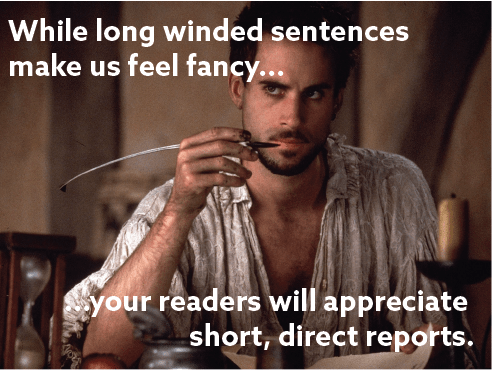
Sentences – Short or Long?

Yes, I’m talking about sentences again! They do matter and are an excellent tool to regulate pacing. Do you want to take your reader on a stroll through the park or a heart stopping sprint through the woods?

Have you ever read a sentence and thought that it was way too long? The author lost you two commas ago, and now you have to go back and read the whole thing again to try and figure out what’s going on.

Or maybe you read a short sentence, followed by another short sentence, and another, and you’re thinking whoa, slow down.

There’s not a set rule for short or long. The sentence length you choose depends a lot on what you are trying to accomplish. There are good reasons for those long, lost me a long time ago sentences, and short, what just happened sentences. It’s up to you to decide when to use them, given the context of your writing.

What do short sentences do?

  • Create tension-When an author starts using short sentences, it’s usually a sign that something is about to happen.—-The dog growled. His teeth flashed. Jake turned. It was too late.
  • Call the attention of a reader to a significant detail—She walked past Central Park in Manhattan with her head held high. Gorgeous woman. Long blond hair. Blue eyes. Impeccable taste.
  • Present sudden events-Out-of-the-blue actions that no one was expecting.—-We sat quietly enjoying our meal at the local fast-food restaurant. Boom! “What was that?” I turned to see people rushing toward the gas station up the street.
  • Quicken the pace.
  • Summarize the ideas presented in the long paragraph or sentence.

What do long sentences do?

  • Develop tension-While the short sentence is imminent, culminating with the actual event being acted out, the long sentence adds to the suspense, hinting at a situation in the process of developing.
  • Give vivid description-depicting a setting, love scene, or someone’s appearance.—Autumn came without special invitation coloring the trees in orange, yellow and red, whispering the cold in our ears and hiding the warm sun rays from our eyes.
  • Slow down the pace to give your reader time to catch their breath.
  • Investigates arguments, ideas, or facts thoroughly.

Although long sentences have the smell of the old-fashioned 19th-century romantic prose, the usage of the long sentence in modern creative writing has its place. When it comes to writing artistic literature, fairy tales, ghost stories, or mysteries, don’t underestimate the effects of short sentences.

Hope this didn’t confuse you too much. To sum it up, there’s a time and place for everything 🙂

-Jan R

Sentences – Short or Long?

Pacing Is A Tool

3.4-PacingexamplePacing sets the tempo of your novel. How fast or slow it moves depends on the function of the scene and the intent of the author. As discussed in a previous blog, you can speed your story up or slow it down depending on how you use exposition and action.
Intensely dramatic or violent scenes can be either fast or slow depending on your intent. If you slow down the scene, you can ring out the last bit of suspense and mystery, as well as heighten the drama by stretching out something that occurs in seconds.

Sudden shifts in pacing from slow to fast can shock your reader and make your book memorable. Nicholas Spark’s books are a great example of sudden shifts in pacing. In his books, Message In a Bottle and The Best Of Me, he uses the entire book to build a relationship between the main characters only to kill one of them off on the last page. I was totally shocked and a little mad after reading those books. I like happy endings. But he achieved what he set out to do. They evoked strong emotions and I’ve never forgotten them.

Tolkein’s, The Lord Of The Rings vacillates between exposition and action. The varied pace and information provided, allows us to visit middle earth and participate in its history.

Remember, a fast pace is action-packed leaving your reader breathless, and slow pacing is meditative and dramatic.

While I love action-packed, fast-paced books, I realize we need exposition to give the reader a breather and prepare them for what comes next. Balance is the key.

Pacing is an important part of your novel, and if you are a novice, it’s something you probably haven’t given much thought too.  I know I didn’t. I love to read and knew that some of the books I read were more fast-paced than others, but didn’t stop to think that the author intentionally wrote them that way.

When you begin the editing process, the pacing is another fundamental to add to your list of things to review.

Hope this helped.

-Jan R


Pacing Is A Tool

What Is Pacing?

images-7People who love to read but have never written books are cognizant of the pacing. Pacing sets the tempo of your story. Is it a fast read or did it seem to drag on for days? Hopefully you’ve found a balance between the two and they perform like a fine tuned orchestra.

I have read many good books that I skipped portions of, because I was tired of reading about the duchess’s frilly dress or  inner hull of a slave ship. I’m glad the authors did their homework and provided historical information, but sometimes it can be a bit much and totally bog down your story. I have read other books that were nonstop action that left me wanting; they were missing the details that made the story real and the characters endearing.

So how do you control the pacing of your story since once you start writing it seems to take on a life of it’s own? Be cognizant of the tempo and your audience. You have to strike a balance between the amount of information in the pages you are given and the patience of your reader.

There are three main ways to control the pace of your novel:

  1. The number of pages/words in the novel vs. the time period covered – Long books that depict a short period of time are going to move at a slower pace.  Short stories depicting long periods of time are going to move at a faster pace. This is common sense really.  You have to move a story along faster if you have a limited amount of time to share it.
  2. The density of the narrative – The length of the story versus the number of twists and characters within.
  3. Scenes vs. Exposition                                                                                                          Scenes are the important events that move the story forward.  They are the action and dialogue that occur during the course of the story.                                                    Exposition is the back story or descriptive information that stands outside of the story and slows things down.

I hope this blog helped you get a better idea of what pacing is, and how it effects your novel. I would also recommend that you stop by Quintessentialeditor’s blog from this past week for tips on how to correct your pacing.

Thank you so much for joining me on this journey. If you haven’t added your name to my followers, I would like to ask you to consider following me.  I write a blog on Tuesdays and Thursdays of every week. Followers are notified via email whenever a new post is published.

If you have any questions or comments, I would love to hear from you.

-Jan R

What Is Pacing?

What Is The Purpose Of Pacing?

Pacing sets the tempo for the novel. How fast or slow it moves depends on the function of the scene and the intent of the author. As discussed in my previous blog, you can speed your story up or slow it down based on how you use exposition and action.

When introducing new characters or interjecting scenes of day to day life, your pacing is usually slow.

Intensely dramatic or violent scenes can be either fast or slow depending on your intent. If you slow down the scene, you can ring out the last bit of suspense and mystery as well as heighten the drama by stretching out something that occurs in seconds. Slowing down the pace to dramatize the most important moments of the story works really well too.

Sudden shifts in pacing from slow to fast can shock your reader and make your book memorable.

Nicholas Sparks is a great example for sudden shifts in pacing. In his books Message In a Bottle and The Best Of Me, he uses the entire book to build a relationship between the main characters only to kill one of them off on the last page. I was totally shocked and a little mad after reading those books. I like happy endings. But he achieved what he set out to do. They evoked strong emotions and I’ve never forgotten them.

Tolkein’s The Lord Of The Rings, vacillates between exposition and action. The varied pace and information provided, allows us to visit middle earth and participate in it’s history. 

Remember fast pacing is action packed leaving us breathless and slow pacing is  meditative and dramatic.

Expository scenes are to give the reader a breather and prepare them for what comes next.

Pacing is an important part of your novel, and if you are a novice, it’s something you probably haven’t given much thought too.  I know I didn’t. I love to read and knew that some of the books I read were more fast paced than others, but didn’t stop to think that the author made them that way.

When you begin the editing process, pacing is another fundamental to add to your list of things to review.

Hope this blog got you thinking. I would love to hear from you. If you have any comments on this blog or suggestions to make it better please let me know.

Also I would like to ask you to consider following me. By signing up you will receive notices through email whenever I update or publish a new blog.

-Jan R

What Is The Purpose Of Pacing?