Waiting For Inspiration?

imagesMEZC930WWaiting for inspiration will kill your novel. It’s also an excuse I have used many times over the years.

Some writers don’t write unless they feel inspired. They think they’re wasting their time by pushing through the mental block that is stifling their creativity. Their argument is that they are bound to make more errors and have to go back and do significant revisions so why bother.

These writers are better known as aspiring authors or unpublished.  They don’t complete their masterpiece because they are waiting for something that may never come.

Think of writing as a job. You can’t call in every other day and say I’m not working today. I just don’t feel inspired. I guess in all reality you could, but it wouldn’t go over very well and that would be the end of that job. You get the picture?

Sometimes we have to push ourselves even when we don’t feel like it. In most cases the results are positive and once we get going things just flow. Published Writers/Authors have the mindset that you work on your craft every day. They set quotas based on time or number of words.

Remember, the more you write the better you will become. Writing every day also helps you to develop a writer’s mindset. If you are concerned about ruining your story by writing without inspiration, you can always leave your story alone and work on something else until the creative juices start flowing.

I can relate to those of you who procrastinate and make excuses. Some days it is a true battle of the mind. Thank goodness for my accountability partner.

Something to think about.

-Jan R

Waiting For Inspiration?

Say What You Mean!

Organize-Your-ThoughtsIf you find yourself reading a sentence more than once, or adding information for clarification, that’s a red flag.

Your reader has less information than you. If you are confused by your work, you can only imagine what your reader is going through. I love a great mystery, but my writing shouldn’t be one.

It’s not the reader’s job to interpret your work. You should be clear and concise.  If your writing causes a pause something isn’t working.

I have to admit I love dangling modifiers though. They are some of my favorite mess-ups. I even wrote a blog entitled ‘just for laughs’. They are funny, but not in the middle of a serious scene. You don’t have to try to hard to imagine how quickly they can pull your reader out of their suspension of disbelief.

Dangling modifiers occur when the modifier has no clear referent, and twist the meaning of your sentence in an unintended fashion.

  • I saw a tree walking down the street. Who knew a tree could walk 🙂
  •  The babysitter handed out sandwiches to all the children in Ziplock bags. I just want to know how those children got in those bags 🙂

Misplaced modifiers are similar but not nearly as fun to read. As with dangling modifiers, there is no clear referent, which can lead to a clumsy and confusing sentence.

  • Lucy carefully studied the situation.                                                                                 Lucy studied the situation carefully.

Another mistake new writers make that isn’t always as obvious but makes for a clumsy sentence that will cause a pause is comma splicing.

Comma splicing is when two sentences are linked by a comma but they don’t really work because they’re two separate ideas.

  • John saw the rabid fox and ran to the house to get his gun, he forgot to eat lunch and his tummy rumbled.

What about ambiguous sentences? The sentence is grammatically and structurally sound, but the reader has no idea what you are talking about.

  • My older students know I’m extremely careful with my language. Is the teacher referring to age or length of time the students have been in his class?

Be clear and concise! Say What You Mean!

Something else to think about.

-Jan R


Say What You Mean!

Thursday Thoughts

headercreativeexercisesToday’s readers want less description and more action. The strongest stories start with a bang. Readers are drawn to stories where authors pose a question, establish a dilemma, or otherwise inspire curiosity right from the start, creating the turn-the-page urgency that readers crave.  Jane K. Cleland Writers Digest
Something to think about.

-Jan R


Thursday Thoughts

Strong Nouns (Revisited)

untitled.pngWe’ve talked about weak and strong verbs, but did you know the same holds true for nouns? I never really thought about it, until I took an online class that talked about strong and weak nouns. My first thought on weak nouns; the instructor has to be referring to pronouns. Well, he wasn’t and that is a subject for another day.

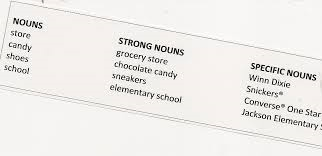
Strong nouns can help your reader picture what/who the writer is talking about immediately. The author doesn’t have to describe the person, place, or thing. We get it. The more specific the noun, the clearer the picture.

If I wrote a city, dog, or car in a sentence, you would picture your version of the city, dog, or car in your mind. While these nouns aren’t bad, they could be made stronger. An upgrade would be; New York City, German Shepherd, or Ford Mustang. While you may want to make that mustang candy apple red, it doesn’t need much more detail to get a clear picture of the author’s intent.

Names are also strong nouns. Cinderella, Clark Kent, and Harry Potter, all conjure up strong images in your mind.

Weak nouns require additional information to create a clear image in your mind.  The weaker the noun, the more information you will need to provide.

Most weak or dead nouns end in ‘tion’. Examples would be publication, devotion, recitation, adaptation.

These nouns tend to way your sentences down and as stated above, require more detail to produce a clear image. The best way to address these weak nouns, is to change them back into verbs, and rework the sentence.

The couple’s separation occurred at the end of the year.

The couple separated at the end of the year.

Just something else to think about while you’re writing that best selling novel 🙂

-Jan R

Strong Nouns (Revisited)

Thursday Thoughts

“Vigorous writing is concise. A sentence should contain no unnecessary words, a paragraph no unnecessary sentences, for the same reason that a drawing should have no unnecessary lines and a machine no unnecessary parts. This requires not that the writer makes all his sentences short, or that he avoid all the detail and treat his subject only in outline, but that every word tell.”

William Strunk, Jr.

-Jan R

Thursday Thoughts

Thursday Thoughts

If your heroine is a beautiful actress, a fine painter, an engineer, a cabinetmaker, a superb cook, a daring test pilot, a whiz at electronics, a doctor, a lawyer, and an Indian chief, don’t you think you ought to humanize her at least to the extent of giving her a zit on the end of her nose?       Dean R. Koontz – How To Write Best Selling Fiction

Something to think about.

-Jan R

Thursday Thoughts

Surviving The Sting

imagesX0EBMH1NI write a lot about rejection because it’s a part of life if you’re an unpublished author seeking a literary agent or publishing contract. Many would-be authors allow a simple rejection to end their attempts at writing. Their thought – I must not be good enough. Well maybe that’s true, but odds are it is not.

Manuscripts are rejected for numerous reasons, and many have nothing to do with your work. So what are you supposed to do if you receive a rejection?

  • Admit it hurts.
  • Allow yourself time to grieve, but never take more than a week.
  • Nurture your artist. Read a good book, take a walk, eat some chocolate… TLC is a good thing, but don’t wallow in self-pity.
  • Share your news and disappointment with close friends and family who will understand and offer encouragement.
  • If you must, write a rebuttal to the editor or literary agent, but don’t send it. Tear it up and throw it in the trash. Your only response should be a thank you for their time and consideration.
  • Just because your work wasn’t right for that particular editor or agent, doesn’t mean it won’t be right for another.
  • Remember just because it isn’t ready for publication, doesn’t mean you can’t make it publishable.

A writer not being able to deal with rejection, is like a doctor not being able to deal with death. It’s going to happen, and like successful authors, you will have to learn to live with it.

-Jan R

Surviving The Sting