
Believe in yourself!
-Jan R
Believe in yourself!
-Jan R

I got tickled when I first saw this word. I have to admit, I have dealt with rewrite-itis. What is it? It’s a severe condition that effects both published and unpublished writers according to The Everything Guide to Writing a Romance Novel. It means you are unable to call a book, chapter, or even a scene finished. So, what causes the condition? A fear of failure or success. For me it is definitely failure.
What are the symptoms?
So, what do you think? Do you have a case of rewrite-itis?
Rewrite-itis has a close cousin – Research-itis. Maybe you have that one too. True research is crucial to any novel, but an author needs to know when to say, “Enough is enough.”
So what is the cure? Set goals and deadlines and stick to them. Remember your manuscript is your baby, but sooner or later you have to turn it loose.
Just something to think about.
-Jan R

Something to think about! Do a little and go from there.
-Jan R

One of my favorite Posts deals with ‘ing’ words. They’re there. Sometimes they take over your story without you even realizing it, and other times they get lost in the background. Take a closer look at your prose. Especially in those areas that aren’t reading as smoothly as you would like. Maybe you will discover you are having a love affair with ‘ing’. These ‘ing’ words are all over the place.
Once I discovered my love affair with ‘ing’, I stopped the revision process and did some research on ‘ing’. I remembered reading somewhere, that the overuse of ‘ing’ words was not a good thing.
Opportunities to overuse the ‘ing’ word are boundless. There are nouns, adjectives, verbs, and even verbs masquerading as nouns called gerunds, all ending in ‘ing’.
So, what’s the big deal? What’s wrong with ‘ing’ words?
The overuse of ‘ing’ words mark you as an amateur – Don’t be alarmed if you see more than a handful on one page. Do take a closer look if you see more than a handful in a single paragraph.
Example of bad use of ‘ing’
While wrapping a soothing sling around the fledgling’s broken wing, Diana was humming, dreaming of her prince charming. Yet troubling thoughts about his depressing friend Starling kept intruding, interrupting her very entertaining daydreams. There was something intriguing and alarming about him.
‘ing’ verbs weaken your writing and make it clumsy and hard to read . Abigail was walking along the bike trail. There was a boy riding his bike. He was smiling up at her as she passed. She started wondering what the boy was so happy about.
Abigail walked along the bike trail. A boy smiled at her as he rode passed. She wondered what he was so happy about.
Starting a sentence with an ‘ing’ word is the weakest way to begin a sentence.
Hitting the thug in the face with her purse, Josie reached for her phone.
Josie hit the thug in the face with her purse and reached for her phone.
To identify overuse of ‘ing’ words in your writing, try this:
Once you identify ‘ing’ words, replace weak or common ones with specific, stronger word choices. Your writing will become more concise, clear, and engaging.
Remember, not all ‘ing’ words are bad. The issue is whether or not you have made the best word choice.
So much info on the internet. You get the cliff notes. Hope they help, or at least get you thinking 🙂
-Jan R

I hope you have goals!
-Jan R
A few years ago, I picked up a copy of “The Elements of Style” at a library book sale for a dollar. If you’ve never heard of the book, I would highly recommend it. It’s one of those books that every writer should own.
It is filled with tips on how to write and make every word count, or every word tell, as the authors like to put it.
One of the tips offered, that I am guilty of, is avoiding the addition of qualifiers to your words. Qualifiers are words like rather, very, pretty, big, and little. My favorite one to use, or misuse I should say, is very 🙂 These words are described as leeches that take hold and suck the blood out of your words.
Because ‘very’ is my nemesis, I thought I would share a picture that I found on Google Images. As you can see, it provides alternatives to using ‘very’ and gets you to thinking about what you are really trying to say. I love it, and it has been very helpful (invaluable) to me. I hope it helps you as well.

Something to think about!
-Jan R

Something to think about!
-Jan R
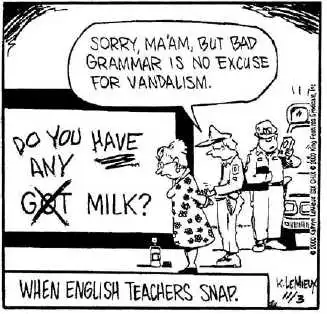
This is by far one of my favorite posts. I have revisited it several times over the years. With new subscribers and writers joining my blog, I thought this would be a good time to bring it back. Humor me 🙂
I wasn’t an English major, but I never had an issue with stringing words together and making a coherent, easy to read sentence. I know most of the rules, but I also know those rules are meant to be broken, especially if you are writing fiction.
The purpose of English Teacher grammar is to understand how to create sanitized, standardized, easy to understand, impersonal, inoffensive writing. If you’re looking for a job writing pamphlets for the government, instructional manuals, or news reports, then that’s the way to go.
These rules aren’t meant for fiction. That does not mean your story shouldn’t be grammatically and structurally sound. We are talking about styles here, not mechanics.
Fiction writing is nonstandardized, complex, personal, and occasionally offensive. It is the best way to reach into your readers head and show him your words. In order to bring your voice to life and get your world on the page, you need to say goodbye to English Teacher writing.
Fiction Writing Vs. English Teacher Writing
Fiction Writing fits the world of the book, the mouths of the characters, and the writer who wrote it.
English Teacher Writing incorporates a specific, caricatured, extreme form of writing without regard to the story’s world, characters, or even the writer and what he or she is like.
Fiction Writing changes with the situation.
English Teacher Writing is unchanged.
Fiction Writing does not look to impress, its sole purpose is to present the story.
English Teacher Writing is self-conscious, self-important, and looks and feels forced and out right silly at times.
Fiction Writing is not always pretty, but it always fits the circumstances, characters, and story.
English Teacher Writing is always pretty and always smooth, but rarely fits anything.
Example:
Fiction Writing
“Get away! Don’t touch me! Leave me alone!” The girl in the alley curled into a tighter ball, her scarred, skinny arms pulling her knees up against her chest, her eyes white-rimmed, her hair wild.
English Teacher Writing
“Get away from me! Don’t lay a hand on me! Leave me alone!” The girl in the alley, already in a fetal position, pulled her knees tighter to her chest. She wore an expression of dazed panic and radiated the signs of post-traumatic stress disorder.
Something to think about 🙂
-Jan R
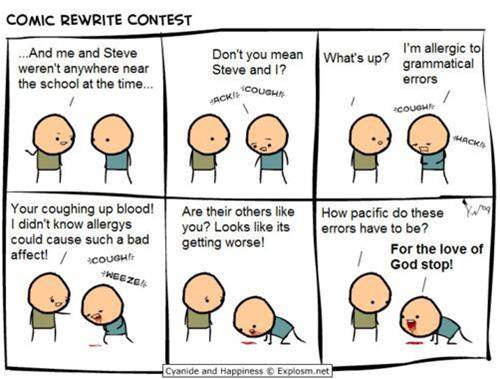
Look closely! A literary agent will! Something to think about!
-Jan R

Your lead character doesn’t have to leap tall buildings in a single bound, and he doesn’t have to stop speeding bullets with his bare hands, but he darn well better know the difference between right and wrong, and he better be kind to animals, and it sure wouldn’t hurt any if he brushed his teeth regularly. Dean R. Koontz – How To Write Best Selling Fiction
I think you get the picture. Your main character needs to be likable and relatable. It would help if he had a few flaws as well. Nobody’s perfect.
Something to think about 🙂
-Jan R
 Writing your first novel-Things you should know